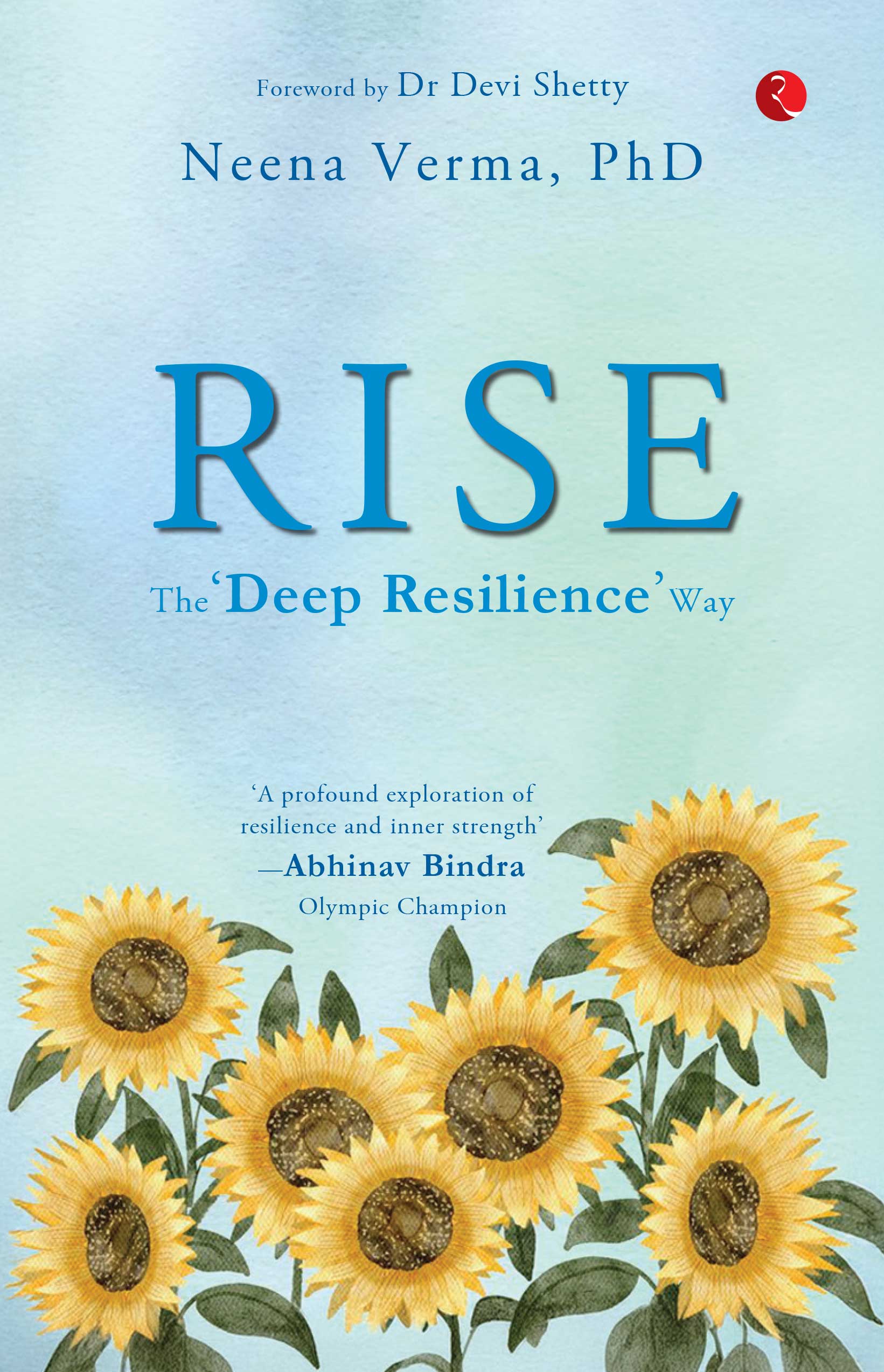
ABOUT THE BOOK:
Life is a mosaic of misery and meaningfulness—it offers both rainstorms and rainbows. While it tests us with setbacks, turbulence, loss, and trauma, it also blesses us with the gift of resilience. Often, when fear, chaos, and despair take over, we forget to invoke this inherent capacity to rise. Dr Neena Verma, a seasoned practitioner, coach, and educator in leadership, resilience, wellbeing, grief, post-traumatic growth, and therapeutic writing, redefines resilience beyond the clichéd notion of ‘bouncing back’. She guides readers to explore the deep, restorative, generative, supple, and expansive dimensions of resilience.
The book introduces two original constructs—‘resilience mindset’ and ‘deep resilience’—derived from Neena’s extensive practice, research, and lived wisdom. It serves as a comprehensive guide to recognizing, kindling, cultivating, practising, embodying, and nourishing your inner resilience. Welcome to RISE: The ‘Deep Resilience’ Way.
ABOUT THE AUTHOR: Dr Neena Verma is a lifelong seeker, practitioner and facilitator of deep resilience. She brings a multi-disciplinary background across organizational behaviour, appreciative inquiry, grief psychology, depth psychology, compassionate mind, and therapeutic writing. A scholarly practitioner and educator, and ICF credentialled PCC level coach, Neena specializes in leadership, resilience, wellbeing, grief, compassion, and systemic positive change. She is a prize-winning alumna of University of Delhi, with several international accreditations, including notably being the first from India to be certified in appreciative inquiry and meaning-focused grief therapy. Neena is also an NTL Professional Member and TAOS Associate. Her last book Grief …Growth … Grace: A Sacred Pilgrimage is arguably the first by an Indian author on the complex topic of grief. Neena also runs an independent library endeavour in the service of children from underserved backgrounds.
Restorative Adaptation
I am life that wills to live in the
midst of life that wills to live.
—Albert Schweitzer
A happy, bright, skinny new teen, Paul pooled his savings with his older brother’s to buy a bench-press so they could work out. Soon Paul noticed some changes that made him happy. He ran excitedly to show his mother who was aghast to see what the young boy had mistaken as muscles. Investigations soon revealed a substantial tumour under Paul’s arm. It was a form of cancer called Hodgkin’s disease.
The next couple of months were wrapped in pain, fear, worry, sorrow and anguish. Paul coiled through the maze of biopsies, surgeries, and prolonged hospitalization. While his family did their best to hold him warm and strong during the brief visiting-hours, Paul’s horrifying encounter with trauma filled his long lonely days in the children’s ward. He had no one but himself to take care of his mental wellbeing in the
midst of fellow patients’ disturbing howls. Yet all that Paul felt for them was compassion. One day a stranger walked up to him. A cancer survivor himself, he said things that made Paul feel as if a ‘bringer of hope’ had visited him. Decades later, this experience inspired Paul to title his book—intended to help those struggling with cancer—‘Don’t Bring Lasagna’. Bring hope instead.
Finally, Paul was discharged from the hospital and reached home feeling relieved. Turns out, more suffering was waiting around the corner. The six-week long radiation that followed ‘blasted’ Paul completely. Yet you hear him emphasize with gratitude, ‘radiation killed the cancer and saved my life.’
His graceful silence hides the reality that radiation also left him with a horde of lasting issues that wrecked his body forever. If only the fall of 1979 could be erased from the chronicles of time. Instead, a new traumatizing phase unfolded. Returning to school with a cancer-treatment-scarred appearance, the
14-years-young Paul got christened as the ‘cancer kid’. Called a ‘weirdo’, Paul was teased, shamed and made to feel embarrassed of the very visible effects of his cancer treatment. He had become an ‘outcast’. Being a naturally appreciative person though, Paul chose to focus his attention on those few
‘awesome kids’ who reached out with acceptance and warmth. He didn’t want anyone’s pity or sadness. He ‘just wanted to be Paul’. It was decades later that he realized what it meant to be Paul. Life kept flowing. And so did Paul. He built friendships, including—importantly—with Jackie, who later became his
lifelong soulmate and most determined warrior in the much more fierce battle that was yet to unfold.
Radiation had left Paul with traumatizing ramifications. Eyes, teeth, hair, neck, back, shoulders, skin, heart valves, bones—his body bore multiple lasting painful effects. Even more agonizing was the abiding fear of cancer making a comeback. And sure enough, it did. A happily married man, father of two lovely children and a successful professional, 46-year-old Paul was hit by cancer once again. Familiarity, yes.
But how could that wipe the emotional trauma that someone diagnosed with full-blown stage IV cancer would feel? More stark and scary than before. But his gritty wife Jackie wouldn’t take the battle lying low. She ‘fought it out much more fiercely’ than Paul himself, as he says with love, pride and gratitude.
By now Paul knew ‘cancer doesn’t hurt, cancer treatment does.’ This time the treatment was chemotherapy—eight rounds, each eight-hours long, with untellable misery in-between and after. It was hard-hitting for Paul to realize that the highly hazardous stuff (chemo drug) that the attending staff (shielded in full-body protective gear themselves) wouldn’t even touch, was going to be injected into his body. For days after each round, he would be engulfed in nausea, exhaustion, weakness and pain. He acknowledged his hard feelings and allowed them their due space. He didn’t mask positivity but he also
didn’t let himself slip into victimhood. He was falling. But not failing. He kept gathering himself up, with dignity and grit.
Paul met life with the will to say YES. To restore and keep an eye on his blessings without hiding or negating his misery. Once, when he was writhing in pain, Paul’s mother nudged him to see his illness as an opportunity. Not amused, he listened on nonetheless to what she had to say—‘From their youngest days, you have taught your kids to walk, talk, study, live with good values and work ethic. They need to learn so much more about life. Someday they are going to be dealing with their own struggles, pain, suffering, despair. And right now, they are watching you. They are learning how to face and endure suffering, and still stay resilient with courage and grace.’ What a perspective! This brought about a fundamental shift—a turning point—for Paul who lapped up the gift of perspective with open heart and mind. His wife Jackie’s generative conversations inspired him to polish it further.
Dark impulses were nonetheless regular visitors. At one point, just before entering the chemo room, Paul felt the urge to ‘just run away’—into the woods, anywhere, maybe another life. Looking back, he light-heartedly calls it stupid. I find it natural. Who would not harbour resentment when locked in the ring of fire life had thrust him into for a second time? Not Paul. He had, what I named, his waffle eye. Once, while in terrible nausea, he felt a craving for a waffle. Jackie quickly got him one, warm and dripping with butter and syrup. Paul goes quiet with emotion, trying to put in words the gratitude he felt in that moment, savouring something ‘as ordinary as a waffle’. The joy was extraordinary. You can’t miss it in his eyes and smile. Paul decided he was going to see life as if it were a waffle—through storm or sunshine. Behold his child-like smile and you would see a rainbow dancing in the thunderous skies of his abiding trials. He has found—and become—the Paul he wanted to be at 14 years of age—a happy, content, gracefully resilient man who lives life with meaning and believes, deep in his heart, that he is ‘blessed’.
Paul, dear reader, has been cancer-free for over 14 years now. Doctors rate his chances of getting it again to be the same as anyone else in the population. Deep inside though, Paul knows what, who and how he will be if, God forbid, a life-storm comes visiting again. How does one say YES to the trials and trauma triggered by life-threatening cancer? Twice! How does one muster the will and strength to endure the terrible lasting after-effects and debilitating pain that cancer treatment brings along? How does one re-will life, keeping faith and hope, when all reasons for it disappear? How does one restore and adapt with such grit and grace as Paul did? How does one keep the tryst with trauma and turn it into a love affair with life? Just how! The answer lies in the affirmative phenomenon of restorative adaptation—the
first aspect and restorative phase of deep resilience that I briefly introduced in Chapter 4.
Excerpted with permission from RISE: The ‘Deep Resilience’ Way by Neena Verma. Excerpt permission obtained via publisher.