Rating: ⭐⭐⭐⭐⭐ (5/5)
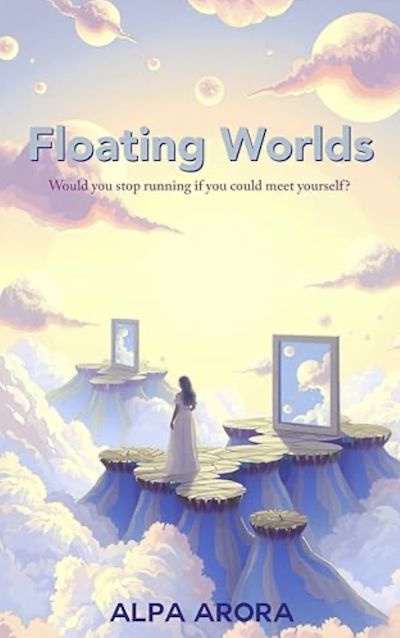
Alpa Arora’s Floating Worlds is a deeply introspective novel that explores the fragile boundary between reality and imagination, love and longing, sanity and self-discovery. Through the psychological journey of its protagonist Ruby Khanna, the novel examines themes of identity, emotional isolation, motherhood, spirituality, and the human tendency to create alternate inner worlds when reality becomes overwhelming.
Rather than following a traditional linear plot, Floating Worlds unfolds as a series of reflective episodes that move fluidly between memory, dreams, philosophical conversations, and present-day events. The result is a narrative that feels less like a conventional story and more like a psychological landscape; one where the reader inhabits Ruby’s mind as she tries to make sense of her life.
The author is clearly well read, as the very first page opens with a quote from Anais Nin. In today’s social media driven literary world which is often overrun by references to Kafka and Dostoevsky largely; any writer who draws on Anais Nin deserves a readership.
A Story Rooted in Inner Conflict
Ruby Khanna is the emotional centre of the novel. From the very opening chapter, where she sits by the Ganges in Rishikesh observing the river at night, it becomes clear that Ruby is a woman burdened with deep internal conflict. Her thoughts drift constantly between present reality and introspective questioning.
She is married to Kabir and is the mother of a son, Trilok. Yet the life she inhabits feels strangely distant to her. She performs the roles expected of her i.e. wife, mother, member of society, but internally she remains detached, almost like an observer of her own existence.
Ruby often describes feeling disconnected from the world around her. Everyday interactions seem to lack meaning, while her mind wanders toward philosophical questions about existence, identity, and the nature of the self. The novel captures this sense of dissociation with remarkable nuance.
Her mental landscape is filled with memories, dreams, and imagined conversations that blur the boundary between what is real and what is not. In many ways, Ruby appears to inhabit two worlds simultaneously: the external world of family and responsibility, and the internal world where her true emotions unfold.
The Complexity of Love and Desire
One of the most powerful emotional threads in the novel is Ruby’s relationship with Shiv. Their connection is complicated, unresolved, and emotionally charged. Shiv represents something Ruby feels she has lost—or perhaps never fully experienced—in her marriage.
However, their relationship is not portrayed as a simple romantic escape. Shiv is married, and Ruby understands the moral and emotional implications of their bond. What she feels for him is deeply conflicted: a mixture of desire, longing, admiration, and guilt.
Their conversations often revolve around existential questions rather than romantic declarations. For Ruby, Shiv becomes a mirror reflecting parts of herself that she struggles to understand. He represents both emotional intimacy and unattainable possibility.
The novel portrays this emotional tension with restraint. Rather than dramatizing the relationship, Arora allows it to unfold through subtle moments of reflection, memory, and dialogue.
Marriage, Silence, and Emotional Distance
Ruby’s marriage to Kabir forms an important counterpoint to her feelings for Shiv. Kabir is not depicted as cruel or abusive; instead, he represents the ordinary stability of domestic life.
Yet this stability feels suffocating to Ruby. The two communicate through long stretches of silence that speak louder than words. Kabir suspects that something is wrong with his wife but struggles to understand her inner world.
The tension between them reflects a broader theme in the novel: the difficulty of truly knowing another person. Even after years of marriage, Kabir and Ruby remain strangers in many ways.
Kabir’s frustration grows as Ruby begins to drift further away emotionally. He worries that she is losing touch with reality, while Ruby insists that she is simply choosing a different way of seeing the world.
This conflict highlights one of the novel’s central questions: is Ruby escaping reality, or is she simply refusing to accept the narrow version of reality that society offers her?
Childhood, Memory, and the Formation of Identity
The novel frequently returns to Ruby’s childhood memories, which reveal important clues about her personality. As a child, Ruby was imaginative and emotionally sensitive. She cared deeply about animals and vulnerable people, often showing empathy beyond her years.
Her childhood experiences also suggest a tendency to retreat into imagination. When reality felt painful or confusing, she would create alternate narratives in her mind.
These patterns continue into adulthood. Ruby’s vivid inner life allows her to cope with emotional stress but also distances her from the world around her. The reader gradually understands that Ruby’s “floating worlds” are both a refuge and a trap.
The Symbolism of Water and the Sea
Water appears repeatedly throughout the novel as a powerful symbol. From the Ganges in Rishikesh to the beaches of Goa, bodies of water become spaces where Ruby confronts her thoughts and emotions.
The sea, in particular, carries philosophical significance. In one conversation, Ruby reflects on the endlessness of the ocean and compares it to the continuity of the soul. The sea becomes a metaphor for existence itself—vast, mysterious, and interconnected.
These moments reveal Ruby’s fascination with metaphysical questions. She constantly searches for meaning beyond the surface of everyday life.
Spiritual Inquiry and Self-Understanding
Another major influence in Ruby’s life is Raghu, a spiritual guide who encourages her to explore deeper philosophical ideas. Raghu does not present himself as a traditional guru; instead, he positions himself as a fellow traveler in the search for understanding.
Through their conversations, the novel explores concepts such as the ego, consciousness, and the nature of reality. Raghu challenges Ruby to question her assumptions and examine the fears that shape her identity.
These discussions add a contemplative dimension to the narrative. The novel becomes not only a psychological story but also a meditation on spirituality and self-awareness.
Dreams, Fear, and Symbolic Imagery
Dream sequences play an important role in Floating Worlds. Ruby often experiences vivid dreams that feel almost as real as waking life. These dreams frequently contain unsettling imagery, including recurring encounters with animals such as tigers.
The tiger becomes a symbolic representation of fear, danger, and suppressed emotion. In Ruby’s dreams, the tiger stalks her relentlessly, reflecting the internal anxieties she cannot fully confront in her waking life.
These surreal moments add a layer of psychological depth to the novel. They reveal how Ruby’s subconscious mind processes the emotional pressures she faces.
The Fragility of Reality
One of the most intriguing aspects of the novel is its exploration of how reality itself can become unstable. Ruby frequently questions whether the experiences she remembers actually happened or whether they are products of her imagination.
This ambiguity forces the reader to engage actively with the narrative. Rather than offering clear answers, the novel invites the reader to inhabit Ruby’s uncertainty.
In many ways, this uncertainty mirrors the human experience itself. Memory, perception, and emotion constantly reshape our understanding of reality.
Writing Style and Narrative Voice
Alpa Arora’s prose is reflective and atmospheric. The language is often poetic, filled with sensory details that capture Ruby’s emotional state.
The narrative voice shifts between external observation and intimate inner monologue. This technique allows the reader to move seamlessly between Ruby’s actions and her thoughts.
While the novel contains moments of dialogue and external events, its primary focus remains psychological exploration. The pacing is slow and contemplative, encouraging readers to pause and reflect on the ideas presented.
Strengths of the Novel
One of the book’s greatest strengths is its psychological authenticity. Ruby feels like a fully realized character whose thoughts and emotions are deeply believable.
The novel also excels in its exploration of philosophical themes. Rather than presenting abstract ideas in a detached way, it integrates them naturally into Ruby’s personal journey.
Additionally, the recurring symbolism, particularly the sea and the tiger seems to add emotional resonance to the story.
Limitations
Because of its introspective nature, Floating Worlds may feel slow for readers who prefer plot-driven narratives. Much of the novel unfolds through reflection rather than action.
At times, the transitions between memory, dream, and present reality can feel disorienting. However, this stylistic choice also reinforces the psychological themes of the book.
Conclusion
Floating Worlds is a thoughtful and emotionally layered novel that explores the complexities of identity, love, and self-awareness. Through Ruby’s journey, Alpa Arora examines how individuals navigate the tension between societal expectations and their inner truths.
The novel suggests that everyone carries hidden worlds within themselves; places shaped by memory, imagination, and longing. Ruby’s struggle is not simply about finding happiness or resolving a romantic dilemma; it is about understanding who she truly is beneath the roles she plays.
For readers who appreciate introspective fiction that blends psychology, philosophy, and emotional depth, Floating Worlds offers a compelling and reflective reading experience.