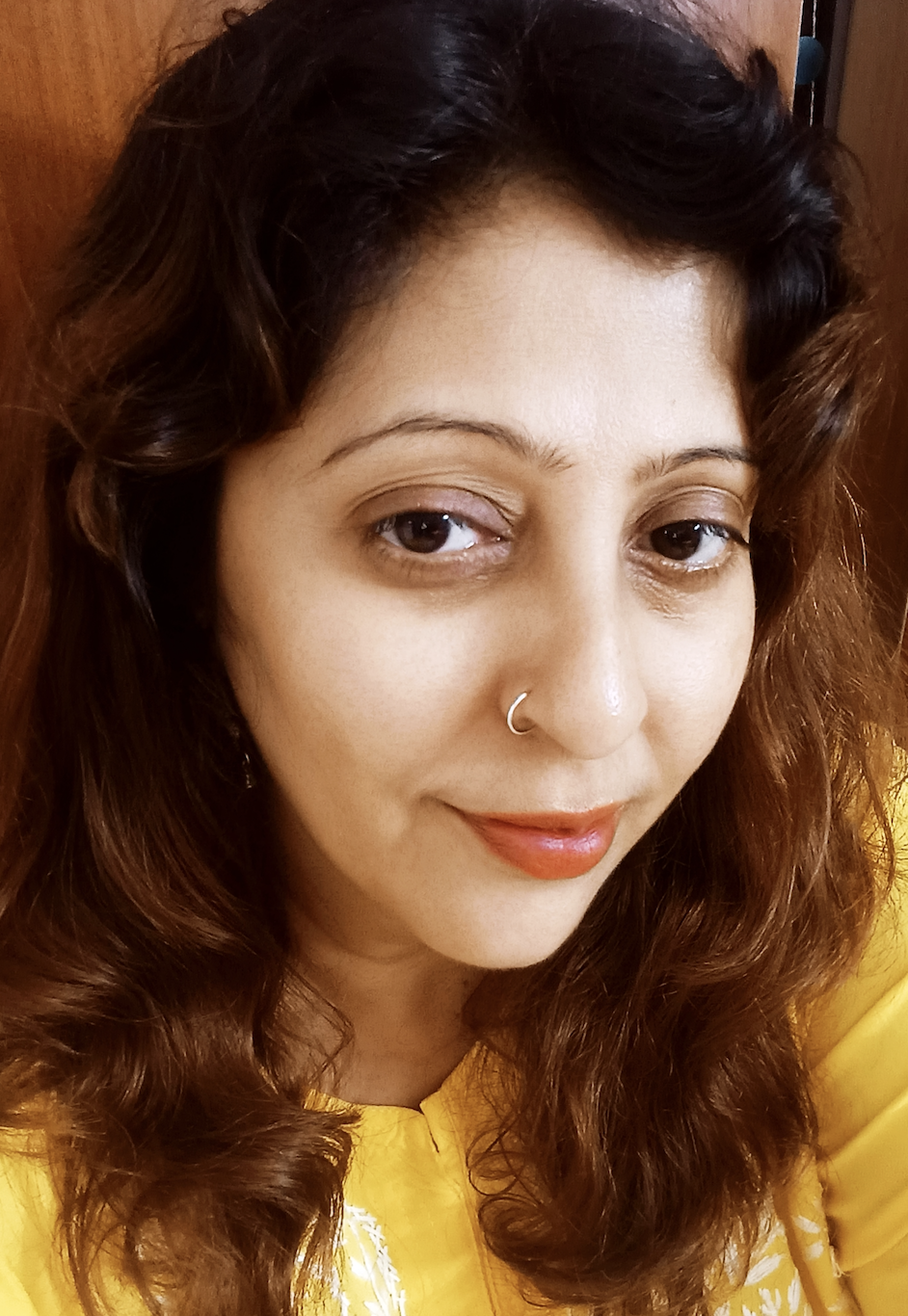
Alpa Arora is a former journalist and content writer with over 25 years of experience crafting articles, poetry, and short stories. Her work has appeared in publications such as The Times of India, Bengaluru Review, Kitaab, Borderless Journal, and 1455 Arts. Deeply interested in human psychology—especially the complexities of the subconscious female mind; she channels these themes into her writing. Read the review of her Floating Worlds here.
NAW: Floating Worlds offers an intimate portrait of Ruby Khanna’s inner world. What inspired you to delve into the psyche of a woman grappling with emotional detachment and existential unease?
Ruby’s journey was inspired by my own mid-life crisis and that of other women around me. I realized that as women reach their forties, something inherently starts changing in them. If they were comfortable with defined roles and patriarchal systems earlier, suddenly they find themselves questioning everything that makes up their identity. This is a difficult transition period for women, and some deal with it by rejecting outdated roles, while others respond by going deeper within themselves to find out what is it that they really want. This is not akin to saying that it doesn’t happen to women at other ages, but I wanted to write about a middle-aged woman who is stereotypically supposed to be grounded and balanced, but is in the midst of utter chaos and the only way she knows how to deal with it without destroying her family in the process, is by detaching herself from her reality and creating a new one.
NAW:The narrative moves fluidly through memory, dreams, and reflection rather than following a linear structure. How did you craft this dreamlike form while maintaining narrative coherence?
Since I was attempting to write in the stream of consciousness style, at least in the first half of the book, I had to map the fantasy elements (dream, memory etc.) and weave them into the linear narrative. This was done by interplaying the storyline with corresponding triggers that help us understand the protagonist’s thought process better. The idea was to pick up major events from her life that give us a sense of her development over the years and follow that up with something happening in real time. I like to think of it as a ‘literary’ montage; it is similar to a technique used in films to add symbolism that might seem incongruous at first, but is actually there to give the reader additional insight. For example, the chapter where her aunt confesses to Ruby that she had an affair is followed by the flashback chapter where Ruby puts in her papers at work to focus on her family life. Here she explains to Kashish, her subordinate that what makes a character unforgettable is their relatability and their ability to make mistakes. The next chapter is back in the present, where she meets Riyaz, who serves as a reminder to Ruby that she is allowed to make mistakes. In a way, the audience is watching Ruby understand herself better.
NAW: Ruby seems to inhabit two parallel world; her outward life of duties and her deeply immersive inner reality. Do you see her interior world as an escape, or as a truer expression of self?
I don’t think of the word ‘escape’ as something negative. It is our rich, inner minds that truly make us who we are, not the roles we play or the image we build so that people might respect us. I don’t even think our inner worlds are a true indicator of our real selves. I think all humans vacillate between both worlds on a daily basis. If you ask someone what they are really thinking, chances are most people will never be completely honest with you. It is okay to balance the two, with one foot in reality and the other in our thoughts. It helps regulate our emotions, so that human beings live in a society devoid of utter chaos because we are living out our fantasies in our mind. I see a lot of reviews of the book where they talk about fantasy as if it is a form of escape and call out Ruby’s character as disturbed or living in her imagination. I find it amusing, because it reiterates how much people are scared to admit that they do the same as well. Well, in a way the book is normalizing what is in fact normal, but not spoken about that much.
NAW: The dynamic between Ruby and Shiv is nuanced, shaped by longing, restraint, and ethical tension. What were you hoping to explore about love beyond traditional romantic constructs through their relationship?
I was trying to understand the kind of mystic love that you read about in Sufism, where love is a form of worship and surrender, a bridge that brings you closer to Divinity and dissolves the Ego. Ruby tells Shiv time and again, that she does not want anything from him, because in her mind she already has him. It is a sort of metaphysical and transformative love that helps you become a more evolved version of yourself. It does not demand recognition or labels, because it exists in a realm where there is no judgement, only acceptance. In the end, it is irrelevant if they are friends or lovers, if they stay together or have parted. All that matters is if they have understood each other.
NAW: Ruby’s marriage to Kabir is defined more by silence than overt conflict. How central was the idea of emotional distance in your portrayal of contemporary relationships?
I wanted the reader to sympathize with Kabir and yet not hate Ruby for drifting away. The idea of marriage by itself has become redundant when you have the whole world to connect with thanks to your phone. Emotional distance is a choice, because sometimes couples really have nothing in common. You find most couples sitting separately on their phones, never being truly honest with each other, while the only thing holding them back from leaving, is a child. In Ruby’s case, the child is grown up and gone, and even when the child was young, her partner never understood what she was going through. Ruby chooses to be emotionally distant because of incompatibility and fear of being judged. She is not distant with Shiv or Riyaz, only with Kabir as she does not feel safe to open up with him. Silence is an indication that you don’t trust the other person at all, but conflict is healthy if approached respectfully.
NAW: Through Raghu, the narrative engages with philosophical and spiritual questions. How did you balance these contemplative elements with the emotional realism of the story?
The book to be described in a nutshell, is about healing. So, spirituality was a major theme I wanted to explore in the book. When you start healing, the first thing you do is ask questions. Then you figure out what works for you and what doesn’t. Raghu is merely acting as a mirror for Ruby’s unhealed self. He is here to be a friend to the reader as well. When the reader is exhausted by Ruby’s endless questions, Raghu serves as a temporary relief and answers those questions. He is patient, grounded and curious to learn, something we know Ruby aspires to be as well. The emotional heaviness in the book needed an anchor to hold the weight, and Raghu was created to do that.
NAW: The novel frequently revisits Ruby’s childhood. How do you view the role of early emotional experiences in shaping one’s inclination toward imagination and inner retreat?
Our fears, triggers, idea of safety and emotional acceptance stem from our early childhood. Our parents are our first role models and we learn how to regulate our emotions by emulating them. We also unknowingly carry their trauma, because even though children don’t understand much, they are always observing their parents. Someone like Ruby who experienced her personal boundaries being violated by incest and sexual abuse as a child, is bound to create a parallel reality where she is in control of everything and where she can feel safe. If you have parents who are creative and encourage imagination in the form of free play, Art or storytelling, the child will end up as an adult with a rich inner world, as opposed to a child who is chastised for being imaginative and asked to stick to pure logic.
NAW: The recurring presence of the tiger in Ruby’s dreams is both vivid and unsettling. What does this symbol signify, and how does it relate to her deeper anxieties?
I think this part is explained in the book itself when Ruby has a dream where the tiger is old and finally seems powerless. Since these nightmares started when Ruby was just a child, the tiger symbolizes something that holds power over her, something that makes here feel scared and helpless. It is usually men, first the ones who molest her, then Kabir who she feels is tracking her down and eventually her own self that she is conflict with. When she starts accepting her reality and stops fleeing from it, the dreams change and the tiger is no longer a threat.
NAW: Name five of your favourite writers.
Jack Kerouac, Haruki Murakami, Ernest Hemingway, Milan Kundera, T.S. Eliot, The Bronte sisters, Margaret Atwood, Erica Jong. There are more, but I’ve already crossed five!
NAW: What are you reading currently? What do you do apart from writing?
I’m reading a great book written by my college friend, Beneath Divided Skies by Natasha Sharma. I’m also reading a book on Chinese medicine. Apart from writing, I raise two boys, run a household, travel and most importantly, dream. That’s the main thing in life, to keep dreaming.