Aparna Sanyal is the award winning author of ‘Instruments of Torture’, a short story anthology with HarperCollins in 2024. She holds an MA from Kings College, London. She is a recipient of the 14th Beullah Rose Poetry Prize and was shortlisted for the 2018 Third Coast Fiction Prize for her short story titled ‘The Rack’. ‘Instruments of Torture’ featured on The Telegraph’s ‘Page turners of 2024’ list, Sonali’s Book Club’s ‘12 books to read in 2024’ and Books & Beyond Podcast’s ‘Best Reads of 2024’. It also featured on the Amazon India Fiction Bestseller list and has stellar reviews in Scroll, The Asian Age, The Tribune, The Telegraph, BOUND, The Purple Pencil Project, et al. Her debut book (tales told in rhyme), Circus Folk & Village Freaks (released, October 2018) was number one on the Amazon India Poetry Bestseller list. It was the first featured poetry recommendation on ‘Sonali’s Book Club’ and was very favourably reviewed in The Hindu, The Asian Age, The Indian Express, Midweek, et al.
Aparna’s publication credits include The Yearbook of Indian Poetry in English 20-21, The Hong KongProverse Poetry Prize Anthology 2020, The Penn Review, Smartish Pace, Dunes Review, SOFTBLOW, Vayavya, Typehouse Literary Magazine, et al.
Aparna’s next will be a novel- length work of gothic fiction.
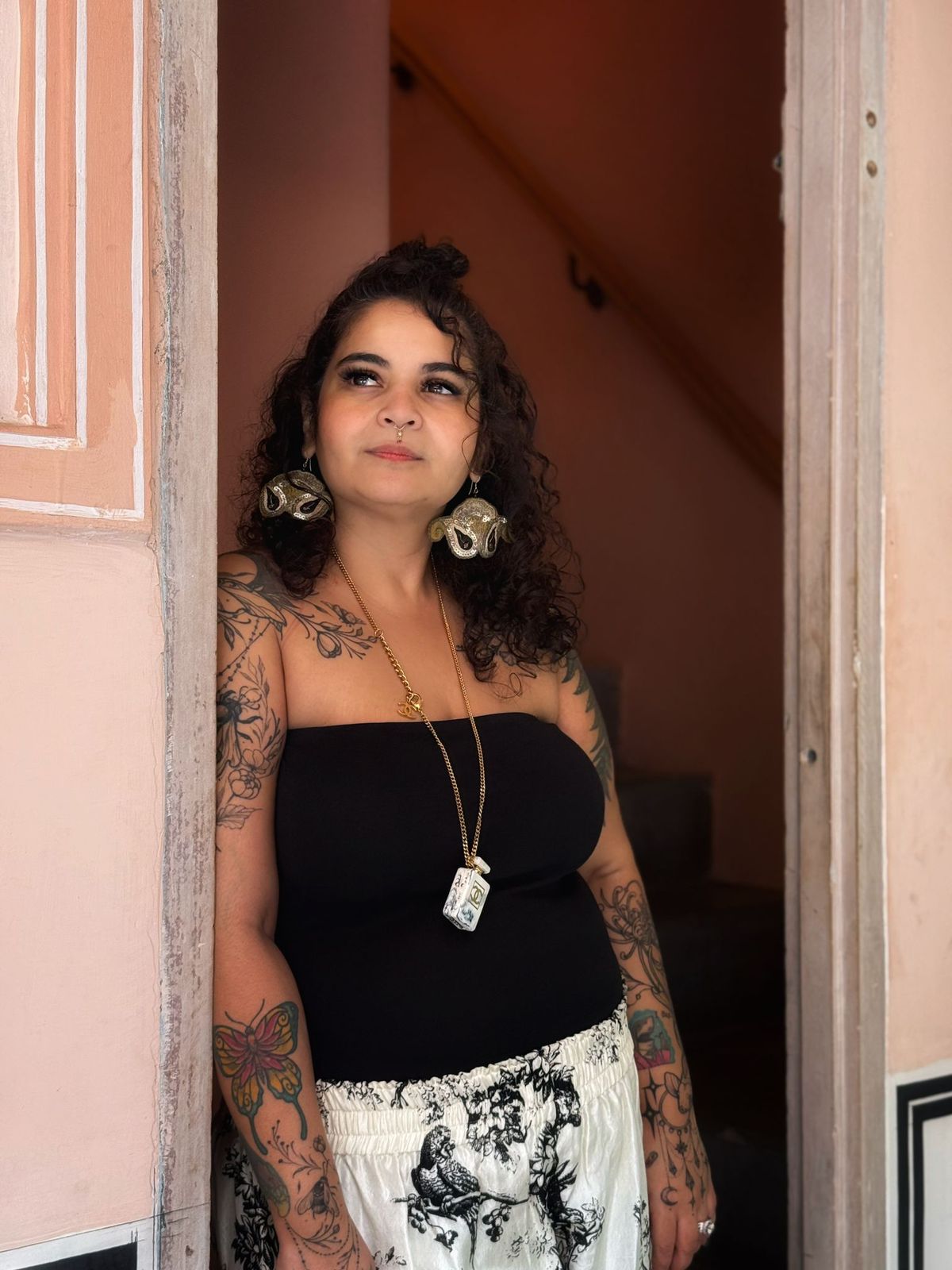
NAW: What led you to adopt ‘Instruments of Torture’ as the central theme in your work? Was there a specific experience or moment of insight that sparked your examination of emotional and psychological suffering through this lens?
I came across a physical traveling exhibition of medieval torture instruments while on a trip with my husband in 2015. Seeing a physical manifestation of the kind of cruelty man is capable of inflicting on his fellow man was both eye-opening and immensely sobering. Some of them more physically imposing contraptions, like the iron maiden, were almost beautiful in their monstrosity. Right there I knew that I wanted to use these instruments as metaphors to write about so many stories that lived in my head. Stories that may be considered taboo or difficult to read, but that I needed to tell.
NAW: Did you ever realize (while writing) this book was a brave decision since this kind of genre doesn’t really work very well for subcontinent readers?
I have been a poet much before I started writing prose. So, the idea of saleability has never influenced what I write. I don’t see my words as brave, but as tools that help me make sense of my inner and outer world. Writing for me, always has been a deeply personal, cathartic act. That people choose to engage with this writing is a cherry on top. That’s not to say that I don’t want to be read and respected for my work. Like most authors, the feedback and engagement of readers and the need to be known for my words is innate. However, sales would never really influence or make or break what I write.
NAW: Your book often weaves together delicate imagery with stark, even brutal emotion. How do you navigate the balance between brutal physical torture against raw emotional intensity without compromising the power of either?
I think, quite possibly, because I try to accept and find beauty in the shadowed parts of my own psyche, that’s why, when I write, perhaps the grotesque seems delicate or taboo seems common place. Also, editing plays a seminal role in my process. I try to be really strict with myself, but still can lean towards purple prose or bombast at times.
NAW: The title Instruments of Torture is striking and evocative. How did you decide which kinds of “instruments” did you intend to include in the book—and how did you arrive at this title? Tell us about the research you did for the book?
The title of the book was an obvious choice given the subject matter. I chose to write about those instruments whose physical imagery stayed with me, and with which the parallels of my stories flowed organically.
I did some online research to verify and place the instruments historically, although one of the instruments, the chastity belt, has mythical origins, and no historical record exists of its usage.
NAW: Were there specific writers, thinkers, or maybe some personal influences that shaped your approach to Instruments of Torture—whether in terms of style, voice, or thematic direction? Which writers have inspired you?
A: I consume books, not so much as read them. Who I am influenced by at any point, changes with the phase I am going through in my life. Therefore, the list of authors who inspire me is a long and evolving one. Currently, I am deeply influenced by the work of woman Gothic fiction writers like Catriona Ward, Laura Purcell, and Alma Katsu.
NAW: Your prose is both brutal and unflinching. Do you have a professional background in writing? How did you decide the language and tonal choices in Instruments of Torture?
I wish I had an MFA, but I don’t. I haven’t studied writing at school, although I have written in some form all my life. I am still learning so much about the craft and evolving daily. I think I have a long way to go before I am truly happy with my voice.
NAW: What kinds of conversations has Instruments of Torture sparked among readers? Have any responses or encounters left a lasting impression on you?
I am very lucky to have found an engaged readership, who make my voice feel relevant. I have been approached by many folks who have felt marginalized by society or struggle with mental health issues. A lot have said that my words make them feel seen. This is by far the most rewarding feedback I have received. I feel deeply grateful & so privileged.
NAW: The book lays bare many cruelties and torture techniques. Which ones did you find the most challenging to write about?
The Rack, The Judas cradle, and The Falarides Bull were the three toughest stories to write since they all have child protagonists. Being the mum of an 11-year-old, I feel particularly vulnerable and turned inside-out when I write about children.
NAW: This genre is difficult to market and publish. Please tell us about your publishing journey.
I took to writing poetry at the age of 40. I am very privileged to have my poetry published by several reputed, international literary journals. My first book, ‘Circus Folk & Village Freaks’, was published by a boutique Publishing House in Pune. Being aware that none of the big publishing houses accept poetry, especially from a relative unknown, I didn’t even bother to submit there. Luckily for me, the book did well, was number one spot on the Amazon India best seller list for weeks and was generously, favourably reviewed.
Serendipitously, a year after its release, my editor at HarperCollins, who is also a poet, reached out to ask if I was working on anything new. I did a happy dance and sent her the first draft of Instruments of Torture. Within months, I was signed by HarperCollins India. I was signed pre-pandemic and Covid delayed the release of my book by almost 3 years, but the wait was well worth it. Within that time, I edited the manuscript 6 to 7 times and also started working on my current manuscript, a full-length novel of Gothic fiction.
NAW: What are you reading currently? What do you do apart from writing?
Apart from writing, I am a very hands-on parent to my 11-year-old son, 18-year-old nephew, 22-year-old niece and 12-year-old dog baby Tinkerbell. Until last week, I was busy packing off my nephew who has lived with us for the last 5 years. I honestly don’t know where the time flies!
I just finished reading a fascinating non-fiction exploration into Indian serpent worship called ‘Naaga’ by K Hari Kumar. In fiction, I have several books lined up, including ‘Black River’ by Nilanjana Roy and ‘Hurda’ by Atharva pandit. I am also re-reading ‘Looking Glass Sound’ by Catriona Ward alongside these.