Paul Waters is the author of Murder in Moonlit Square, the first novel in his Irish-Indian cosy crime series set in Delhi’s Chandni Chowk. The novel reached No. 3 on the Indian fiction bestseller charts. He also wrote Blackwatertown (Unbound, 2020; audiobook narrated by Patrick Moy), The Obituarist, and short stories featured in the anthologies Taking Liberties and Christmas Murders on Bedford Square.
An award-winning BBC producer, reporter and presenter, Paul most recently worked on the BBC World Service’s In The Studio. He co-hosts the acclaimed We’d Like A Word books podcast, shortlisted for Books Podcast of the Year 2020. He is UK Director of the Khushwant Singh Literary Festival London and co-founded the Chiltern Kills crime writing festival.
Raised in Belfast during the Troubles, Paul has reported globally for the BBC in the past.
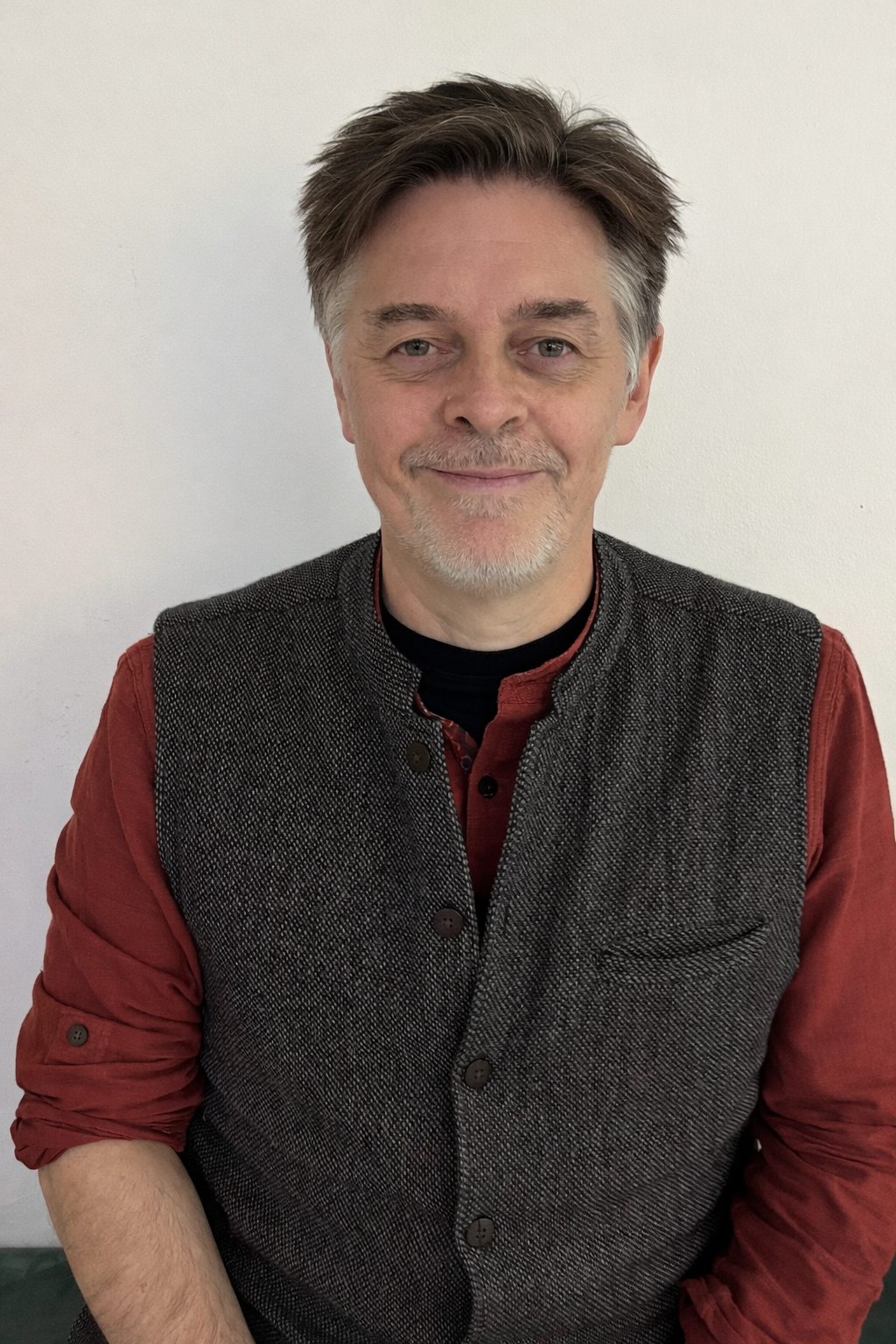
NAW: Murder in Moonlit Square is set in the tightly packed centuries old lanes of Chandni Chowk. What drew you to this particular part of Delhi as the emotional and narrative heart of the story?
There were two reasons. As a writer, you want authenticity — but you also want vividness. Real life, but with the volume, colour, and contrast turned up a notch. Chandni Chowk already feels like real life intensified. It’s noisier, smellier, busier — so many people, pressed together in such a small space.
When I first came to India, I was warned not to go there. So naturally, I went immediately.
It also gave me the title. Murder in Moonlit Square is essentially murder in Chandni Chowk. “Chandni” means moonlit, and “Chowk” means square — so the title emerged organically. It simply felt like the perfect setting.
NAW: Your two central investigators — Irish nun Sister Agatha Murphy and Delhi hotelier Avtar Mehta — are unlikely partners. How did they take shape in your imagination? What do they represent to you?
I’ll confess — I cheated a little. They’re inspired by real people.
Avtar Mehta is loosely based on a friend of mine who runs a hotel in Delhi. Sister Agatha, meanwhile, draws from a real-life relative — more of a cousin — who was a nun in Ireland. Her mother hoped she would remain close to home, but the Mother Superior reportedly said, “The walls of Gortnor Abbey are not high enough to hold Sister Agatha.” So she was sent to India.
She taught in several parts of the country and eventually became the principal of Jesus and Mary College in Delhi, which she helped expand significantly.
The idea to write a novel set in India actually came from my wife, who is from Delhi. I was hesitant at first — I’m not Indian, after all. But then we discovered something extraordinary. My aunt’s first posting in India was in Pune. My wife’s late mother had studied in Pune. When we made some calls, we discovered that my aunt had taught my wife’s mother. That coincidence felt like a bridge — almost a form of permission — to tell this story.
Of course, the real Sister Agatha didn’t smoke, get into mischief, or spar with the police.
Those details are purely fictional.
NAW: The novel plays with ideas of perceived threats from across the border. What interested you about exploring how suspicion and geopolitics seep into everyday life in places like Old Delhi?
One of the reasons I love Chandni Chowk is its diversity. You’ll find mosques, temples, gurdwaras, Jain centres, and churches of various denominations all within walking distance. It’s layered and complex.
A friend in the Delhi hotel industry once told me about a group of pilgrims from Pakistan staying at his hotel. One of them went missing, and the authorities came down heavily on him. He kept saying, “I run a hotel, not a prison.” But when tensions rise, someone has to be blamed.
That story stayed with me.
On a personal level, both sides of my wife’s family originally came from what is now Pakistan. They can’t easily return to the places where they were born. There’s sadness in that — perhaps anger too — but there’s also nostalgia. My father-in-law loves meeting Pakistanis from his birthplace. He’ll ask taxi drivers in England about Sargodha. There’s longing there.
I wanted to explore that complicated mix of loss, sadness, wistfulness — and the question of belonging. If you were born somewhere but had to leave as a child, do you still get to call it home? It’s a question without an easy answer.
NAW: The book involves murder, intelligence agencies, and cross-border tension, yet you frame it as a cosy, light-hearted mystery with Irish satirical elements. Why take that approach instead of writing a traditional thriller?
Because the world already feels overwhelming. There’s so much crime, war, environmental crisis — it can all feel relentless.
I wanted to offer readers something lighter. Yes, there’s murder — cosy crime does require a body or two — but the tone is intentionally warm and humorous. Striking that balance between genuine jeopardy and lightness can be tricky, but the presence of an Irish character helped. There’s something about Irish satire that allows you to look at dark things without being consumed by them.
NAW: Sister Agatha raises questions about forgiveness, feminism, and moral courage. Were you consciously writing her as a counterpoint to the harshness around her?
I don’t think religious people have a monopoly on goodness or ethical behaviour. Morality isn’t confined to belief systems.
But I do like writing about good people — or at least people trying to be good.
Crime fiction often leans into the trope of the morally compromised detective: hard-drinking, cynical, flawed. That’s compelling, of course. But I wondered what would happen if ordinary people were drawn into extraordinary circumstances and still tried to hold onto their moral compass.
In this story, several characters — not just Sister Agatha — are trying to do the right thing. The challenge, of course, is that it’s often difficult to know what the “right thing” actually is.
NAW: You’ve had many professional lives — taxi driver, cook, banker, journalist, broadcaster. Which experience most shaped your storytelling?
Journalism, without question.
It taught me to observe closely, listen carefully, and ask questions. I’m naturally curious — perhaps nosey — and journalism sharpened that instinct.
But it also created a challenge. As a journalist, I was trained to tell other people’s stories and keep myself out of it. Fiction requires the opposite. You have to let your personality, humour, opinions — even your prejudices — surface on the page.
At first, I found that difficult. I’d spent years suppressing that instinct. But once you allow yourself that freedom, it’s incredibly liberating.
NAW: Name five of your favourite writers.
That’s a difficult question — I like so many! But here are five:
Amitav Ghosh — I admire both his fiction and his non-fiction. The Great Derangement felt urgent and important, and the Ibis Trilogy is remarkable.
Will Dean — He writes crime fiction set in Sweden featuring Tuva Moodyson, a deaf local newspaper reporter. Very satisfying storytelling.
Eoin McNamee — His work captures the claustrophobia of the Troubles in Northern Ireland, which I grew up during.
Sipho Sepamla — A Ride on the Whirlwind powerfully explores the intimacy of political struggle and violence.
Belinda Bauer — Her crime novels are unusual, humane, and emotionally intelligent.
NAW: What are you reading at the moment?
I always have a few books on the go. Recently, I’ve been reading:
- The Dismantling of India’s Democracy
- Clown Town
- Mafia Queens of Mumbai
- Indian detective fiction anthologies
- Salil Desai’s work
I like to keep my reading varied — fiction, politics, crime, literary work — it all feeds into the writing in different ways.