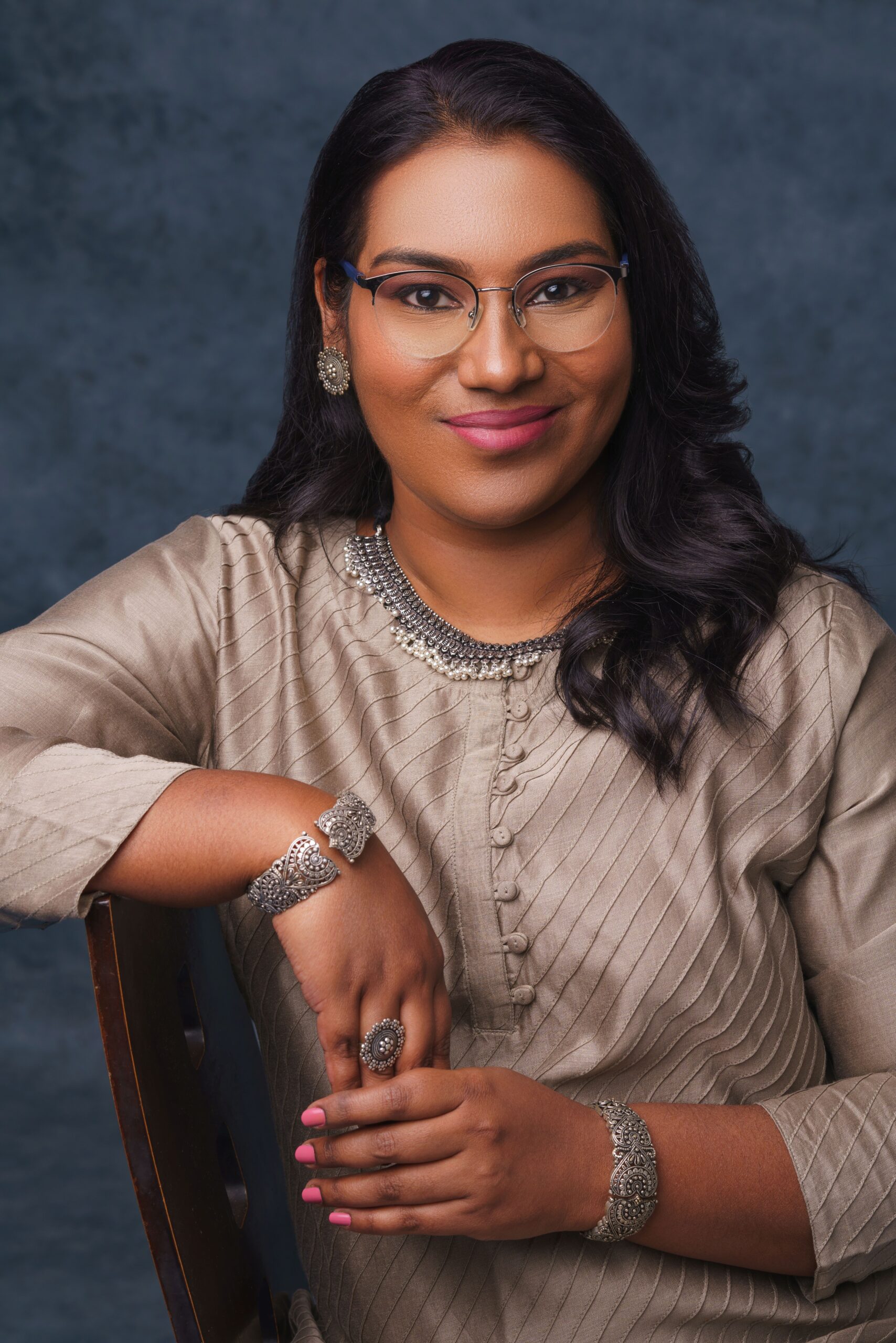
Salini Vineeth is a Bangalore-based fiction and freelance writer who transitioned from a decade-long engineering career to writing full-time. Her latest novella, The Tree, The Well & The Drag Queen (2026), adds to her works including Lost Edges, Magic Square, Everyday People, and travel guides on Hampi and Badami. She is fiction editor at Mean Pepper Vine. Her stories appear in leading literary magazines, and she has won multiple awards, including the Orange Flower Award (2023), MyStory contest (2025), and recognition at the BWW Short Story Award (2024).
NAW- The Tree, the Well & the Drag Queen moves between folklore, horror, magical realism, and queer coming-of-age fiction. What was the first image or emotion that sparked this story?
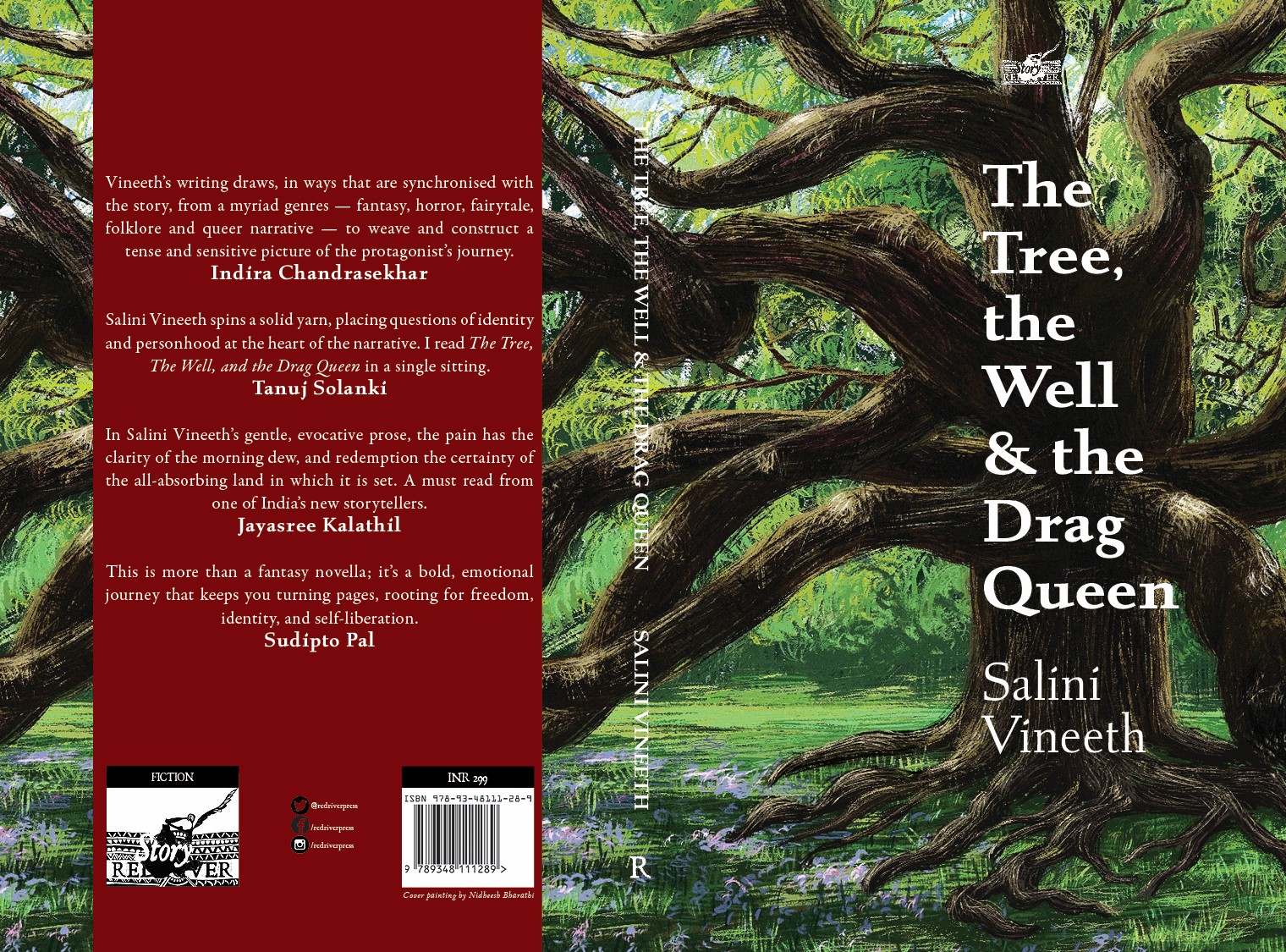
First of all, thank you very much for the review of The Tree, the Well & the Drag Queen in New Asian Writing. The review captured the essence of the book.
The story started from a feeling of entrapment. It was in 2020, during the second COVID lockdown. Though I was thankful for the privilege of staying home safe during COVID, after a few weeks of confinement, I felt trapped. I found myself daydreaming about open spaces, book stores, forests and beaches. ‘Is our sense of freedom just an illusion?’ ‘Is anyone in the world really free?’ Questions bothered me. Then, a character came to my mind: a grown-up person who was stuck in their ancestral home with their parents. It was an interesting premise, as there was a lot of scope for conflict. The story actually started as a very realistic one, but then, I thought, ‘What’s the point of writing about someone stuck at home, while the whole world is stuck at their homes? What is fresh about it?’ But then, this character refused to leave my head.
I tried different points of view, narrative voices, but nothing seemed to work for this story. Then, one day, I wrote a dream sequence of this character, the person dreaming that they’re stuck inside a jackfruit. Those who have read the book will remember the dream sequence that starts like, “I was trapped inside an enormous jackfruit…” Suddenly, I had an ‘Aha!’ moment. It was so fun to write, and I decided to abandon the ‘realistic’ story and kept building upon that fantasy dream sequence. You had mentioned in your review that the book develops through dream-like sequences, maybe it’s because the story started as a dream. Like many of my stories, this was an experiment, and I had no idea where it would go, but then, as I kept on writing, it became interesting; it also gave me a sense of relief and freedom during the dim phase of the COVID lockdown.
NAW- The tree and the well function almost like living entities — both nurturing and destructive. What do these symbols represent for you personally?
When I had the first glimpses of the story in my mind, the tree and the well were a regular tree and a well. But then, when the story took a turn towards fantasy, suddenly there was scope to give these ordinary objects a personality. The tree in the story is controlling and manipulative, whereas the well is mysterious and scary. I have certain symbolism for the tree and the well in my mind, but I feel explaining them would bias the readers to see these entities in a restricted way. I would rather let the reader decide what the tree and well symbolize for them.
NAW- The drag queen’s journey feels deeply interior — less about spectacle and more about self-recognition. How did you approach writing gender fluidity without reducing it to explanation?
When I wrote the drag queen’s character, I didn’t look at them through the lens of gender. Sometimes, developing a character is like bringing up a child; you see the child as a whole, a beautiful human being. You enjoy watching the child grow up with a sense of pride and bewilderment, rather than thinking about individual aspects of their personality.
The Tree, the Well & the Drag Queen is a coming-of-age story that portrays the protagonist’s life starting from a very young age: a child who loved to sing, dance, wear makeup, and have fun. Through my writing, I witnessed this child’s journey into adolescence and then adulthood. It helped me look at the protagonist as a real person, a wholesome yet vulnerable, brave yet insecure person who goes through excruciating experiences in their quest for freedom and authenticity. So, for me, this character is more than what their gender represents, they’re a real person, with happiness, sorrows, dreams and hopes — a person who worries about missing a train, complains about their boss and wonders what shade of lipstick to wear. Maybe that approach helped me focus on the whole person rather than defining the character only by their gender.
NAW- How do you balance mythic storytelling with contemporary social realities without allowing one to overshadow the other?
Be it ancient or contemporary times, human instincts and flaws remain the same. Traits that control human beings, like love, hatred, greed and curiosity, have remained unchanged over millennia, even though humans have evolved socially and technologically. It’s quite interesting to draw parallels between myths and modern realities based on these common human traits. A search for treasure in the ancient world can be compared to a race for a coveted promotion in the corporate world. Isn’t keeping a princess in a high castle for her safety the same as parents forbidding their daughters to step out of the house after dark?
Drawing these kinds of parallels has helped me balance the mythical and contemporary aspects of the story. When you find commonalities between myth and reality, jumping from one to another becomes smoother, and the real world becomes an extension of the myth.
NAW- How do you see Indian English fiction evolving in its engagement with queer narratives today?
Indian English writers, mainly writers from the queer community, are taking the initiative to bring queer narratives to the mainstream. Publishers are also taking an interest in realistic queer narratives. For example, Seagull Books has The Pride List, a series of books spotlighting LGBTQIA+ narratives. They encourage translations from other languages to English. One of the amazing books in this series is Unlove Story by Sudipto Pal, translated from Bengali to English by Arunava Sinha. Members of the LGBTQIA+ community have long been stereotyped by popular Indian media. There have been many caricatural portrayals of queer characters in Indian cinema. The queer narratives written or translated by LGBTQIA+ writers are indeed a breath of fresh air. These books will help readers view the LGBTQIA+ community from the community’s perspective.
NAW- What was the most difficult part of writing this novella — structurally, emotionally, or thematically?
The toughest challenge was portraying a non-binary, gender non-conforming protagonist. As I mentioned in the previous answer, I am acutely aware of how the Indian media has stereotyped queer characters for a long time. So, for me, it was of prime importance to portray a queer character as realistically as possible. Doing so within the framework of a fantasy story was an added challenge. It’s not that I consciously chose a queer protagonist for my novella. When I first conceptualized this thread as a short story, I started writing a narrative from the protagonist’s first-person point of view. I didn’t think about the gender of the protagonist. All I knew was that the protagonist was an artist, someone who loves everything loud and colorful, someone who loves to sing and dance.
But after some time, as the plot expanded, I had to think about the protagonist’s gender, and I couldn’t decide if the protagonist was a man or a woman. And then, I asked myself, “Why are you so adamant that this character should be a man or a woman? What if they aren’t a man or a woman?” It was like an epiphany, and I couldn’t ignore that question. Thus started my journey of understanding gender non-conformity and non-binary gender identity.
It wasn’t an easy journey. To my embarrassment, I realized that I didn’t know much about gender nonconformity. So, I started learning. The more I read, the more I got confused. Slowly, a path opened up. I came across some amazing books, especially Beyond the Gender Binary by Alok Vaid-Menon. It was a steep learning curve, and I realized with some pain that, as a cisgender person, I might not be fully able to internalize the idea of non-binary gender identity. However, I read and watched a lot of videos where people from the queer community shared their experiences and perspectives. They were so generous and open.
Also, as a cisgender person writing a queer protagonist, I was worried about whether I had the right to write such a book. The fear often paralyzed my writing to the extent that I thought of abandoning the book many times. However, the protagonist, the drag queen, was so persistent in my mind that I felt like they were taking the story where they wanted to. It’s a magical experience when a character takes over a story from the writer.
Also, my editor at Red River Story, Sucharita Dutta-Asane, asked me questions and insisted that I should get clarity on the gender identity of the protagonist. Her encouragement and confidence in my manuscript eased my worries to some extent. The thought of abandoning the drag queen’s character felt like abandoning someone I love and care for, so I have tried my best to portray them with honesty and care. I am still learning.
NAW- The book subtly critiques rigid masculinity and societal conformity. Was this political dimension deliberate, or did it emerge naturally from character?
No, it wasn’t deliberate. In my mind, all stories start with a character. In this story, it was an artist stuck in their ancestral home. I wasn’t thinking about any broader themes or political dimensions at that point. But I believe that every person is political, be it a character or a writer. As the character’s journey progressed, more characters appeared in the story, bringing in their beliefs and politics into the plot. My job as a writer is to portray the ideological conflict between these characters. While there are abusive male characters in the novella, there are also kind and sensitive male characters. Again, this was also not a conscious balancing. I was just focused on the characters, their personalities and behaviors. Since they’re political beings, the book couldn’t be apolitical, but the politics emerged naturally from these characters. As a woman writer, I have been disturbed by the glorification of rigid masculinity in popular culture, it could’ve influenced me subconsciously. But, as a writer, I am very careful not to pass judgment on any persons or genders; my job is to simply observe and report.
NAW- Are you interested in continuing to explore myth-queer intersections in future work?
I am a spontaneous and slow writer. Naïve as it may sound, I have no roadmap of what I want to write next or what genres I want to pursue. I do a variety of things, writing, editing, translation, whatever I feel invested in at the moment. My next book is a children’s book, a very light-hearted story, which is so different from my novella. While the idea of myth-queer intersection sounds amazing, I can’t say I will explore it until the next idea strikes.
NAW- Please name five favourite writers—writers who shaped your writing.
Oh, I love this question, even though the answer is not easy. My list of favorite writers is so long, but I will try to pick five in no particular order. I grew up reading two amazing Malayalam writers, Vaikom Muhammad Basheer and Kamala Das. These were legendary writers who created new paths when there were none. Basheer is famous for his unpretentious writing and the lightness of his prose, even when dealing with extremely serious issues. I think I developed a taste for humour from Basheer’s writings. In my childhood, I tried hard to imitate his style, and even published a Malayalam story in Basheer’s style. Kamala Das showed me, at a very young age, that a writer needs to have courage. You can’t write fiction if you’re worried about what people will think. Another writer I totally adore is Perumal Murugan, whose short stories skillfully merge myths with realities, and his prose slips easily into magical realism. I also respect him for his courage in tackling dangerous subjects and his integrity in standing by his work. I have learned a great deal about emotional depth from Anuradha Roy’s novel, The Atlas of Impossible Longing. Hemingway’s minimalistic style has also influenced me, especially in writing dialogue.
NAW- What are you reading currently? What do you do apart from writing?
I am reading a series of Paris Review Art of Fiction interviews. Since I am in the book marketing phase, I find it difficult to fully immerse myself in reading. I enjoy reading the interviews from the 1950s, and I can’t believe how deeply I relate to the experiences and feelings of writers from another generation! Other than writing… I have to think about it. Honestly, my whole life revolves around writing and reading. I edit a quarterly fiction magazine, Mean Pepper Vine and translate children’s books from English to Malayalam. Even when I am watching movies, I am trying to learn craft. The one thing that I do very differently from writing must be playing violin. I am learning to play violin, and it has been going so badly so far!