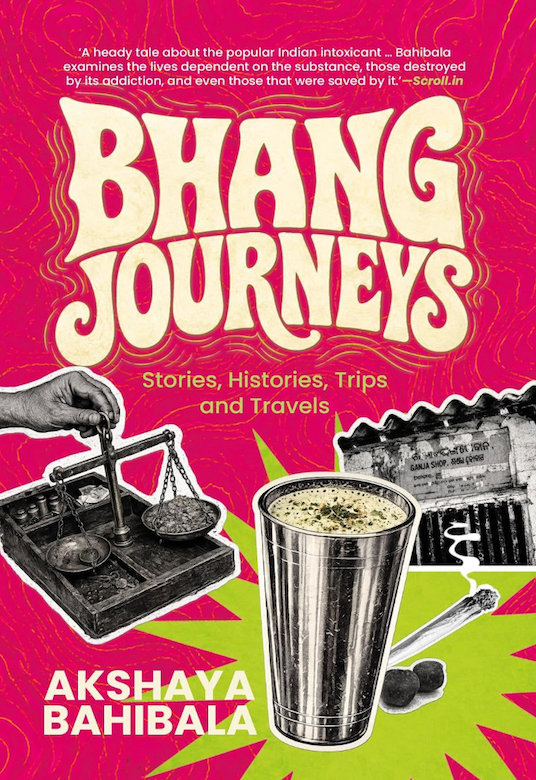
Akshaya Bahibala is an author, poet, bookseller, publisher and passionate advocate of reading and library culture. He co-founded Walking BookFairs, an independent bookstore and publishing house known for its travelling bookmobiles. The author of four books in Odia, Bhang Journeys marks his debut in English. Read the review here.
NAW: What was the original spark behind Bhang Journeys, and when did you realise that your personal experiences with bhang, ganja and addiction could become a book?
During my days on the beach road in Puri, many people I met told me that I had a way with stories, but I was too high to take their advice seriously. When I started working in a bookstore and later co-founded Walking BookFairs with Satabdi, I began reflecting on what people had told me about storytelling.
I started writing poetry and short stories in Odia, but I strongly felt that I needed to write about my days on the beach road, the memories I had made there and how those experiences had shaped me in profound ways. Even though I was almost always high during those days, I met people from all over the world and encountered and experienced countless extraordinary lives. The more books I came across while working at the bookstore, the more convinced I became that I had stories worth telling. And that’s how Bhang Journeys came into being.
NAW: Your book moves between memoir, travel writing, cultural history and investigative reportage. Why did you choose this hybrid structure rather than telling the story purely as a memoir or a work of reportage?
I am not a student of literature. I have never attended university to study writing. I come from the working class of the publishing industry. I simply let the story take its own shape. I am sure there are many ways to tell a story. I strongly believe that everyone has a story, and there are infinite ways and styles of telling it.
I don’t want to give my writing style a single label. I have lived a hundred lives, and I think my writing reflects that, with each chapter having its own unique style. At times, it reads like a report, while at others, it feels like a piece of autobiography. The industry puts labels on writers, not me.
NAW: One of the most striking themes in the book is how recreational use can gradually become dependency. What do you think people most often misunderstand about the transition from casual consumption to addiction?
Sugar is sweet, but too much of it can lead to poor health. Similarly, food is tasteless without salt, but too much of it can ruin the same food. We all need something that gives us a little high in life, but deciding how much is good for us can be very difficult.
Ganja produces a very powerful high. It can make a person feel blissful and euphoric, and it can also provide relief from pain. But the secret lies in knowing how much ganja can bring you bliss and how much can unleash the monsters inside your head. That is why many people fail to recognise when they move from recreational use to dependency, and subsequently, even madness.
NAW: Your own experience gives you an insider’s perspective, but it also means revisiting some difficult parts of your past. Was there anything you found particularly challenging to write about or investigate?
Of course, it is difficult to return to a place where you were almost killed and where you nearly lost your mind. I am still followed by the monsters of the beach road. Going back to the same beach road and meeting old friends there was the most difficult part. I must tell you that I still don’t go back to the house where I lived in Puri.
I have experienced both heaven and hell on the beach road. I have fallen in love and had near-death experiences in the very same place. I lost many years of my youth there, but I also learnt a great deal from those experiences.
Apart from returning to the beach road in Puri, I enjoyed travelling to different places for my research into the illegal ganja trade and meeting people from the Excise Department. However, getting permission to accompany excise personnel on their raids was not easy. It was certainly not a pleasant experience to witness the appalling conditions in which ganja farmers live.
NAW: During your travels through Odisha, you encountered farmers, bhang-shop operators, addicts, traditional practitioners and Excise Department officials. Which encounter or individual stayed with you the longest, and why?
In some of the remote tribal areas of Koraput and Malkangiri districts, I encountered women ganja farmers pleading with Excise Department officials to leave at least a small patch of their ganja farms untouched. This made me think about how people in cities smoke ganja to get high and feel good, while it is the poor who have to pay the price.
I also started thinking about the many students from prestigious universities, artists, writers and politicians I knew who smoked ganja but never got into any trouble. Not one of them had to beg or cry for it. All they had to do was pay some money and get their supply from a dealer.
NAW: The book explores the fascinating contradiction that bhang can occupy a place within religious and cultural traditions while other cannabis products are criminalised. What did your research reveal about why Indian attitudes towards cannabis are so complicated?
I think we live in a very complicated society. Prostitution is illegal, yet we have red-light areas in many Indian cities, including the capital. In my own state, Odisha, we have managed to open at least one Indian-made foreign liquor shop in every gram panchayat, yet most Indian families would deny that any member of their family drinks alcohol.
Our government officials and politicians claim that the government provides the best educational facilities, but their own children attend private schools. I didn’t have the resources to conduct extensive research into the Indian psyche. All I can say is that we Indians are complicated, and this subject deserves much more debate.
NAW: Tell us about your publishing journey.
The story of Bhang Journeys goes back to a small tea shop on the highway from Puri to Bhubaneswar, where I happened to be sitting with a few friends and my publisher, Ravi Singh.
At the tea stall, I caught the smell of ganja, looked at Ravi and remarked that it was good-quality ganja. The conversation then turned to my troubled past on the beach road and my experiences with smoking up. Right there and then, Ravi asked me to write something about my experiences with ganja and offered me an advance of ₹40,000 to get started on the book.
NAW: Please name five of your favourite authors.
I am a college dropout. The schools I attended never had a library. As a child, I remember reading stories in my Odia literature textbooks. A few travellers I met on the beach road introduced me to books before I started working at a bookstore in 2010. That bookstore eventually became my university.
One woman traveller I met on the beach road gifted me The Alchemist by Paulo Coelho, while another gave me The Second Sex by Simone de Beauvoir and The White Tiger by Aravind Adiga. I remember enjoying these books immensely.
I read very selectively, but the writings of Fakir Mohan Senapati, Khushwant Singh, Albert Camus, Aravind Adiga and Hermann Hesse have stayed with me.
NAW: What are you reading currently? What do you do apart from writing?
I am currently reading a lot of historical documents about Puri, the arrival of the British in the city, and the first missionary, William Bampton, along with his documentation of Odisha.
My bookstores take up most of my time, as do my plants and cats. I try to use my experience with books to curate and build libraries. Recently, I helped curate a museum and library in the Simdega district of Jharkhand.
NAW: Can you tell us about your upcoming works?
There are two more books in the pipeline. The first is about Odia coolies in Burma, while the second takes me back once again to the beach road in Puri. You will have to wait for the books to come out to find out more.