A candid and absorbing exploration of India’s complicated relationship with intoxicants, combining personal memory, cultural history, travel writing and investigative reportage.
Rating: ⭐⭐⭐⭐☆ (4/5)
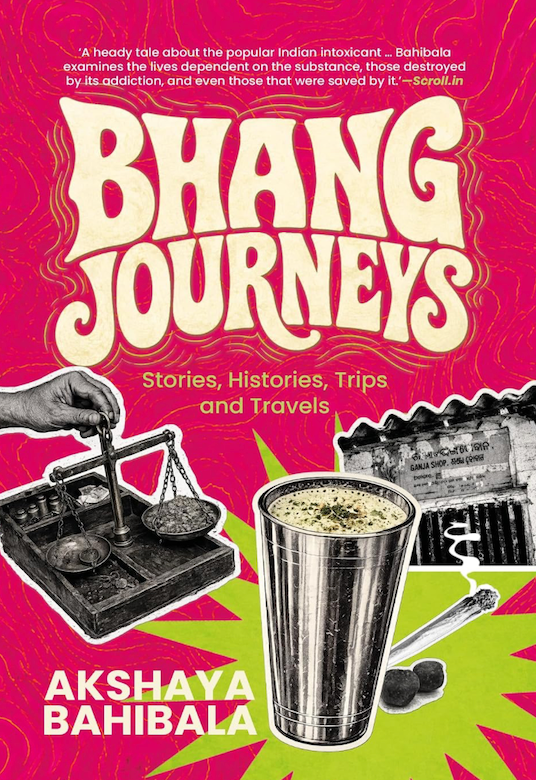
Akshaya Bahibala’s Bhang Journeys: Stories, Histories, Trips and Travels is difficult to classify neatly, and that is one of its most appealing qualities. The book combines memoir, travelogue, reportage, cultural history and social observation, while also drawing on the author’s own experiences with substance use and recovery. Much of the narrative is rooted in Odisha, particularly Puri and the cannabis-growing regions of southern Odisha, where Bahibala investigates the many lives of bhang, ganja and opium—as religious substances, commercial products, intoxicants, traditional remedies and objects of state regulation.
The book’s perspective is unusual because Bahibala is not approaching his subject exclusively as an outsider or academic researcher. His understanding comes partly from having participated in the very culture he later examines. Consequently, the narrative repeatedly shifts between personal recollection and wider investigation. A memory from Puri’s Beach Road may be followed by an account of a government bhang outlet; a conversation with someone affected by addiction may lead into a discussion of cannabis cultivation or Excise Department procedures.
This mixture gives the book a curious dual character. It can be amusing and anecdotal, but beneath that surface lies a serious examination of addiction, social customs, government policy and the complicated place intoxicants occupy in Indian society.
A Personal Account of Addiction and Recovery
The autobiographical portions are among the book’s most compelling sections. Bahibala’s recollections of Puri’s Beach Road between 1998 and 2008 do not follow the familiar structure of a dramatic fall followed by a triumphant recovery. Instead, they unfold through memories, episodes and observations that convey what it was like to spend years immersed in a culture where intoxicants were readily available.
The early narrative evokes a world of backpackers, hippies, tourists, alcohol, cannabis and a loosely organised social environment. At first, this lifestyle can appear attractive: it promises freedom, spontaneity and escape from conventional responsibilities. Gradually, however, the distinction between recreation and dependency begins to disappear.
Bahibala captures that transformation with striking economy:
“First, a chillum or a joint once or twice a day. You feel light and happy at first, forget all worries. Slowly, the euphoria becomes a habit.”
The power of the observation lies precisely in its simplicity. There is no attempt to turn addiction into an elaborate psychological theory. Instead, the author describes how something initially experienced as pleasure can quietly become routine and eventually dependency.
Another line conveys the destructive passage of time even more effectively:
“One day, you look at a calendar by mistake. You realize you have lost a lot of years smoking and rolling.”
The statement gets to the heart of the memoir. Addiction does not always announce itself through one catastrophic event. Sometimes its most frightening consequence is simply the realisation that years have passed while life remained suspended.
Puri’s Beach Road: More Than a Setting
Puri’s Beach Road functions almost like another character in the narrative. Bahibala does not treat it merely as a physical location but as a self-contained social ecosystem populated by travellers, residents, dealers, police officers, tourists and people struggling with substance use.
His depiction avoids turning the place into a romantic counterculture paradise. There is excitement and camaraderie, but there is also exploitation, danger, violence and stagnation. The same environment that offers an escape from ordinary life can eventually become a trap.
The author’s return to this familiar world after trying to change his life is particularly revealing:
“I was back. I was where I knew the scene. Or so I thought.”
The words “Or so I thought” carry considerable weight. Bahibala recognises that familiarity can be deceptive. Places associated with an earlier life can bring back old behaviours and emotional patterns. Recovery, therefore, is not portrayed as a straightforward movement from addiction to freedom. The surrounding environment can remain part of the problem.
Expanding the Journey Beyond Memoir
The book becomes broader in scope once Bahibala begins travelling through Odisha and investigating the people and institutions connected with intoxicants. Farmers, shopkeepers, government employees, traditional practitioners, addicts and Excise Department officials all become part of his inquiry.
This shift transforms the book from a personal memoir into something closer to social reportage.
One important distinction concerns the difference between bhang and ganja:
“The dry leaves of the cannabis plants are famously known as Bhang, whereas their buds, when dry, are called Ganja.”
This distinction is significant because the two substances have not historically occupied identical legal or cultural positions. One of the book’s recurring observations is that Indian society has maintained an unusually complicated relationship with cannabis. It can be associated with religious practice, traditional medicine and social customs while simultaneously being subject to prohibition and criminal enforcement.
Rather than resolving this contradiction, Bahibala uses it as one of the central questions of his journey.
The Government Bhang Shop and the Paradox of Prohibition
The chapter dealing with a government-authorised bhang shop is particularly effective because it makes the contradictions of drug regulation tangible.
Bhang can be legally available through authorised channels, while another preparation derived from the same plant can be treated very differently under the law. This creates an unusual situation in which legality depends not simply on the plant itself but on which part of it is being consumed and how it enters the market.
Bahibala also records the contradictions within the institutions enforcing these rules. Police and government officials occupy one position as representatives of the law, while personal consumption and local cultural practices may place them within the very society that the regulations seek to control.
Instead of turning these contradictions into a dry policy argument, Bahibala frequently lets anecdotes and encounters reveal their absurdity. His understated humour works particularly well here.
Bhang, Religion and Tradition
The religious dimension of cannabis receives considerable attention, adding another layer to the book’s investigation.
The account of the Trinath Mela illustrates how bhang can exist simultaneously as part of ritual practice and ordinary social consumption. The distinction between religious use and recreational use is not always clear.
During preparations for the Mela, the author asks whether ganja is available exclusively for the religious ceremony. The answer he receives is telling:
“Lots of people smoke it now… Even the Mausa who’s going to sell it to us smokes up.”
The exchange captures the difficulty of drawing a firm boundary between ritual and everyday behaviour. What begins within a religious context can become part of a broader social culture.
Bahibala also explores traditional and Ayurvedic claims concerning cannabis and its medicinal applications. Importantly, he generally records these claims without presenting them as automatically established scientific truths. This gives the discussion a useful degree of restraint.
The book therefore avoids two equally simplistic positions: treating cannabis as inherently evil or presenting it as an unquestionable therapeutic substance.
Inside the Excise Department
The sections dealing with the Odisha Excise Department broaden the narrative yet again. Bahibala enters government offices, speaks to officials and investigates the mechanisms through which intoxicants are procured, distributed, regulated and destroyed.
These chapters are valuable because they show what drug policy looks like away from legislation and official statements.
The officials are not reduced to caricatures. They emerge as people operating within a difficult system, often facing limited resources, complicated local conditions and allegations of corruption. The book also records claims that corrupt officials sometimes assist in moving drugs between districts or states.
These accounts turn Bhang Journeys into an examination of the gap between laws on paper and their implementation in everyday life.
Opium and a Much Darker World
The book’s movement into the subject of opium changes its atmosphere significantly.
In “The Opium Cutter,” Bahibala enters a world considerably removed from the relatively casual cannabis culture described earlier. His encounter with a man who inherited the occupation from his father opens a window into the history and government regulation of opium production.
The historical material adds depth to the narrative. Bahibala incorporates an article concerning attempts to abolish opium smoking, demonstrating that debates about intoxicants in India stretch back decades.
The inclusion of official seizure and destruction figures also changes the rhythm of the book. Tables documenting quantities of bhang, ganja and opium seized, as well as hemp plants destroyed, may interrupt the storytelling, but they serve an important purpose. They show the enormous administrative machinery operating behind the personal stories.
People Make the Book
Bahibala’s strongest journalistic quality may be his attention to individual people.
The book contains a gallery of memorable figures: government bhang-shop operators, farmers, villagers, Excise officials, traditional practitioners, tourists, addicts and people attempting recovery. These encounters prevent the subject from becoming an abstract discussion about drugs.
Small details often reveal much larger social histories. One particularly memorable example involves an elderly woman wearing several heavy gold chains who explains the significance of her family’s Bajaj M80:
“This is our family’s oldest vehicle, and that’s why we still have it; it is what made us rich.”
The anecdote has little to do with intoxicants directly, yet it enriches the book by revealing how objects, occupations and personal possessions can preserve the economic history of a family and community.
The Value of Not Taking Sides
Perhaps the book’s most important quality is its refusal to reach an easy moral verdict.
Bahibala does not portray cannabis as either entirely destructive or entirely benign. His memories include enjoyment, friendship, freedom and adventure, but they also contain addiction, violence, lost time and the struggle to rebuild an ordinary life.
That contradiction is central to the entire work.
Bhang can appear in one chapter as part of religion or traditional practice and in another as part of a destructive dependency. A government establishment may sell one cannabis preparation legally while another remains prohibited. People tasked with enforcing drug laws may themselves belong to a culture in which cannabis consumption is commonplace.
The title Bhang Journeys therefore has a meaning beyond physical travel. The journeys are also through a series of social, cultural and legal contradictions.
A Style That Mirrors the Subject
Bahibala’s writing is generally conversational rather than academic. Even when he deals with complicated questions of law, history or drug policy, he does not burden the reader with specialised terminology.
This accessibility is one of the book’s advantages.
The prose works particularly well in scenes involving conversations and personal experiences. Dialogue gives the encounters immediacy, while the movement from one location to another maintains the travel-writing element.
There are also moments when the structure feels deliberately loose. The narrative can move abruptly from memoir to historical material, from interviews to government records and from travel writing to documentary reportage. Readers expecting a tightly controlled, linear narrative may find these transitions somewhat uneven.
Yet the looseness is also part of what makes the book distinctive. It resembles the accumulated record of a curious traveller and investigator more than a carefully compartmentalised academic study.
Fascination Without Glorification
The book’s treatment of cannabis is effective because its fascination with the subject does not become an outright celebration.
Bahibala understands the attraction of intoxication and the communities built around it. He recognises its historical and religious significance and describes the freedom associated with the culture from personal experience.
At the same time, he has experienced the consequences of dependency.
The sections dealing with recovery make that tension particularly clear. Leaving behind a lifestyle organised around cannabis does not automatically make ordinary life easy. Everyday existence requires responsibility, discipline and sustained engagement—precisely the things that can become difficult after years of living within an intoxicant-centred environment.
Consequently, the book poses a more complicated question than the familiar “drugs are bad” argument. It asks what happens when something that begins as an occasional activity gradually becomes the framework around which an entire life is organised.
Conclusion
Bhang Journeys: Stories, Histories, Trips and Travels is an unconventional work, but its unconventional structure is also one of its greatest attractions. What initially appears to be a book about bhang, ganja and opium gradually expands into an exploration of addiction, religion, history, law, bureaucracy, rural economies, tourism and social attitudes.
Its greatest strength comes from the author’s position within the story. Bahibala is not merely documenting a culture from outside. He has experienced it himself, attempted to leave it behind and subsequently returned to examine it with the perspective of an observer. That combination gives his account an intimacy that conventional reportage might not achieve.
The strongest chapters are those where personal memory intersects with investigation: the years on Puri’s Beach Road, the government bhang shop, the Trinath Mela, encounters with Excise officials, the story of the opium cutter and the author’s continuing attempt to understand India’s contradictory relationship with intoxicants.
The book is not without weaknesses. Its transitions can occasionally feel abrupt, and the mixture of memoir, history, reportage and travel writing does not always produce a perfectly cohesive structure. Nevertheless, the lack of conventional neatness suits a work built around journeys, encounters and contradictions.
Ultimately, Bhang Journeys is neither a defence of cannabis nor a straightforward anti-drug book. Its achievement lies in documenting a culture that has occupied several contradictory positions in Indian life: sacred and recreational, traditional and commercial, tolerated and criminalised, celebrated and feared.
For readers interested in Odisha, Indian social history, travel literature, addiction, drug policy or unconventional memoir, the book offers plenty to engage with.