Redtooth is an atmospheric, increasingly brutal and distinctly Indian folk-horror novel that rewards patience. Its greatest strengths are its Himalayan setting, cultural tension, vivid physicality and gradual evolution from trekking adventure into nightmare.
Read an excerpt from Redtooth here.
Rating: ⭐⭐⭐⭐☆ (4/5)
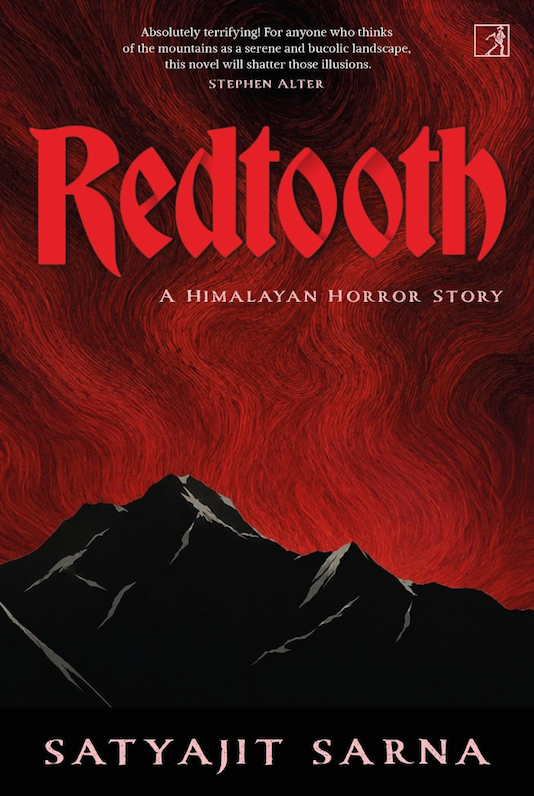
Satyajit Sarna’s Redtooth: A Himalayan Horror Story, published by Simon & Schuster India, begins with what appears to be a familiar premise: a group of trekkers venturing into the Himalayas. Set against the trails around Yuksom, Dzongri and Goecha La in Sikkim, the novel initially resembles a conventional trekking story, populated by urban Indians bringing their personalities, insecurities and complicated histories with them. Yet, as the group climbs higher, the distinction between the tangible world and something far older begins to collapse.
The book is described by its publisher as a folk-horror novel in which trekkers encounter the ancient laws and beliefs of the mountains before coming face-to-face with a mysterious stranger. What distinguishes Sarna’s approach is his refusal to use the Himalayas simply as scenic decoration. The mountains possess a presence of their own—beautiful, unforgiving, indifferent and shaped by traditions that the outsiders barely comprehend.
The novel consequently becomes more than a story about a terrifying creature. Beneath the horror lies an exploration of arrogance, vulnerability, memory and the uneasy relationship between modern outsiders and an ancient landscape.
When a Trek Becomes Something Else
The opening chapters deliberately remain close to ordinary life. The characters worry about food, luggage, altitude, accommodation, weather, connectivity and the practical demands of trekking. Vinod, Manish, Mandhira, Keshav, Moeen, Kapil and the others initially seem far removed from the world of conventional horror. They are recognisable contemporary Indians who have carried their urban assumptions into a landscape governed by an entirely different logic.
That contrast becomes central to the novel.
Vinod’s reaction to Yuksom captures the attitude with which several of the travellers initially approach the region: “Such a small town, thought Vinod. How could anyone ever live here?”
There is humour in the observation, but it also exposes an important sense of superiority. The visitors regard their familiar urban environment as the natural standard against which everything else should be measured. The Himalayas, meanwhile, refuse to accommodate that assumption.
Sarna reinforces this tension through mundane details. The trekkers complain about food, Wi-Fi, clothing, exercise, sleeping arrangements and mobile connectivity. At one point, the novel observes: “Most trekkers prefer it without network. You can put your phone in your bag and forget about it.”
Initially, this sounds like a simple comment about disconnecting from technology. As the story develops, however, the idea becomes more ominous. Losing network coverage also means losing access to the systems of modern life that make the characters feel secure.
The Mountains Become Part of the Story
The greatest strength of Redtooth is its atmosphere, and much of that atmosphere comes from the setting itself.
Sarna understands that the Himalayas do not require supernatural intervention to become frightening. Extreme cold, altitude, exhaustion, darkness, isolation and unpredictable weather already place human beings in a position of weakness. The supernatural elements become more effective because they emerge from a landscape that is inherently capable of making people feel small.
The sections set around Dzongri and Thangsim repeatedly reinforce this vulnerability. As temperatures fall and evening arrives quickly across the mountains, the environment itself begins to feel increasingly hostile.
The progression is important: the landscape becomes frightening before the monsters do.
Altitude also plays a significant psychological role. The trekkers become physically weaker as they climb. Breathing becomes more difficult, exhaustion sets in and their bodies can no longer be relied upon in the way they are accustomed to. Their ability to escape danger is consequently reduced.
This makes the later supernatural developments considerably more unsettling. By the time the truly horrifying events begin, the characters have already been stripped of much of their physical confidence.
From Trekking Adventure to Folk Horror
The novel’s most compelling transformation is its gradual shift from adventure fiction into folk horror.
At first, the characters encounter local traditions from the position of outsiders. They discuss Buddhism, spirits, local gods and the sacred importance of Khangchendzonga. Their conversations initially treat these beliefs as cultural curiosities rather than potential truths.
One statement, however, becomes increasingly significant:
“This area around Khangchendzonga, it’s the centre of the world.”
The visitors can easily interpret such a belief as superstition. Sarna, however, steadily complicates that assumption. The question becomes whether dismissing another culture’s understanding of its environment might itself be a form of ignorance.
For the trekkers, the mountain is a geographical destination. For those who have lived within its traditions, it represents something much larger: a sacred landscape filled with history, memory and forces that cannot simply be reduced to the rational explanations preferred by outsiders.
That is where the novel’s distinction between “superstition” and “knowledge” begins to dissolve.
The horror is therefore not merely about encountering an unknown creature. It is tied to a much older worldview—one that existed long before the trekkers arrived and will continue to exist after they are gone.
Modern India Encounters an Older World
Sarna also succeeds in placing distinctly contemporary Indian characters inside this ancient landscape.
These are educated, urban people. Their conversations range across careers, politics, smartphones, social media, fitness, relationships and modern life. One extended political discussion even moves into subjects such as democracy, minorities, the Ram Mandir issue and India’s changing political landscape.
At first, these conversations can seem disconnected from the horror narrative. In reality, they reinforce one of the novel’s central ideas: the characters bring their entire urban identities with them.
But the mountain is indifferent to those identities.
Wealth does not matter. Education does not matter. Professional success does not matter. Physical fitness, political beliefs and technological sophistication offer little protection against an environment—or a force—that the characters do not understand.
Manish embodies this tension particularly well. He is experienced and responsible, accustomed to organising and protecting trekkers, yet he carries the psychological consequences of something from his past. His competence cannot completely shield him from memory.
People Rather Than Disposable Horror Victims
The large cast is one of the novel’s more interesting features. Sarna gives his characters private anxieties and insecurities beneath their outward personalities, allowing the horror to affect people who already have complicated inner lives.
Mandhira, for example, is portrayed as someone attempting to rebuild her independence. Her conversations about age, diet, yoga and appearance may initially seem like ordinary social exchanges, but they provide a more recognisable dimension to her character.
Her statement, “I don’t eat meat or sugar. I do yoga and that’s all.”, is the sort of mundane detail that prevents her from becoming a generic horror protagonist.
Moeen offers another perspective. Older and more conscious of his physical limitations, he has a deeper emotional connection with the mountains and therefore relates to the landscape differently from some of the other trekkers.
Vinod is considerably harder to sympathise with. His dismissive observations reveal the assumptions of an urban professional accustomed to believing that unfamiliar places and people should conform to his expectations.
Kapil represents another kind of danger: recklessness. As the group moves deeper into the mountains, his behaviour becomes increasingly troubling.
These differences matter. The characters do not enter the horror as blank slates. Each brings personal conflicts, assumptions and weaknesses that become relevant once their surroundings turn hostile.
Atmosphere Before Shock
Sarna’s most effective horror does not necessarily come from the most graphic scenes. Often, the tension works because the reader senses that something is wrong before the characters themselves fully recognise it.
The novel allows anticipation to build.
The horse attack is a particularly striking example. The violence arrives abruptly, leaving blood and destruction against a landscape that has previously been described with careful observational detail.
That contrast makes the scene more disturbing. The beauty of the surroundings is suddenly violated by extreme violence.
Later, the supernatural becomes increasingly tangible. Jaavni’s encounter in the darkness around pages 244–245 moves the novel decisively away from suggestion and into physical terror.
At this stage, the threat is no longer an idea.
It has become flesh, teeth, claws, blood and hunger.
It is here that the title Redtooth takes on its full significance.
When Horror Becomes Physical
The novel does not hold back from graphic violence. There are scenes involving mutilation, blood, torn flesh, animal attacks and bodies being damaged or consumed.
Yet the gore generally works because Sarna builds suspense before revealing it.
The description of Kapil’s mutilated body is disturbing not simply because of what has happened, but because Jaavni does not immediately understand what she is looking at. Recognition unfolds gradually.
The body becomes a piece of evidence.
Like Jaavni, the reader has to reconstruct what happened from what remains.
This physical horror also exists alongside a more psychological form of terror. The characters are increasingly forced to question whether their understanding of reality can still be trusted.
The result is a useful contrast: the violence shocks immediately, while the psychological uncertainty lingers.
Doma and the Knowledge of the Mountains
Doma is important because she embodies a form of knowledge that the urban trekkers lack.
Her warning to Dzangpo is simple:
“Things start changing up there.”
It is easy for outsiders to ignore such a statement. Its significance becomes clear only later.
The reader gradually comes to understand what the characters initially fail to recognise: the mountain has rules.
The prologue establishes this idea before the trekkers even enter the story. The Abbott performs an old ritual and acknowledges the forces and ancestors believed to have governed the mountains for generations.
This is an important structural decision. The novel does not begin with the tourists. It begins with a world that predates them.
The trekkers are therefore not entering an untouched, empty wilderness.
They are entering a place that already possesses its own memory.
The Limits of Human Control
Human arrogance is perhaps the novel’s most important underlying theme.
The characters repeatedly believe that the world can be organised, explained and controlled.
Manish has his checklists.
The trekkers have their equipment.
They have phones.
They have guides.
They have money.
They have fitness routines.
They have professional expertise.
And yet none of these advantages can protect them from something outside their understanding.
This is the central irony of the novel: the mountain is under no obligation to follow the rules imposed upon it by visitors.
The rituals described in the prologue consequently become more meaningful as the story progresses. What initially appears irrational to the outsiders may instead represent a form of environmental and cultural knowledge that modern rationality has forgotten or dismissed.
Where Redtooth Falters
The novel is not without shortcomings.
Its first half moves substantially more slowly than its later sections. Sarna devotes considerable space to establishing the characters, their personalities and the mechanics of the trek. Readers expecting immediate horror may find this section somewhat demanding.
Some conversations also run long, particularly those dealing with politics, religion, lifestyle and personal histories.
Yet the slow beginning serves a purpose. Horror becomes more effective when the reader understands the people whose sense of safety is eventually destroyed. Sarna spends time establishing normality precisely so that he can later dismantle it.
The large number of perspectives can also make the narrative feel fragmented. Once the supernatural elements become more prominent, however, those seemingly separate threads begin to connect.
The novel asks the reader to be patient.
The rewards come later.
A Distinctly Indian Form of Horror
One of Redtooth‘s biggest strengths is that it does not simply take familiar Western horror conventions and place them against an Indian backdrop.
Its horror grows organically from Himalayan geography, local mythology, religious traditions and the uneasy relationship between outsiders and communities that possess a much older connection to the landscape.
India contains an enormous body of folklore, much of which remains relatively underused in contemporary mainstream horror fiction. Sarna’s decision to centre the story around Sikkim and the Khangchendzonga region gives the novel a strong identity.
The setting also benefits from being real. Yuksom, Dzongri and Goecha La are not fictional gothic locations created solely for atmospheric effect. They are recognisable places associated with actual trekking routes.
That realism makes the supernatural considerably more unsettling.
The reader is not being asked to imagine an invented haunted castle. The horror is attached to a landscape that exists.
The Prose: Dry Humour Meets Visceral Horror
Sarna’s prose moves comfortably between different tones.
His descriptions of mountains, forests, snow and weather can be lyrical, but they are frequently interrupted by dry humour and observations about the behaviour of urban Indians.
That tonal contrast is valuable because it prevents the book from becoming overly solemn.
Early complaints about Yuksom and trekking expectations are amusing, particularly when the characters approach the mountains as though they were dealing with an inconvenient version of a holiday destination.
At other times, Sarna’s writing becomes deliberately blunt.
That directness is particularly effective during the horror sequences. He does not romanticise violence. When something terrible happens, the prose often becomes physical and immediate.
As a result, the novel can move from social comedy to visceral horror with very little warning.
When the Nightmare Takes Over
The later sections are markedly darker than the opening chapters.
Later, the characters are no longer simply trekking; they are running, hiding and fighting to survive.
One of the more effective aspects of Jaavni’s storyline is that she eventually acts for herself rather than waiting passively for someone else to save her. Her escape gives the sequence a degree of agency and prevents her from becoming merely another helpless victim.
The concluding sections also bring together many of the novel’s recurring ideas: hunger, violence, ancient belief, vulnerability and the consequences of entering an unfamiliar world without understanding its rules.
The horror therefore feels larger than a succession of monster attacks.
It feels like a reckoning.
Conclusion
Redtooth: A Himalayan Horror Story works because it recognises that the most frightening aspect of the Himalayas may not be whatever creature inhabits them. The deeper terror lies in discovering how limited human power, rationality and knowledge can be.
Satyajit Sarna takes the familiar premise of a trekking group entering a remote mountain region and transforms it into something distinctly Indian through the landscapes, traditions and folklore of Sikkim. The opening chapters are deliberately measured, but that pace establishes a sense of normality before the novel gradually tears it apart.
The story changes character as it progresses. What begins with discussions about food, trekking logistics, relationships, politics and fitness develops into a narrative about altitude, isolation and cultural belief before finally becoming visceral folk horror involving blood, mutilation, creatures and an ancient force beyond the protagonists’ comprehension.
The novel’s greatest achievement is therefore its atmosphere rather than shock value alone. The mountains remain beautiful even when they become terrifying. Snow can be breathtaking while concealing blood. A forest can appear serene while hiding something watching from the darkness. And a warning that initially sounds like superstition can eventually prove to be the most valuable information the characters ever receive.
And Redtooth asks what happens when people enter that world assuming it belongs to them.
That is where the novel’s lingering unease comes from. The creatures may be terrifying, but the more unsettling realisation is that the mountains were never waiting for the trekkers to arrive.
They were there first.