Sonia Bahl is an author and storyteller known for crafting emotionally resonant narratives that delve into relationships, identity, and the complexities of human experience. Her first novel, The Spectacular Miss, garnered significant attention and was later adapted for development by a prominent Bollywood production house. Drawing inspiration from her international background and extensive experience in the worlds of advertising and cinema, Bahl brings a distinctive perspective to her fiction. She is currently based in Singapore, where she continues to write and create. Her latest work is Eighteen Inches Apart. Read the review here.
NAW: The title Eighteen Inches Apart is deeply evocative. What does “eighteen inches” symbolize for you, and how did the title emerge during the writing process?
Eighteen inches is roughly the distance from your head to your heart. Someone once described it as the longest journey we ever take. It went straight into the filing cabinet of my mind. It was never not going to be the title of this book. We spend so much of our lives reasoning, analysing, talking ourselves out of feeling what we feel. The book is about what happens when you stop waiting to understand something and simply allow yourself to feel it. Both protagonists start by believing in something they can’t yet see or explain. It flips the idea of seeing is believing on its head.
NAW: Your novel appears to explore the many distances that separate people; class, grief, geography, and emotional barriers. What inspired you to examine connection through these different forms of distance?
I wrote the first draft during the isolation of the pandemic, when physical distance became the defining condition of our lives. And in that strange, suspended time, all our yearnings suddenly felt universal. Everyone, everywhere, was grappling with the same separations at once. Some of that inevitably seeped into Eighteen Inches Apart.
But here’s the paradox that interested me most. The pandemic forced us apart and somehow, briefly, dissolved the usual fault lines—wealth, ambition, privilege. It took a global catastrophe to do that. I was drawn to the people who cross those distances instinctively, because their hearts simply refuse to recognise borders or caution. Leela and Neel both live in that zone.
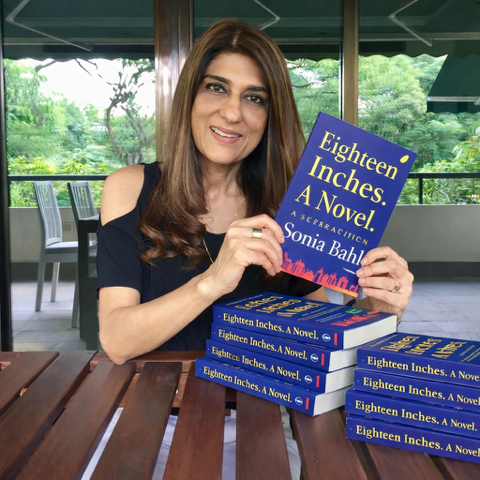
Pic Credit: Author
NAW: The relationships in the novel seem to develop through ordinary moments rather than dramatic gestures. Was it a conscious choice to privilege emotional intimacy over conventional romance tropes?
I’ll confess something. I’m often told I write romance well, and I absolutely do not believe it. I don’t think I have ever written anything that falls under the umbrella of a proper romance. I feel quite ill-equipped to do that.
And yet I believe a story without love isn’t worth telling. So the love I write has to arrive another way. Through unnameable feelings, unsaid things, and a yearning that cannot be explained. Like that conversation that goes on a beat longer than it needed to. And that ordinary moment that never leaves you. Love that’s felt rather than formulaic, with no perfectly wrapped romantic denouement.
NAW: Class differences between characters are present throughout the story, yet the novel avoids easy binaries of privilege and hardship. How did you approach writing these social dynamics with nuance?
Honestly, I didn’t approach class as a theme to be tackled at all. I approached people as individuals, and class simply happened to be one of the many things they carried, like grief or talent or stubbornness. The nuance, if there is any, came from refusing to see anyone through a single lens.
There’s a moment that captures what I was reaching for. Leela, who comes from privilege, is planning Zain’s first visit to London, when she realises he’s anxious about whether his passport will even arrive in time. It hadn’t occurred to her that he’d never owned one. Everyone in her world had passports within months of being born, eventually bursting with visa stamps. That Zain had travelled so far in life with so little makes her love him even more. It’s a small moment, but it holds everything. The privilege she takes for granted is simply invisible to her until it isn’t. Partial blindness and dawning of awareness of privilege weave in and out of the narrative. But to me the heart of the story was never about that. It’s about that liminal space between losing and finding.
NAW: Family relationships, especially those involving parents, seem to leave lasting emotional imprints on your characters. What role does family play in shaping identity in your fiction?
Family, or the lack of it, shapes so much of who we become. All the more in a character-driven story. It becomes the foundation of who these people are and what they want. A gardener’s trellis that gives form and shape to what grows.
But I’m just as interested in the families we choose as the ones we inherit. In this story, Neel is shaped as much by his estrangement from his father as by the warmth he finds at someone else’s Sunday lunch table. Leela’s parents quietly alter the course of a boy’s entire life, simply because they love him like family. Some characters are formed by absence, others by an abundance they didn’t expect. The book is rooted in the idea that families—the ones we are born into and more significantly, the ones that find us—leave indelible imprints on our lives.
NAW: At its heart, the novel asks what truly brings people together. After writing Eighteen Inches Apart, has your own understanding of love and human connection changed in any way?
Connection has been the quiet obsession running through everything I’ve ever written, so I’m not sure this book changed my understanding of it. If anything, writing it reaffirmed what I’ve always suspected: that what truly brings people together has very little to do with time, or proximity, or familiarity. It’s something far more mysterious. A quiet attention. A willingness to be altered by someone you barely know. Or, as in this case, may never have met.
What the book did change was how hard I had to work to get there! This was my third novel, but unlike the old axiom, the third time wasn’t a charm. Writing this and finally letting it go felt harder than anything I’d done before. And not to be facetious, but in a book about distance, the distance between what I had in my head and what landed on the page always felt miles apart. Until, finally, it didn’t.
NAW- Tell us about your publishing journey?
Pivoting to screenwriting after years in advertising felt natural. Becoming a novelist, on the other hand, always felt accidental.
It began when a screenplay that had been greenlit suddenly went into rigor mortis. I decided to take a breather, and my manager suggested I write the next story as a novel instead, just for a change of scene. Quite literally. My husband, of course, had called it long before anyone else: that book is long overdue. The debut came pouring out, fast and furious, zero overthinking and almost zero expectation. I sent it to Mita Kapur, who is still my literary agent, and moved straight on to my next screenplay project, mildly relieved—I gave it a shot—and somewhat embarrassed by my audacity. A publisher picked it up and before I knew it, it was in bookstores. It felt like an unexpected, un-dreamed-of gift.
I might have been done with novels altogether if it weren’t for the editor who’d worked on the first one. She never stopped asking for the next manuscript: like it was a given I was writing another book! Her prodding and belief, led to what I now call a get-off-my-back move. I wrote something for her as a long text message. She saw it as the first chapter of my next book. That became A Year of Wednesdays. As I mentioned earlier, third time wasn’t a charm. But somewhere along the way, writing a novel started to feel just a little less accidental.
NAW: Please name five of your favourite authors.
That’s excruciating! The favourite circle is an ever-increasing, hefty one. Let’s just say I feel a palpable sense of excitement when any of these authors release a book: Julian Barnes, Jhumpa Lahiri, Min Jin Lee, Nick Hornby, Kazuo Ishiguro, Helen Fielding. Oops, an extra one snuck in.
NAW: What are you reading currently?
Mieko Kawakami’s Sisters in Yellow and 84 Charing Cross Road by Helene Hanff
NAW- Can you tell us about your upcoming works?
You know that cliché from spy movies: if I tell you, I’d have to kill you. No, the truth is I am in the midst of a screenplay and the way that business goes, you are literally bound into secrecy.