Rating: ⭐⭐⭐⭐☆ (4.5/5)
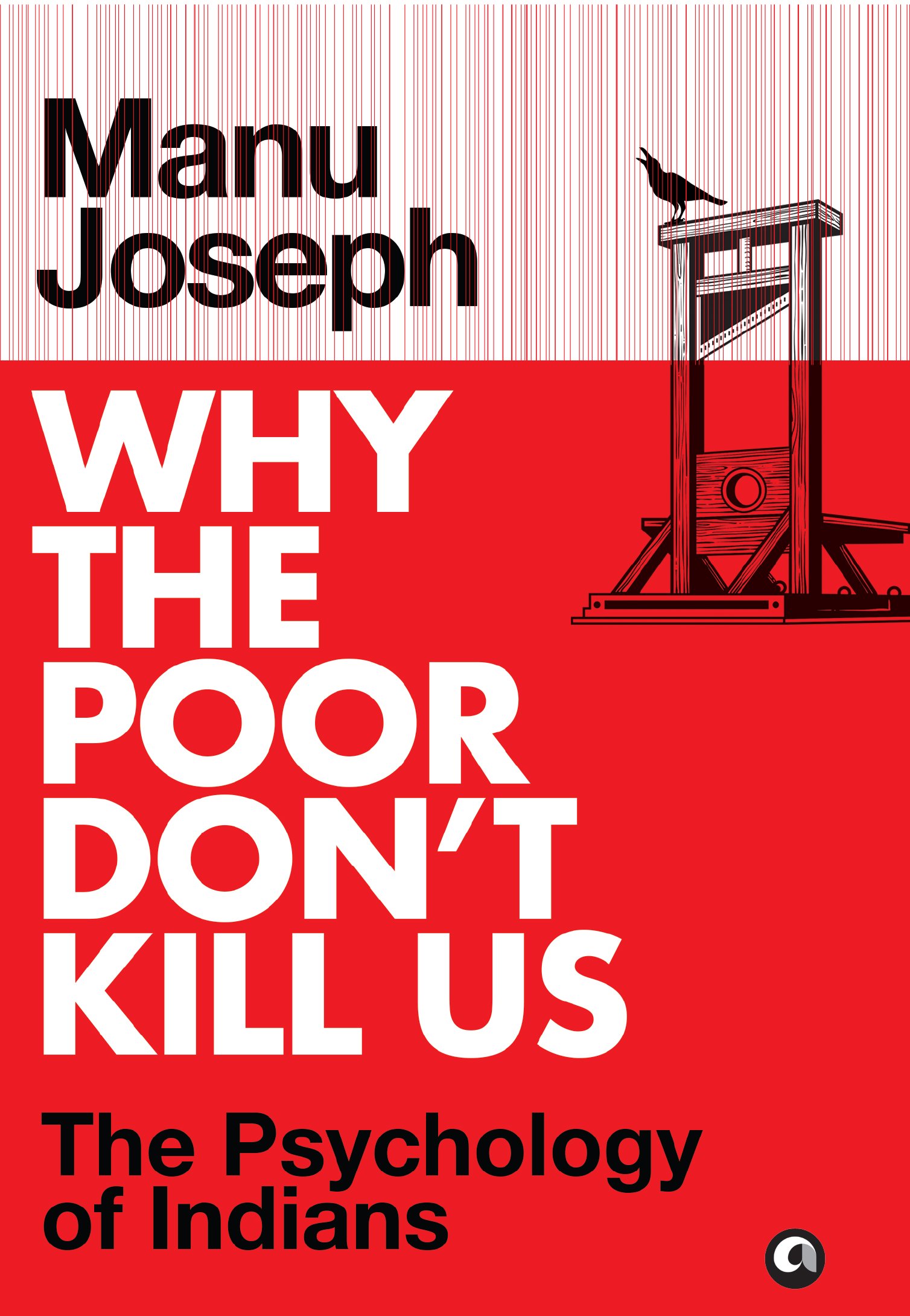
Manu Joseph’s Why the Poor Don’t Kill Us: The Psychology of Indians is an unusual and provocative examination of Indian society. Instead of approaching poverty through conventional discussions of economic policy, welfare programmes or development indicators, Joseph begins with a question that is both unsettling and difficult to answer: why does a society marked by enormous economic inequality remain comparatively peaceful?
The book’s central question is introduced in the author’s note, where Joseph describes his subject as “how Indians behave” and frames the discussion around the mystery of “why is there peace between the classes in one of the most unequal regions on Earth?”
From this starting point, Joseph develops an extensive argument about the psychological and social mechanisms that prevent poverty and inequality from producing constant class conflict. Across eighteen chapters, he examines poverty, domestic workers, education, politics, urban life, nationalism, aspiration, social mobility, money, privilege and inequality.
The book does not offer one straightforward answer. Instead, Joseph suggests that India’s social stability is the result of several forces operating simultaneously: fear, caution, hope, political representation, social divisions, aspiration, cultural identity and the remarkable human capacity to adapt to difficult circumstances.
The result is a book that is often funny, frequently cynical and deliberately provocative. Joseph’s objective is not to reassure the reader but to make familiar aspects of Indian life look strange enough to be questioned.
Rethinking Who Counts as Poor
Joseph begins by challenging the way poverty is normally understood.
For him, poverty cannot be reduced entirely to a statistical category. He distinguishes between people who are technically above a poverty line and those who remain genuinely economically vulnerable. He explains that although he uses “poor” broadly, his principal concern is with “the very poor, the sort of people whom India considers poor, people who are centuries behind”.
This distinction is important because India’s enormous middle class exists alongside large numbers of people who continue to experience extreme insecurity.
Joseph also argues that poverty becomes psychologically more complicated when it exists next to wealth. A poor person living in an isolated impoverished environment may have fewer opportunities to compare his circumstances with those of the wealthy. In India, however, the poor frequently live and work alongside people who possess vastly greater resources.
The contrast is therefore unavoidable.
This proximity between poverty and wealth forms the foundation of much of Joseph’s argument. The question is not simply why poor people remain poor, but why seeing the lives of richer people does not produce continuous rebellion.
The Gujarat Earthquake and the Nature of Human Behaviour
One of the most striking sections of the book comes from Joseph’s account of the 2001 Gujarat earthquake.
As a young reporter, he travelled to Bhuj shortly after the earthquake and witnessed scenes of extraordinary destruction. People were trapped beneath collapsed buildings, families were searching for relatives, and the dead were everywhere.
Joseph is particularly interested in the practical behaviour of survivors. Some people sought photographs of dead relatives because they could function as evidence of death. Others searched collapsed houses for valuables even while family members remained buried nearby.
The author uses these experiences to explore what happens when ordinary social conventions disappear.
He argues that catastrophe can strip away the habits and expectations associated with modern life. People from different economic backgrounds can suddenly find themselves behaving according to the same basic logic of survival.
Joseph describes this condition in deliberately provocative language:
“They were behaving like poor people.”
He then extends the idea by describing the poor as:
“ancient people living in our modern times.”
These statements are among the book’s most controversial. Joseph is attempting to describe a population exposed to conditions that modern wealth has largely insulated others from. Yet the terminology can also make readers uncomfortable because it risks reducing complex human lives to a broad historical category.
That discomfort is characteristic of the book. Joseph repeatedly uses provocative formulations to force the reader to reconsider conventional assumptions.
Dana Majhi: Poverty as Everyday Reality
The story of Dana Majhi is perhaps the most powerful individual example in the book.
In 2016, Majhi became the subject of a widely circulated photograph after he was forced to carry his dead wife’s body for a long distance because he could not afford transportation from the hospital to his village. His young daughter accompanied him.
Joseph does not treat the photograph merely as an image of deprivation. Instead, he asks what Majhi’s behaviour reveals about the psychology of poverty.
He writes:
“He just carried his wife and walked.”
The sentence is simple, but its implications are enormous.
Majhi’s experience suggests a world in which institutional failure has become sufficiently normal that extraordinary suffering can be met with practical resignation rather than confrontation.
Joseph does not suggest that Majhi did not suffer. Instead, he suggests that people living in persistent deprivation may learn to treat hardship as an ordinary part of life.
That idea becomes central to his explanation of why extreme inequality does not automatically lead to revolt.
Challenging the Romantic Image of the Poor
A major strength of the book is Joseph’s refusal to romanticize poverty.
He recounts how Nani Palkhivala described India’s poor as “wonderful people.” Joseph finds this attitude simplistic.
He argues:
“the visible niceness of the poor is nothing virtuous—it is a consequence of compulsion.”
The argument is deliberately provocative. Joseph is questioning the tendency of wealthy people to admire the poor for qualities that may actually be products of limited power and restricted choices.
At the same time, he rejects the opposite assumption that poor people are inherently violent.
Instead, he proposes that human beings are fundamentally cautious. Fear of consequences, dependence on social relationships and the need to preserve one’s limited security can all discourage violence.
He writes:
“I think they are intrinsically cautious.”
This becomes an important part of Joseph’s explanation of social stability. The poor do not need to be morally superior to avoid violence. Ordinary human caution may be sufficient.
Why Inequality Does Not Automatically Produce Class War
The traditional theory of class conflict assumes that people who share similar economic disadvantages will eventually recognize their common interests and unite.
Joseph questions this assumption.
He argues that poor people frequently compete against other poor people for jobs, housing, resources and social status. Their strongest rival may therefore be someone who occupies a similar position rather than someone at the very top of the economic hierarchy.
He writes:
“The poor are the worst enemies of the poor.”
This argument is particularly important because it explains why poverty does not automatically produce class solidarity.
Caste, region, religion, occupation and local competition can divide economically disadvantaged people. A migrant worker and a local worker may both be poor but still perceive each other as competitors.
The result is a fragmented social structure in which the poor rarely function as one unified political group.
India’s Disorder and the Psychology of Belonging
Perhaps the book’s most original argument concerns India’s physical environment.
Joseph argues that the country’s visible disorder and ugliness can have an unexpected psychological consequence. A country that looks poor and chaotic can reassure poorer citizens that they have not been completely excluded from it.
He writes that India’s municipal ugliness:
“conveys to the poor that the nation belongs to them, that it has not left them behind.”
This is not an argument in favour of poor infrastructure. Joseph explicitly makes clear that he dislikes India’s disorder.
Instead, his point is psychological.
A highly polished urban environment can communicate prosperity, but it can also communicate exclusion. If public spaces appear designed exclusively for affluent citizens, poorer people may feel like outsiders.
India’s chaos, by contrast, creates an environment in which everyone encounters the same disorder.
The argument is unconventional, but it demonstrates Joseph’s ability to find social meaning in things that are normally treated as purely aesthetic or infrastructural problems.
Hope as a Mechanism of Social Stability
One of the most important concepts in the book is hope.
The poor do not necessarily believe that their lives are permanently fixed. Many believe that their children can do better.
Education becomes particularly important in this context.
Joseph argues that poor families are drawn into the promise of education because it offers a possible route toward social mobility. Yet he also points out that social class continues to determine access to some of the most desirable professions.
He writes:
“the elite hold all the cards.”
Education therefore occupies an ambiguous position.
It is not simply a false promise. It genuinely improves lives and allows some people to move upward. But its partial success is precisely what makes it such an effective source of hope.
If upward mobility were impossible, people might reject the system entirely. Because mobility is possible for some, millions continue investing in the belief that they or their children may succeed.
The Poor May Not Be as Miserable as Outsiders Assume
Joseph also questions another common assumption: that poor people must necessarily be permanently unhappy.
He asks whether outsiders exaggerate the psychological suffering associated with poverty.
The book does not deny the material reality of deprivation. Instead, Joseph points out that people adapt to their circumstances and establish expectations based on the lives they know.
He writes:
“Maybe, the poor are not as miserable as we fear.”
This is a subtle argument.
Someone can be objectively deprived while still experiencing happiness through family, friendship, love, community, humour, religion, achievement or ordinary daily routines.
This helps explain why poverty does not automatically create revolutionary anger.
If every poor person were permanently furious, the stability of unequal societies would indeed be difficult to understand.
Wealth Can Produce Aspiration Rather Than Anger
Joseph’s discussion of Mukesh Ambani’s enormous home is another example of his unconventional thinking.
Many intellectuals interpreted the house as an offensive display of wealth. Joseph argues that ordinary Indians may interpret such displays differently.
Rather than seeing the wealth exclusively as an insult, they may see it as something they could potentially acquire themselves.
Joseph writes:
“People, today, aspire to money and not class.”
This distinction is central to the book.
The poor may not necessarily want to overthrow wealthy people. They may want to become wealthy themselves.
This aspiration can therefore stabilize inequality because it transforms resentment into ambition.
The rich become not merely enemies but possible models of what economic success looks like.
The Problem of Excess
Joseph’s treatment of India’s five-star buffets illustrates his broader interest in everyday class relations.
He examines the enormous quantities of food displayed at luxury hotels and the amount that can ultimately be wasted. From the perspective of an affluent guest, the abundance represents hospitality and choice. From the perspective of a worker who has grown up in poverty, it may represent something very different.
Joseph describes such waste as particularly troubling because workers can see the enormous difference between the value of the food being consumed and their own economic circumstances.
This discussion also demonstrates Joseph’s writing style. He can move from humour to social criticism within a few paragraphs.
His observations are sometimes exaggerated for comic effect, but the underlying question is serious: how much inequality can people observe before it becomes psychologically intolerable?
Politics as an Outlet for Anger
Politics is another major mechanism in Joseph’s explanation.
He argues that politicians often give the poor ways to express grievances that might otherwise become more dangerous.
Political leaders may offer welfare benefits, subsidies, free consumer goods or symbolic recognition. Joseph discusses examples from Tamil Nadu involving televisions, smartphones, computers, internet access and other benefits.
Such policies can be dismissed as electoral populism, but Joseph sees a broader function.
They create a relationship between citizens and the political system.
The poor may therefore channel dissatisfaction through elections rather than through violence.
Politicians also give expression to emotions that respectable institutions may avoid acknowledging. Joseph’s discussion of villagers and leopard attacks demonstrates how politicians can articulate anger even when government officials are bound by laws and institutional responsibilities.
In this sense, politics can serve as a safety valve.
The Political “Revenge” of the Poor
Joseph later reverses his original question.
If the poor do not physically destroy the privileged, perhaps they can exercise power through democracy.
In the chapter “Revenge of the Poor,” Joseph argues that India’s political system can sometimes become an expression of resentment toward richer and more privileged citizens.
His conclusion is deliberately provocative:
“In that way, the poor do kill.”
The statement should not be interpreted literally. Joseph is describing political consequences rather than physical violence.
Poor and lower-middle-class voters can influence the direction of governments, policies and public life. Their choices may sometimes frustrate affluent citizens or produce political outcomes that the privileged dislike.
This becomes an alternative form of class power.
The poor may lack wealth, but they possess votes.
Nationalism and the Dissolution of Class Identity
Another important part of Joseph’s argument is the role of national and cultural identity.
People who might otherwise share an economic identity can become united through religion, caste, nationalism or other forms of collective belonging.
Joseph argues that nationalism can help bring together people who occupy very different positions in the economic hierarchy.
This is significant because class identity is only one identity among many.
A poor person may think of himself first as a member of a particular religion, caste, region or nation rather than as a member of an economic class.
As a result, the possibility of a unified class movement becomes weaker.
The Role of the Middle Class
Although the title focuses on the poor, Joseph’s criticism often falls heavily on the middle and upper-middle classes.
He argues that affluent Indians frequently underestimate the privileges they possess because they compare themselves with billionaires rather than with ordinary workers.
This produces an interesting illusion.
Someone may consider himself relatively modest because he does not own a private jet or an enormous mansion, while still benefiting from elite education, inherited property, professional networks and social connections.
Joseph develops this idea in the final chapter, arguing that upper-middle-class privilege can be more consequential in everyday competition than billionaire wealth.
The advantage is not merely financial.
It can involve access to the right schools, the right social circles, professional contacts and cultural knowledge.
These forms of privilege are much harder to measure than income, but they can significantly influence life outcomes.
Revolution and the Role of Elites
Joseph also challenges the popular image of revolution as a spontaneous uprising of the poor.
He argues that major political revolutions are often driven by conflicts within elite groups, with ordinary people mobilized to support one side.
He writes:
“Every revolution is created and sponsored by the second rung of the elite to trounce their oppressor, nominally in the interest of things like equality and fairness.”
This argument extends beyond historical revolutions. Joseph applies it to modern activism as well.
His point is not necessarily that activists are dishonest. He explicitly recognizes that many genuinely believe they are working for social improvement.
Instead, he argues that large political transformations generally require organization, leadership and resources that ordinary poor people rarely possess independently.
The Book’s Final Question: Can Inequality Be Eliminated?
The final chapter, “Inequality Cannot Be Solved,” brings together many of the book’s earlier arguments.
Joseph asks whether economic equality is even possible.
He distinguishes between inequality that is visible in statistics and the less visible advantages that families pass to their children.
Families naturally try to improve the prospects of their children. They provide education, contacts, knowledge, cultural capital and financial support.
Even if one form of inequality is reduced, another may emerge.
Joseph therefore questions whether complete equality is a realistic goal.
However, he does not argue that inequality should simply be accepted because it is natural. He makes an important distinction:
Money and the Measurement of Human Worth
Joseph’s final argument is less about eliminating inequality than about changing how people understand it.
Money is measurable, which makes it easy to compare. But human lives contain many forms of value that cannot be expressed financially.
Joseph points to health, family, love, beauty, intelligence, youth and other personal qualities.
His argument is that society’s obsession with economic measurement can cause people to regard themselves as inferior simply because they possess less money.
The deeper problem, therefore, may not be inequality alone but the tendency to treat economic status as a measurement of human worth.
Strengths of the Book
A Powerful Central Question
The book’s title is its greatest intellectual strength. By asking why the poor do not revolt, Joseph turns a familiar discussion of inequality into a psychological investigation.
Original Observations
The book finds meaning in ordinary things: domestic workers, hotel buffets, urban ugliness, political promises and educational aspirations.
Engaging Prose
Joseph’s writing is energetic and frequently humorous. Even when readers disagree with his arguments, the prose encourages them to continue reading.
Willingness to Challenge Stereotypes
The author refuses to portray the poor as either saints or criminals. He also challenges the middle class to examine its own privileges.
Broad Scope
The book combines sociology, politics, psychology, journalism and personal observation. Its scope allows Joseph to connect seemingly unrelated aspects of Indian life.
Weaknesses of the Book
The book’s greatest weakness is also one of its defining features: Joseph generalizes extensively.
India’s poor are not a single psychological group. Their experiences differ according to geography, caste, religion, gender, occupation, education and family background.
Some of Joseph’s claims therefore work better as provocative observations than as universal explanations.
His language can also be unnecessarily harsh. The phrase “ancient people living in our modern times,” for instance, is memorable but potentially problematic because readers may interpret it as an implicit judgment about the intellectual or cultural abilities of poor people rather than as a description of their material circumstances.
The book is also more essayistic than empirical. Joseph presents observations and arguments rather than a systematic sociological study supported by extensive quantitative research.
Readers should therefore approach the book as an intellectually provocative interpretation of Indian society, not as a definitive scientific theory.
Conclusion
Why the Poor Don’t Kill Us is ultimately a book about the strange stability of an unequal society.
Manu Joseph’s answer to the question posed in the title is deliberately complicated. The poor do not simply refrain from violence because they are peaceful or morally superior. They are restrained by caution, dependence, social divisions and institutional power. At the same time, they are sustained by hope, aspiration, education, political participation, identity and the ability to find happiness within difficult circumstances.
Joseph’s most interesting contribution is his insistence that inequality does not automatically produce rebellion.
People can tolerate inequality when they believe they may eventually escape it. They can accept hardship when they regard it as normal. They can direct anger toward people within their own social group. They can turn resentment into political choices. And they can replace class identity with religious, caste, regional or national identities.
The apparent stability of Indian society therefore rests on a complicated psychological balance.
India’s poor may not be engaged in a continuous physical revolt, but they are not without power. They influence elections, shape political agendas, provide essential labour, participate in consumer markets and increasingly challenge traditional forms of social submission.
At the same time, the affluent cannot assume that economic privilege automatically guarantees social control.
The final chapter adds an even deeper dimension. Joseph argues that inequality is extraordinarily difficult to eliminate because privilege is reproduced not only through money but through families, education, networks and social connections.
Yet the book does not completely surrender to fatalism. Its most important philosophical observation is that the existence of inequality does not make inequality morally acceptable.
The real challenge, Joseph suggests, may be to stop treating money as the only meaningful measure of a person’s life.
For all its provocations and generalizations, Why the Poor Don’t Kill Us succeeds in making the reader look at contemporary India differently. It turns ordinary experiences into questions about class and power and asks readers to reconsider assumptions they may never have consciously examined.
It is not always comfortable, and it is not always convincing. But it is consistently stimulating.
Manu Joseph’s book is ultimately valuable because it refuses easy answers. It does not ask merely why some Indians are poor or why others are rich. It asks how people at opposite ends of India’s economic hierarchy continue to live alongside one another, what prevents their differences from becoming open warfare, and how long that uneasy balance can survive.
That makes Why the Poor Don’t Kill Us not simply a book about poverty, but a provocative study of the psychology, contradictions and hidden tensions of modern India.