Rating: ⭐⭐⭐⭐☆ (4/5)
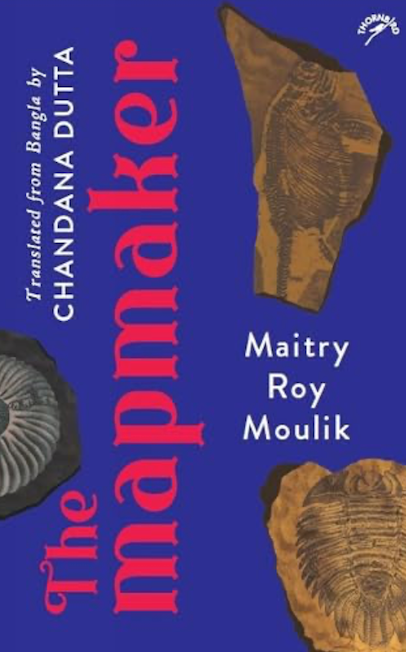
Published by Niyogi Books in 2025 and translated by Chandana Dutta, The Mapmaker is a historical novel about William Smith, the largely self-taught geologist whose painstaking investigations fundamentally altered the way England’s geological landscape was understood. The narrative moves across different periods of Smith’s life, beginning with his disappearance in 1819 before returning to his childhood, apprenticeship, friendships, marriage, professional disappointments and eventual recognition.
Yet, the novel reaches beyond the biography of a single scientist. At its core, it asks who is entitled to produce knowledge, who has the authority to claim it, and how social class can shape not only a person’s opportunities but also the historical record of their achievements.
A Life Told Backwards
The novel begins with a striking scene: a celebrated yet impoverished cartographer walks out of prison only to discover that he is unable even to gain entry to his own home. The image immediately establishes the book’s central paradox. Smith has created a geological map of immense significance, but his intellectual accomplishments have done little to alter his position as a social outsider.
He is introduced as the man who had produced geological maps showing “each layer of rock below the ground for the whole of England, South Wales and Scotland”. Yet he is simultaneously described as “unschooled, destitute and rustic, the son of a blacksmith” and consequently regarded as unfit to move among aristocrats.
The unusual narrative structure creates the atmosphere of an investigation. The reader already knows that Smith will eventually acquire importance, but the real mystery is how someone of such remarkable intellectual ability could remain so thoroughly excluded from the institutions that benefited from his work.
The chronology is intentionally discontinuous. The story moves from 1819 back to 1769 and then through the 1780s and 1790s, repeatedly returning to the nineteenth century. This fragmented structure allows the older Smith’s humiliation to be set against the curiosity, intelligence and promise of his younger self.
William Smith and the Discovery of Deep Time
The emergence of modern geology provides the novel with its intellectual centre. Smith’s achievement is portrayed as far more significant than the creation of an important map. His work challenged prevailing assumptions about the age, formation and history of the Earth.
The novel situates Smith’s intellectual journey within an era when inherited religious explanations were increasingly coming under pressure from empirical observation. The traditional account of creation in six days appears increasingly difficult to reconcile with geological evidence pointing towards an Earth of almost unimaginable antiquity.
The tension is captured particularly well in an early discussion of geology:
“how long had the universe taken to be born—six days, six years, six hundred years, or perhaps centuries?”.
Smith’s achievement consequently has both scientific and philosophical significance. His maps transform something invisible into something that can be read and interpreted. The earth beneath human feet becomes a record of its own history.
Fossils and geological strata repeatedly serve as evidence throughout the novel. Nature preserves its history in “sedimentary layers”, while fossils and the strata in which they occur provide a means of establishing relative ages. Smith’s geological map is therefore not simply a representation of physical geography. It is an attempt to reconstruct the history of the planet itself.
This is among the novel’s most compelling insights. An ordinary map tells us where things are. Smith’s map also tells us when they were formed.
The Tyranny of Birth
The deepest conflict in The Mapmaker, however, is not ultimately between religion and science. It is between merit and hierarchy.
Smith cannot entirely escape the social consequences of his origins. Being the son of a blacksmith means that his extraordinary intellectual accomplishments do not automatically grant him legitimacy among those who control Britain’s learned institutions.
The contradiction at the centre of his life is stark. Smith succeeds in uncovering the history of the Earth, while the society around him refuses to give adequate recognition to the history and identity of the person who made that discovery possible.
His friend Cary exposes the absurdity of this social system by imagining future historians deliberately removing Smith from the historical record:
“The world of the future must not know that there existed someone called William Smith, the Father of Geology.”
The irony is particularly powerful because the scientific establishment presents itself as rational and committed to evidence, yet becomes deeply irrational when faced with a scientist whose social background does not fit its expectations.
One of the novel’s strengths is its depiction of class discrimination as something that need not always involve an explicit ban. It can operate through the people who are not invited, institutions that remain inaccessible, recognition that is withheld and assumptions about who is naturally entitled to intellectual authority.
The Map and the Theft of Credit
The conflict involving George Bellas Greenough provides the novel with one of its most dramatic episodes. Smith’s work is appropriated, and a geological map is published under another man’s name. What is at stake is not simply money or professional advancement. The appropriation threatens to sever the connection between an intellectual discovery and the individual who painstakingly produced it.
The novel presents Greenough’s map as substantially derived from Smith’s earlier work, while Smith himself receives no proper acknowledgement.
This episode raises one of the book’s central questions: Who owns knowledge?
Smith has the observations and accumulated expertise. Others possess access to the institutions capable of converting those observations into recognised knowledge. That distinction is fundamental to the novel’s argument. Making a discovery does not necessarily mean receiving credit for it. Knowledge has to move through publishers, learned societies, universities, patrons and political structures—and those structures are shaped by existing relations of power.
The irony deepens as Smith’s maps gradually become impossible to ignore. His work eventually acquires public importance, forcing the very establishment that excluded him to acknowledge a contribution it had once attempted to marginalise.
The Price of Genius
The novel also resists turning Smith into a purely heroic figure. His commitment to geology comes with substantial personal costs.
He travels constantly, works with extraordinary intensity and frequently neglects the responsibilities of ordinary domestic life. His marriage to Mary Ann is particularly tragic. Her mental illness and Smith’s inability to respond adequately to her circumstances are portrayed with considerable emotional weight.
Smith himself is far from easy to admire. He can be selfish, impatient and at times cruel. During his imprisonment, he lashes out at his wife even when she brings him food, and eventually she and his nephew leave him.
This complexity is important. Smith’s suffering does not make him automatically virtuous, just as his brilliance does not excuse his personal shortcomings. The novel asks the reader to hold both realities together: he is an extraordinary scientific mind and, at the same time, a deeply imperfect husband and human being.
One of the most revealing moments comes when Smith reflects on his own prospects:
“I am destined to fail, I can never cross the line beyond food, sleep and back-breaking toil.”
The thought reveals how prolonged humiliation can become internalised. Smith is not merely being judged by society; gradually, he begins to see himself through the same limiting assumptions that society has imposed upon him.
Fate, Society and Personal Responsibility
The question of fate runs throughout the novel. Smith frequently connects his difficulties to the circumstances of his birth, but the narrator presents a more complex account of how a life is shaped:
“It is a complex mix of birth, upbringing, nature, intellect, activity, society, family, friends, well-wishers, enemies…”
This introduces an important philosophical dimension. Neither individual merit nor social circumstances, taken alone, can adequately explain the course of a person’s life.
Smith possesses exceptional ability, but that ability operates within institutions and social structures. Cary, despite his own relatively modest origins, manages to establish himself in publishing. Smith is less successful because personality, opportunity, money, circumstance and social hierarchy interact differently in his life.
The novel therefore avoids a simplistic division between innocent victim and obvious villain. Its argument is more nuanced: society distributes opportunities unequally, but people still exercise agency within the limitations imposed upon them.
Science Against Authority
Another notable feature of the novel is its portrayal of science as an activity of questioning rather than merely a body of settled knowledge. Conversations involving Erasmus Darwin, William Buckland, Sedgwick and other intellectual figures reveal a scientific culture undergoing profound change.
An early exchange begins with a deceptively simple challenge:
“what if it is not? I say, can you take me outside of this world and show me how it appears from far?”
The question captures the intellectual atmosphere of the period. Established explanations are increasingly being tested against observation, measurement and evidence.
But the novel also identifies an important contradiction. Scientific institutions can challenge religious authority while simultaneously preserving other forms of hierarchy. Those who reject one orthodoxy may remain deeply committed to another. Intellectual freedom, therefore, does not automatically produce social equality.
The Ending: Recognition Without Restoration
The conclusion offers recognition, but not a conventional victory. By 1834, Smith’s maps are displayed in the Scarborough Museum, connecting his work with an institution that preserves and acknowledges its significance.
Yet Smith himself has been physically worn down. Years spent walking, hammering rocks and conducting geological fieldwork have left lasting consequences. One character notes that work that might otherwise have required a century was completed by Smith in just sixteen years.
The final picture is deliberately quiet. Smith lives away from the centre of public attention, caring for Mary Ann and assisting local farmers. His maps endure even as he has largely withdrawn from public life.
There is therefore no complete restoration of what Smith lost. Recognition arrives late, and neither his personal suffering nor the years taken from him can be recovered.
The refusal to provide a conventional triumphant ending strengthens the novel’s emotional impact.
A Few Reservations
The novel’s considerable historical scope is also occasionally its principal weakness. The large cast, frequent movement across time and lengthy conversations can make the narrative feel somewhat diffuse. At several points, particularly during explanations of scientific and historical material, exposition takes precedence over dramatic momentum.
Some secondary figures appear primarily as embodiments of particular ideas rather than as fully rounded characters. Likewise, the opposition between aristocratic privilege and working-class ingenuity can sometimes become too explicit. At moments, the novel explains its argument rather than allowing readers to arrive at it themselves.
These shortcomings, however, do not diminish the book’s larger achievement. It takes what could have been an extremely technical account of geological history and turns it into an accessible human story by placing scientific discovery within the life of an intellectually extraordinary but personally flawed individual.
Conclusion
Ultimately, The Mapmaker is a novel about who gets remembered.
William Smith charts the physical layers of England, while the novel simultaneously exposes the social layers of nineteenth-century Britain: aristocrat and labourer, educated and unschooled, insider and outsider, celebrated scientist and neglected discoverer.
Its most significant argument is that scientific and social progress do not necessarily move together. A society can champion reason while maintaining irrational attitudes towards class. It can celebrate innovation while refusing proper credit to the person responsible for it. It can create institutions dedicated to knowledge while allowing those institutions to reproduce the prejudices embedded in the wider social order.
Smith’s tragedy therefore extends beyond his individual misfortunes. He develops a new way of interpreting the Earth, yet remains unable to completely escape the social circumstances into which he was born.
History, however, ultimately produces its own form of justice. Institutions can appropriate his work, disregard his name and attempt to diminish his importance, but they cannot permanently eliminate the evidence of what he discovered. His labour remains embedded in the landscape he mapped.
That is what makes The Mapmaker such a compelling historical novel: the map survives the mapmaker, and eventually the map forces history to remember who drew it.