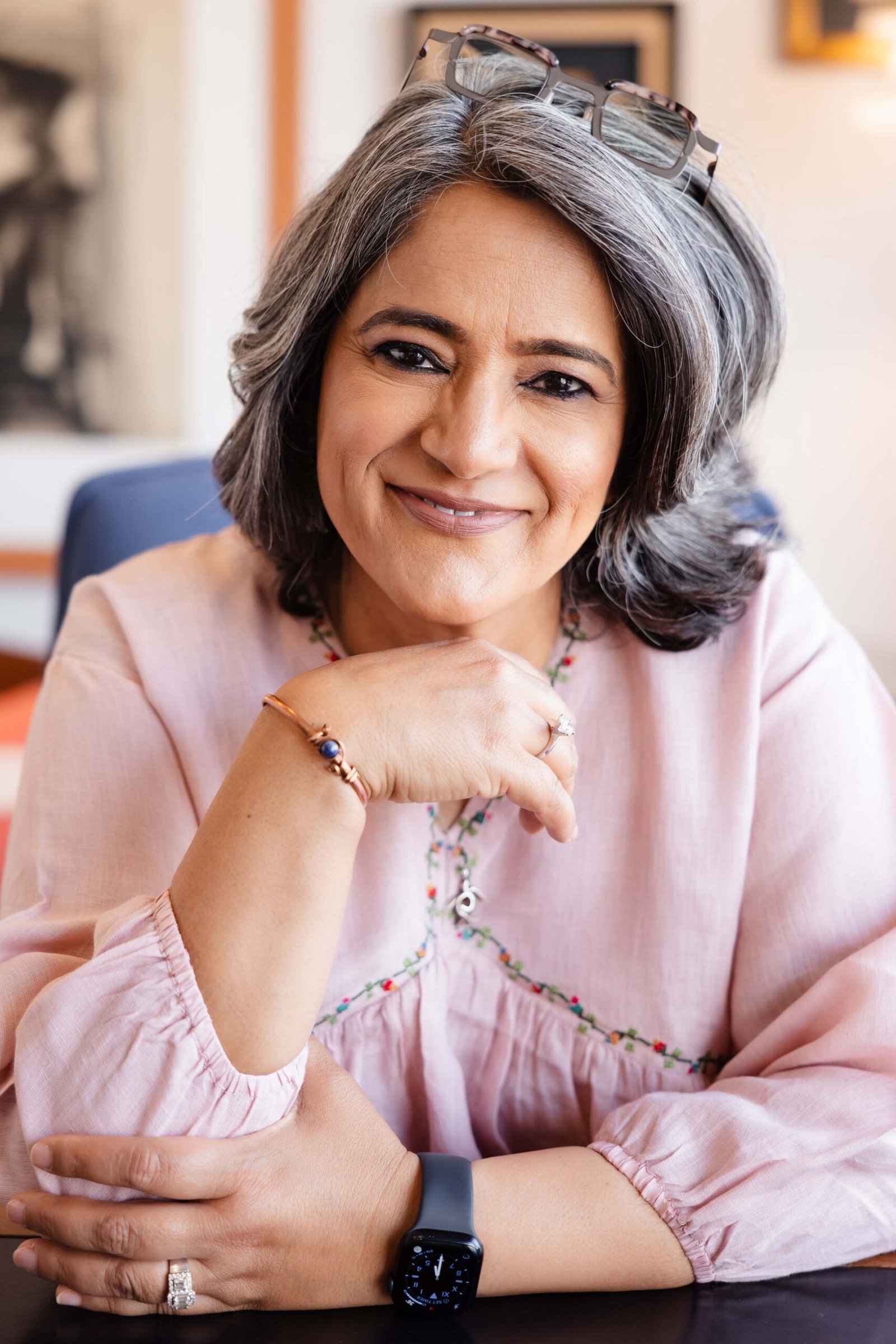
Priya Hajela lives in Pune with her husband and two dogs. Writing is a second career for her. She graduated with an MFA in Creative Writing from Goddard College in Vermont in 2017. Prior to taking to writing, Priya got an MBA from Vanderbilt University in 1992 and worked in a variety of telecom and IT organizations in senior marketing and business development roles for twenty-two years. Her debut novel, Ladies’ Tailor, was published in 2022.
Read the review of her book For Whose Dear Sake Our Fathers Died here.
NAW- The novel begins from a deeply personal idea of fathers, sons and inherited memory, but it unfolds against the enormous historical canvas of the Anglo-Sikh Wars, 1857 and colonial rule. How did you balance the intimate story of individuals with the scale of these historical events?
In my mind, our history could not have taken place without at least some of us participating. It could not have been run by the Generals and the leaders alone. Who were the people on the ground? Who were the people who ran around making things happen – following orders or defying them? I went looking for those people and I have to say, they were not easy to find. The heroes were readily available but the common soldier, the farmer turned fighter, the men and women who scraped and starved so that some good happened for them, for their children and for their country, not so much. Balancing the history and the fiction was not easy, as you yourself pointed out. At some points, the events of history pushed out my characters. This was but natural but it was those events that not only drove my story forward but they also helped the country change its shape.
NAW- You have spoken about deliberately reading British accounts alongside Indian histories rather than relying on a single version of the past. When historical sources contradict one another, how do you decide what belongs in a work of fiction—and what should remain uncertain?
I had to do this because for one thing a lot of the early accounts of these battles, particularly some of the personal diaries that were written very close to the time, were written by the British. For another, whitewashing or brown washing would help neither my story nor my characters. I tried to state in places what I believed to be true – as was the case with the massacre of women and children in Kanpur. That story, in particular, is one I had to step around carefully because certain things did happen. Who perpetrated them is in question.
NAW- The novel repeatedly complicates the idea of courage. Balwant’s courage, for example, is accompanied by fear, exhaustion, guilt and the instinct to save another human being. Were you consciously trying to move away from the conventional romantic image of the soldier and the battlefield?
I don’t think It was a conscious movement away from a conventional representation of the soldier. I just felt that it couldn’t possibly be as simple as it is often made out to be. Good war stories dig deep into the horrors of war but also into the details. How did the rescuing force know which way to go in Lucknow? How did the besieged troops fight their way out. It couldn’t have been as simple as guns blazing. It would have been slow and deliberate. The same holds for the emotional elements. Soldiers can’t all be crystal clear in their heads about the good and bad of what they are doing. Fear, exhaustion, guilt, are all human emotions that cross our minds in trying times. So why not Balwant’s?
NAW- Your women characters experience history differently from the men who fight in wars. The women in your novel carry families, preserve memories and live with the consequences of decisions made by others. Did writing these women change your own understanding of what it means to be a participant in history?
When I wrote my first novel, Ladies’ Tailor, my main character was a man. My women played important roles but weren’t as consequential as the man. I was asked why I had not spent more time with the women. It was a good question. I didn’t want to make the same mistake again. This time, I agonized over the women. They weren’t fighting wars but they also weren’t just sitting around. So, what were they doing? How did they spend their time? In delving into their lives, I did gain a deeper understanding on how events actually turn. How the steering is done by a multitude, men and women, not just one or two so called leaders.
NAW- Sindhu’s engagement with the Guru Granth Sahib is especially interesting because she is neither simply accepting nor rejecting inherited tradition. How important was it for you to portray religious identity as something that can be lived, questioned and interpreted rather than simply inherited?
It is interesting that you note this. While I was editing this book, I was asked to write a book on the lives of the Sikh Gurus, a subject I was most ignorant about. I set this one aside and took nine months to write the Gurus book (Sakhis – Parables of the Sikh Gurus). But when I came back to this, I brought a few things with me. Particularly the bit about how the Gurus lived their own lives and how religion can be just what you want it to be and not what others dictate.
NAW- The title comes from Rudyard Kipling’s “The Children’s Song”, but the novel asks us to question who exactly our fathers died for—and what later generations do with the inheritance of those sacrifices. When did you realise that the title captured the central question of the novel?
I came up with this title when the book was finished. Fully edited, run through many times and done. It was a song we sang in school. I loved the song and our rendition which was quite different from what I was able to find on YouTube now. In my last editing cycle, I had added a lot about inheritance and stories being passed down. My placeholder title – Battle Lines had become a bit not right. This song came to mind, and we decided to go with the rather long but most appropriate title.
NAW- Beant’s act of telling and preserving family stories suggests that memory itself can become a form of inheritance. Do you see storytelling as a way of recovering histories that official records; particularly histories centred on leaders, battles and political events have left out?
That is possible, of course but we’ll have to hurry up and get some of those stories told. The Partition Archives is a great example of the use of storytelling to recover history that has not been recorded or has been glossed over.
NAW- Your novel ultimately asks what remains worth fighting for when the great battles of history are over. After spending so many years researching this period and living with these characters, what question from the novel do you hope stays with readers after they have finished the last page?
That there is always something worth fighting for. That if life is too easy, you are doing it wrong.
NAW- What are you reading currently? What do you do apart from writing?
I am reading John of John by Douglas Stewart and Hocus Pocus by Brinda Charry. Brinda and I are scheduled to be in conversation at the Indian American Arts Council Literary Festival in NYC in November. I’m also reading Daniyal Mueenuddin’s This is Where the Serpent Lives, a book that has disturbed me more than others and one that I have to put down and pick up after a break.
NAW- Please name five of your favourite authors.
Amitav Ghosh, Ann Patchett, Elif Shafak, Tayari Jones, Don Winslow