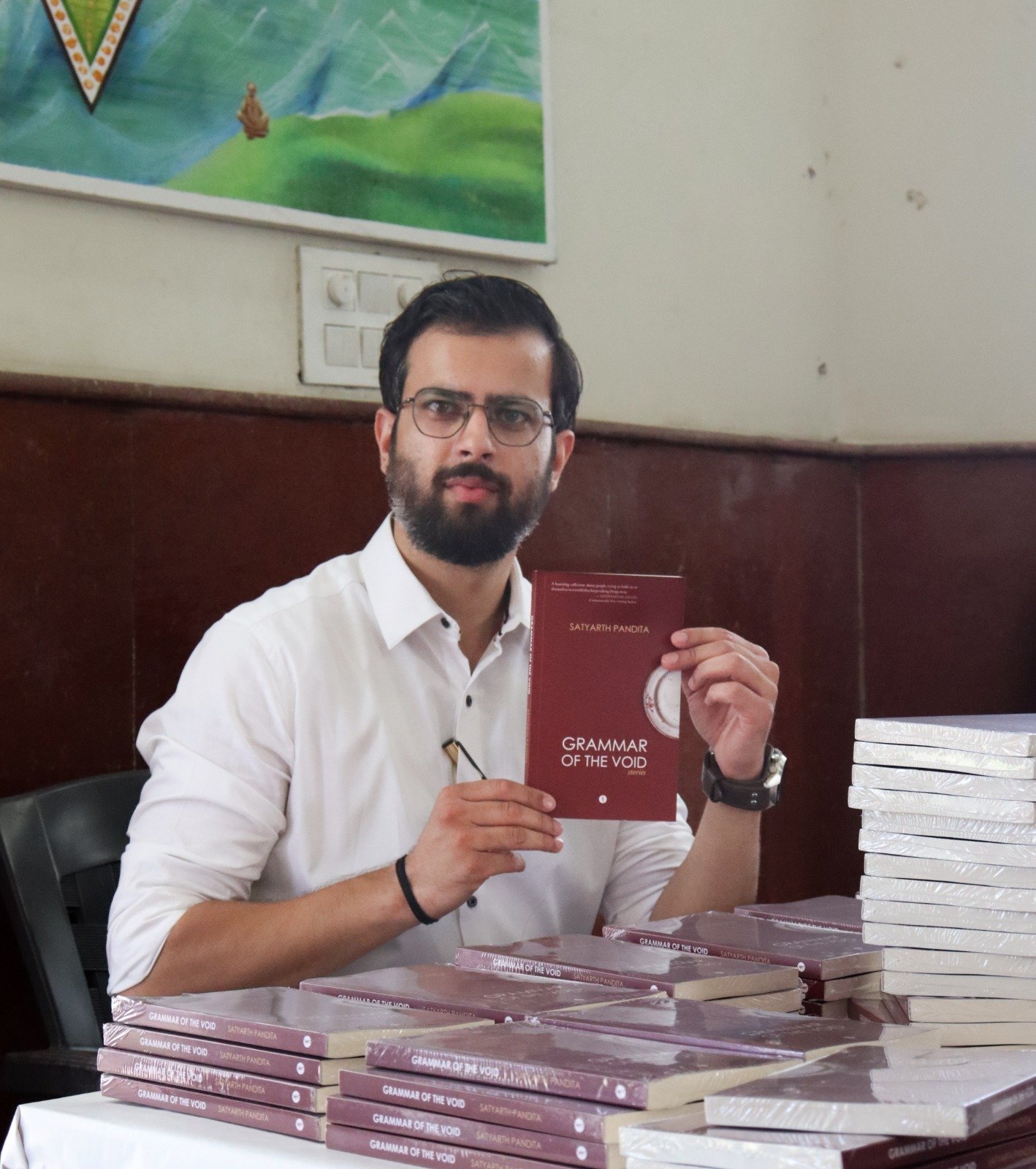
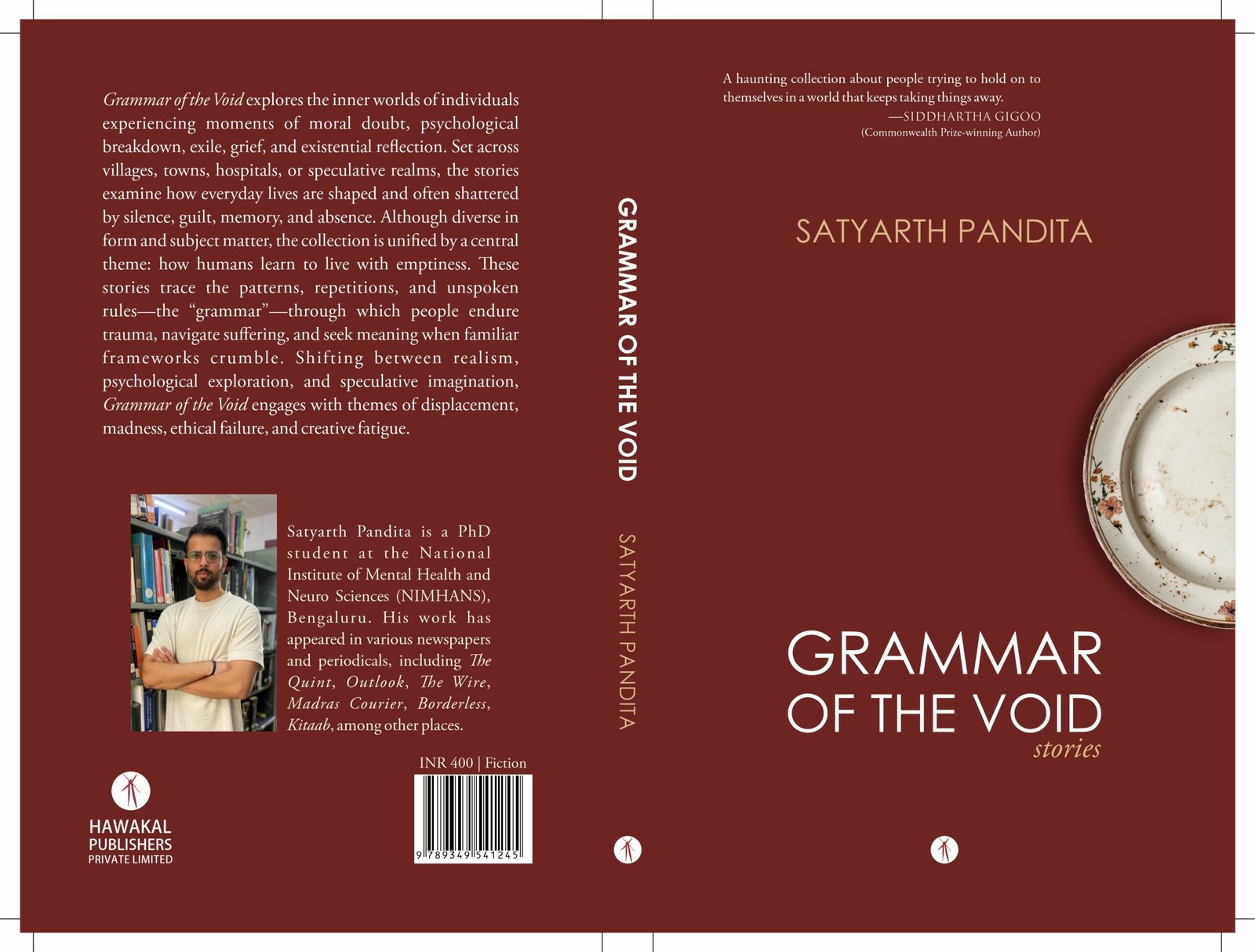
Satyarth Pandita is the author of the book Grammar of the Void: stories (2026). He is pursuing his PhD in Biophysics from the National Institute of Mental Health and Neuro Sciences (NIMHANS), Bengaluru. He completed his dual degree, a Bachelor of Science and Master of Science in Biological Sciences (major) and Humanities and Social Sciences (minor), from the Indian Institute of Science Education and Research Bhopal (IISERB). His works have appeared in various newspapers and periodicals, including The Quint,Outlook, The Wire, Madras Courier, Borderless, and Kitaab, among others.
Read the book review here.
NAW- The idea of the “void” seems to be at the heart of the collection. What did the void initially mean to you when you began writing these stories, and did its meaning change as the book developed?
First of all, I would like to thank NAW for the apt and comprehensive review of my book published this month, and for giving me this opportunity to connect with your readers.
Initially, the void was not something I consciously set out to explore. I had been writing stories since my school days, and over the years I accumulated quite a few of them. Some were published, others unpublished. Those stories were quite diverse in form and genre. I was also experimenting a great deal at the time. Even then, I did not have any plan to bring out a short story collection, as I was working on a novel and I expected that to be my first book.
It was only in 2025, when I revisited the stories that I had published alongside the new stories that were sitting in my drafts, that I could see a book taking shape. Then I began refining those stories, and during the revisions, I realized that the stories written over a span of almost ten years were, strangely enough, unified by a common theme: absence, or the void.
The characters, settings, or ideas in the stories seemed to reflect different kinds of void- existential, technological, psychological, or related to identity. It was not something I had consciously designed. It just happened.
So, even when the book was complete, I don’t think my idea or meaning of void changed so much as it assumed its final form. I began to see that the different stories were perhaps approaching the same absence from different directions.
NAW- How would you describe your creative process? Do you usually begin with an idea, a character, an experience, or something else?
My mind is never at rest. It is continuously hunting for ideas. It will not stop even if I tell it to. So, I generally let it run wild. I manipulate it when necessary, feed it inputs, and it, in turn, generates ideas for me. Those inputs are usually observations and questions.
For me, a story can begin with something as small as an observation. Breath with Interruptions, for instance, begins with the observation of a character’s uneasiness. The idea of Pirouette began during my master’s when I was working with fruit flies. It began with the image of a mutant Drosophila spinning in endless, erratic circles until it eventually starves to death.
Being a research student, I also sometimes try to synthesize a story from a question.
Synapse, for example, is built almost entirely around a simple question: what would happen if we stopped dreaming? The rest of the story develops from that question.
I am reminded here of Paul Valéry’s idea of une ligne donnee―the idea that one line is given to the poet by God or by nature; the rest he has to discover for himself. But, for a writer, I believe, ideas and themes are constantly flying in the air around us. Therefore, all I do is try to look around, catch one, and meditate upon it.
NAW- There is a strong interest in human vulnerability throughout the book. What do you think fiction can reveal about vulnerability that other forms of writing cannot?
I think fiction allows us to experience vulnerability rather than merely understand it. We can read an essay about grief, displacement, loneliness, ageing, or fear and understand the argument intellectually. But fiction can place us inside the consciousness of someone experiencing those things. It can make us inhabit a mind that is not our own. I think this is one of the peculiar powers of fiction: it allows us to enter the private spaces of other human beings. Spaces that are often inaccessible to us in real life. A character can think things that they would never confess, remember things they would rather forget. We are allowed to witness all of it without the character having to explain themselves to us.
NAW- Many of the stories deal with memory, particularly memory that refuses to remain in the past. What interests you about the relationship between memory, trauma and the present?
I think memory and absence are intimately connected. We remember precisely because something is no longer there. A person, a place, a time. Memory becomes a way of keeping company with something that has disappeared. But memory does not always preserve things intact. It leaves gaps. It distorts, fragments, and sometimes invents. And those gaps can become as important as what remains. That is particularly interesting to me in relation to trauma. There are experiences that a person desperately wants to forget but cannot, and there are others that the mind seems to protect itself from remembering completely. In both cases, the past remains present through what is remembered as well as through what is missing. Perhaps that is why memory appears in several forms throughout the collection.
NAW- Kashmir appears not simply as a geographical setting but as a landscape of memory, displacement and loss. How much did your own relationship with Kashmir influence the emotional and thematic world of the collection?
I was born in exile. I was brought up with memories of home, of Kashmir. I have imagined my ancestral home through the stories of my parents and grandparents. I collect those memories as different pieces of a jigsaw puzzle and try to create one final image, which is still a blur.
That, in itself, is another form of void. A void of belonging.
Perhaps this is why Kashmir in my writing is not merely a geographical location. It is also something imagined, remembered and reconstructed. It is a place that exists partly through stories told to me, through fragments of memory, and through the things that are absent.
In that sense, the Kashmir I write about may sometimes be less a physical place than an attempt to understand what it means to inherit a home through memory.
NAW- Science appears repeatedly in the collection. What attracts you to using scientific ideas as a way of exploring philosophical and human questions?
I think science and literature are two different ways of looking at the same mystery: existence. Science gives us remarkable ways of understanding how things work. Literature asks what those things mean to us. And sometimes the boundary between the two becomes very interesting.
As a neuroscience research student, I spend a considerable amount of time thinking about biological systems, the brain, neurons, behavior, and the mechanisms underlying life. But scientific facts often generate philosophical questions in my mind. What is consciousness? What constitutes identity? What happens when something fundamental to our existence is altered? A scientific idea can therefore become the seed of a fictional question. I am not particularly interested in using science merely as a decoration or technical detail. What interests me is taking a scientific premise seriously enough to follow it into the human and philosophical territory that lies beyond the laboratory. If a scientific possibility forces us to reconsider something we take for granted about memory, identity, consciousness, or mortality, then it becomes fertile ground for fiction.
In that sense, science gives me the question, while fiction allows me to explore its consequences.
NAW- The collection moves between realism, psychological fiction, mythology, and speculative fiction while maintaining a focus on human vulnerability. How do you decide which form or genre is right for a particular story?
I don’t think I consciously choose a genre first. The story usually dictates the form it needs. If an idea can be contained within a realistic situation, I don’t see a reason to make it speculative. But sometimes the premise itself demands another kind of world. A scientific question may require speculative fiction. Similarly, a psychological experience may work better through an altered or unreliable reality. I don’t think these forms are as separate as we often imagine them to be.
NAW- This is your debut collection. Looking back at the book now, is there anything about your voice, structure or approach that you would handle differently, and what kind of writer do you hope to become with your next work?
I don’t think I would change anything. I made a conscious choice to retain the language, structure, and style of some of my stories that had been previously published. I could have revised them according to my current intellectual ability, but that would have changed them entirely. I wanted to preserve them in their original form because they reflected my own state of writing at that particular time.
In a way, the collection is also a record of how I changed as a writer over those years. I didn’t want to erase that history in the process of making the book more uniform.
As for what kind of writer I hope to become, I hope that my subsequent work establishes that I have something worthwhile to say―something that respects the reader’s time. As of now, I write primarily for myself. But I do hope that my work will eventually influence people in some good way.
As Bhavabhuti says:
“…I don’t write for them
But for that soul, twin to mine,
Who will be born tomorrow.
Time is long, and the world is wide.”
NAW- Please name five of your favourite authors.
I have always wondered about this question. I have asked myself many times: what does a favourite writer actually mean to me? Does it mean that I love every work of theirs? Does it mean I love them in their real life as well? If I like one book by an author but not all their books, would that still make them a favourite?
So I don’t really have favourites in the conventional sense. But there are, however, many writers whom I deeply admire and whom I return to for different reasons.
Recently, I completed Report to Greco by Nikos Kazantzakis, and, my God, what an extraordinary book that was. It answered many questions I had been carrying with me. I haven’t read any other work by him yet, but I have certainly come to love Kazantzakis through this one book.
I love Dostoevsky because he taught me how deeply literature can enter the human psyche.
I love Octavio Paz, especially for his book The Monkey Grammarian. He taught me how to endow prose with the nectar of poetry.
I love Georges Perec for his experimental work, particularly Species of Spaces and Other Pieces. He taught me how to appreciate the infra-ordinary in everyday life and how stories often lurk in the mundane and the unobvious.
And lastly, I would love to add Jorge Luis Borges, because he showed me how an enormous philosophical idea can be contained within a deceptively small story.
NAW- What are you reading currently? What do you do apart from writing?
I am currently reading multiple books. Initially, I tried reading one book at a time, but that didn’t work out for me. I need multiple things to stimulate my mind.
At present, I am halfway through An Experiment with Time by J. W. Dunne, Correction by Thomas Bernhard, Consciousness Explained by Daniel Dennett, Today I Wrote Nothing by Daniil Kharms, and some of my academic favourites, such as Principles of Neural Science by Prof. Eric R. Kandel and his co-authors.
I suppose my reading habits reflect the way my mind works. I don’t like keeping science and literature in separate compartments.
Apart from writing, I am involved in academic research where I study cognition and memory using laboratory rats. A large part of my time therefore goes into reading, thinking, and research. In some ways, I don’t know where one activity ends and the other begins. Even when I am not writing, I am usually observing, reading, or asking questions, and those eventually find their way back into my writing.