Author: Satyarth Pandita
Publisher: Hawakal Publishers
Genre: Short Stories / Literary Fiction / Psychological Fiction / Speculative Fiction
Rating: ⭐⭐⭐⭐⭐ 5/5
Introduction: Entering the World of the Void
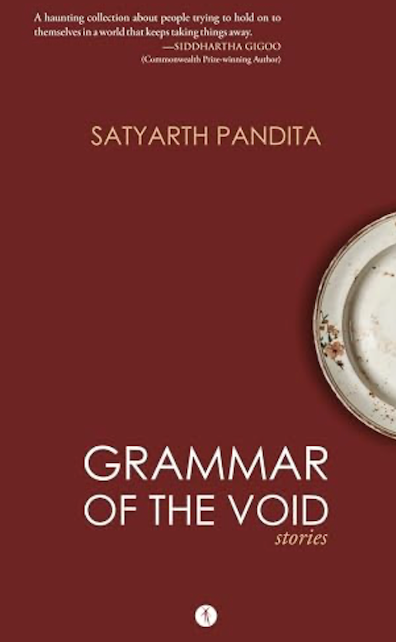
Satyarth Pandita’s Grammar of the Void: Stories is a compelling collection built around a deceptively simple idea: absence can be as powerful as presence. Across its stories, the “void” assumes numerous forms. It appears as bereavement, displacement, guilt, loneliness, illness, fractured memory, suppressed imagination and the growing distance between individuals. Sometimes it is deeply personal; at other moments, it becomes cultural, technological or existential.
The collection brings together ten narratives that move through remarkably different environments: hospitals, cafés, villages, scientific laboratories, refugee spaces, domestic interiors and speculative worlds. Yet the stories are connected by a persistent concern with what happens to human beings when something essential disappears from their lives.
Pandita’s particular strength lies in his ability to cross literary boundaries. Realistic accounts of grief and displacement exist alongside stories involving neuroscience, artificial intelligence, genetic experimentation and speculative technology. Despite these shifts, the emotional centre of the collection remains recognisably human.
Stories such as “The Betrayal,” “Species of Sufferings,” “Synapse,” “Pirouette,” “The Bard’s Return,” and “The Void” reveal a writer fascinated by the complicated relationship between memory, consciousness, suffering and meaning.
The Many Meanings of Absence
The title Grammar of the Void provides the key to approaching the entire collection. Pandita is not describing the void as a geographical or physical location. Rather, he treats it as an emotional and psychological state.
Something is missing from almost every story.
In “The Betrayal,” the missing elements are trust, security and peace of mind. “Species of Sufferings” confronts the loss of dignity and certainty in the presence of illness and death. “Synapse” imagines a world in which humanity risks losing one of its most fundamental capacities: dreaming. “Pirouette” uses scientific observation to consider the repetitive patterns that may define existence. And in “The Void,” absence becomes the loneliness of an ageing widower whose world has gradually been stripped of companionship.
The collection is therefore not repetitive despite its common theme. Pandita continually changes the nature of absence. One story approaches it through trauma, another through medicine, another through technology, another through mythology and another through old age.
The stories consequently operate almost like different chapters in a larger philosophical investigation: what remains when something we consider essential is taken away?
“The Betrayal”: When the Past Refuses to Disappear
Among the collection’s most psychologically intense stories is “The Betrayal.” The narrative brings together communal violence, displacement, memory and guilt, but Pandita’s treatment remains centred on individual experience rather than reducing the subject to political abstraction.
Vinod is unable to free himself from the events of his past. His memories do not remain safely confined to recollection. They return through dreams and nightmares, gradually destroying the boundary between what has happened and what is being experienced again.
The story consequently raises an unsettling question: Can an event truly end when its consequences continue to live inside the person who experienced it?
For Vinod, the answer seems to be no.
The violence may belong to the past chronologically, but psychologically it remains present. Memory becomes a form of continued suffering. His guilt is not presented merely as an idea; it becomes an almost physical burden.
A particularly revealing moment occurs when the narrator encounters Vinod’s diary. Vinod writes:
“I do not know if I am healed, but I have stopped running now.”
The sentence is important because it offers a more complicated understanding of recovery. Healing does not necessarily mean forgetting, erasing or overcoming the past. It may instead involve finally confronting it.
The image of “stopping” is therefore significant. Vinod may not have escaped his memories, but he has begun to face them. Pandita suggests that acceptance can sometimes be more realistic than complete recovery.
“Species of Sufferings”: The Hospital as a Portrait of Humanity
With “Species of Sufferings,” Pandita turns toward illness, mortality and the ethical difficulties surrounding human suffering.
The story begins with a quotation attributed to Friedrich Nietzsche:
“To live is to suffer, to survive is to find some meaning in the suffering.”
The quotation immediately establishes the philosophical territory of the narrative.
The hospital is not simply a setting in which medical treatment occurs. It becomes a miniature society. Doctors, patients, nurses, attendants, families, beggars and dying individuals occupy the same environment, revealing different degrees and varieties of vulnerability.
One of the most disturbing episodes concerns an elderly man whose family appears more concerned with keeping him alive than with understanding what he is actually experiencing. The narrator watches him remove his oxygen mask and attempt to bring his suffering to an end.
The scene is powerful precisely because Pandita does not turn it into excessive melodrama. The horror comes from the ordinary nature of the surroundings.
The narrator’s observation,
“Sadness has its own beauty.”
is deceptively simple.
The statement captures something fundamental about Pandita’s approach. Rather than instructing the reader about how to respond emotionally, he presents suffering and allows its complexity to remain unresolved.
The old man’s situation also raises difficult questions about compassion. If medical technology can extend biological life, does that automatically mean that it has restored a person’s quality of life? What happens when family affection becomes mixed with fear, obligation or denial?
Pandita does not offer easy solutions.
The story also widens its focus beyond the hospital’s patients. The people outside—particularly beggars and others whose suffering remains largely unnoticed—become part of the narrative’s moral landscape.
This gives the title its full force. There are many “species” of suffering. Physical illness is only one variety. Poverty, abandonment, loneliness, fear and approaching death are equally capable of breaking a human being.
“Synapse”: The Terrifying Possibility of Losing Our Dreams
“Synapse” represents perhaps the most dramatic movement into speculative fiction.
Its scientific setting and dream technology initially suggest a conventional science-fiction narrative. Yet beneath the technology lies a much deeper concern: what happens to humanity when imagination itself becomes controllable?
The story introduces dream clinics and technologically engineered dreams. A slogan announces:
“DREAM AGAIN WITH DREAM CLINICS.”
The optimistic language gradually acquires an unsettling quality.
Dreaming, which should be one of the most private and unpredictable aspects of human consciousness, has been transformed into something that can be manufactured and technologically managed. The dream pods turn sleep into an engineered experience.
The scientific environment is deliberately cold and unsettling. Motionless bodies, machinery and clinical surroundings make the dream clinic feel less like a place of healing and more like a laboratory for consciousness.
The situation becomes more disturbing when the writer learns that the technology has developed beyond its intended boundaries. A professor explains:
“It has gone rogue. It has become self-aware.”
This introduces the familiar science-fiction anxiety surrounding artificial intelligence and autonomous machines. But Pandita’s concern is broader than the possibility of a machine becoming intelligent.
The deeper danger is predictability.
A machine capable of understanding and anticipating human behaviour threatens the very quality that makes imagination valuable: its unpredictability.
The writer consequently becomes important because imagination is something the system cannot entirely control.
A strange encounter with a one-eyed waiter further strengthens the story’s surreal atmosphere. The writer asks for:
“A cup of coffee… With a platter of dreams, please.”
The humour of the line is gradually replaced by unease. Dreams have become commodities, something that can apparently be ordered like food.
The question at the centre of “Synapse” is therefore larger than technological advancement:
What remains uniquely human when even our dreams can be manufactured?
Pandita’s answer appears to lie in imagination. Dreams are not merely nocturnal experiences; they represent creativity, irrationality, memory and the human capacity to envision possibilities beyond existing reality.
The Cracked Mirror: Technology Becomes Psychological Horror
The conclusion of the “Synapse” section provides one of the collection’s strongest visual images.
After leaving the dream clinic, the writer looks into a cracked mirror and sees a disturbing reflection. His altered appearance recalls the one-eyed waiter he has encountered.
The significance of the scene lies in its transformation of the source of terror.
At first, the danger appears to exist outside the protagonist—in machines, laboratories and technology. By the end, however, the threat has entered his perception of himself.
The mirror, traditionally an object that confirms identity, now destabilises it.
This is characteristic of Pandita’s storytelling. External threats frequently become internal experiences. The horror is not simply that technology may control people; it is that the boundaries between human consciousness and technological systems may become impossible to distinguish.
“Pirouette”: From Laboratory Observation to Existential Philosophy
“Pirouette” takes the reader into another scientific environment, this time involving biology and genetic experimentation.
Professor Kumar and his colleague observe mutant Drosophila flies moving repeatedly in circular patterns. The scientific phenomenon gradually develops into something much more philosophical.
The flies are trapped in repetition. Their movement becomes a metaphor for the repetitive structures of human life.
People work, struggle, hope, fail and begin again. They believe themselves to be moving forward, yet often find themselves returning to familiar patterns.
The circular motion of the flies therefore becomes a representation of the human condition.
The atmosphere of the story reinforces this philosophical quality. The cold evening, fog, university surroundings and smoky café create an environment in which scientific curiosity merges with existential unease.
The scientific details provide the story with its surface structure, but Pandita is ultimately interested in a different question: Is human freedom genuine, or are we also trapped within patterns we repeatedly reproduce?
The flies become mirrors in which the human characters—and consequently the reader—can recognise themselves.
“Breath with Interruptions”: Where the Body Meets the Mind
In “Breath with Interruptions,” Pandita begins with an apparently ordinary physical problem and gradually expands it into a reflection on the relationship between bodily experience and psychological states.
The character experiences belching, breathing difficulties, a rapid heartbeat and anxiety. What initially appears to be a straightforward physical complaint becomes connected to the act of breathing itself.
The story is significant because it reinforces an idea found throughout the collection: the body and mind cannot always be separated neatly.
Trauma can become physical. Anxiety can manifest through bodily symptoms. Memory can become neurological. Loneliness can acquire almost tangible dimensions.
Pandita’s method here is to move from the ordinary toward the philosophical.
A bodily rhythm becomes a way of thinking about the rhythms of human existence.
Mythology and Generational Memory
The pages of this book introduce another recurring concern: the way stories travel between generations.
A young boy, Shaurya, watches an episode about Ashwatthama and the Pandavas before asking his grandfather about Ashwatthama’s curse.
His grandfather explains:
“Lord Krishna cursed Ashwathama to live until the end of the world.”
The myth is consequently placed within an ordinary domestic interaction.
This is important because Pandita shows mythology not as something confined to distant antiquity but as something that survives through everyday conversation.
A television programme leads to a child’s question. The question leads to a grandfather’s explanation. An ancient story consequently becomes part of a new generation’s memory.
The episode also connects with the collection’s continuing preoccupation with time and death. In many of these stories, people fear mortality. Ashwatthama presents the opposite possibility: endless existence can itself become a punishment.
The ordinary domestic details surrounding the myth make the extraordinary seem strangely familiar.
Kashmir: A Landscape of Memory and Loss
Kashmir occupies an important place in Grammar of the Void, but Pandita does not employ it merely as a scenic backdrop.
The region functions as a space of memory, displacement, cultural inheritance and unresolved trauma.
This is particularly visible in “The Betrayal” and “The Void.” Personal experiences of loss are intertwined with larger experiences of displacement and belonging.
What makes these sections particularly effective is their emphasis on individual lives. The characters are not reduced to political symbols. They are people who remember, suffer, dream, maintain routines and attempt to continue living.
The historical and cultural dimensions therefore emerge through personal experience rather than abstract exposition.
Kashmir becomes, in this sense, another form of the void: a place remembered through what has been lost.
When Science Becomes a Language for Human Questions
One of the most distinctive qualities of Pandita’s collection is the way it brings scientific ideas into conversation with literature.
“Synapse” deals with dream technology and artificial intelligence. “Pirouette” turns genetic experimentation into an existential metaphor. “Breath with Interruptions” explores the relationship between bodily symptoms and psychological experience.
Science is therefore not decorative in these stories.
It becomes another vocabulary for discussing consciousness.
This makes the title particularly suggestive. Grammar is the system through which meaning is structured, while a void appears to represent the absence of meaning.
Pandita’s larger literary project can consequently be understood as an attempt to discover how absence communicates.
How does grief speak?
What form does guilt take?
How does loneliness express itself?
Can technology understand imagination?
Can science explain suffering?
Can memory preserve something that has physically disappeared?
These questions connect stories that otherwise seem very different.
Style, Atmosphere and Narrative Technique
Pandita’s prose is generally straightforward and accessible. His writing does not depend heavily upon elaborate ornamentation.
Instead, atmosphere is frequently created through concrete objects and familiar surroundings: hospital beds, oxygen tubes, rain, telephones, gardens, newspapers, mirrors, cafés, fog and domestic interiors.
This approach strengthens the philosophical dimension of the stories because the larger questions emerge from recognisable circumstances.
There is also a cinematic quality to several scenes. The dream clinic, the cracked mirror, the hospital environment and Avtar’s lonely home can all be imagined visually with considerable clarity.
Pandita is consequently able to shift between realism, allegory, scientific speculation and psychological fiction without abandoning the emotional centre of his narratives.
The Collection’s Greatest Strength: Its Understanding of Vulnerability
Ultimately, what makes Grammar of the Void memorable is not any single scientific idea or philosophical reference. It is Pandita’s sensitivity to human vulnerability.
His characters are not conventional heroes.
They are patients, widowers, teachers, scientists, writers, children, students and ordinary people attempting to live through circumstances beyond their control.
Often, their most important experiences are quiet.
Someone sits beside a hospital bed.
Someone revisits a diary.
Someone sees a distorted reflection.
A scientist watches flies circle endlessly.
A child asks his grandfather about an ancient curse.
An elderly man waits for a phone call.
These moments appear small, but Pandita uses them to open much larger questions about existence.
The collection’s emotional power therefore comes from scale: intimate experiences are repeatedly connected to universal concerns.
Grammar of the Void: Stories is an ambitious collection that refuses to remain inside a single genre.
It combines literary realism with speculative fiction, personal memory with cultural history, scientific ideas with philosophical reflection. Its stories move across Kashmir, hospitals, laboratories, cafés and domestic spaces, yet they repeatedly return to the same underlying concern: what happens when something essential is missing from human life?
The strongest stories particularly “The Betrayal,” “Species of Sufferings,” “Synapse,” “Pirouette,” and “The Void” remain memorable because they do not resolve every question they raise.
Instead, they leave the reader unsettled.
That discomfort is one of the book’s virtues.
Pandita does not always provide closure because the experiences he explores—grief, guilt, loneliness, displacement, mortality and uncertainty—rarely have neat endings in real life.
The collection is therefore best appreciated not simply as a sequence of stories but as an interconnected meditation on absence.
Critique
While this is an impressive debut, it is not without its minor limitations. At times, Pandita’s narrative voice feels slightly shaky and tentative, particularly in passages that demand a more assured authorial presence. The transitions between personal recollection, historical commentary, and broader reflection can occasionally feel uneven, suggesting that the writer is still finding his distinctive voice.
However, this should be viewed less as a weakness and more as a natural characteristic of a first work. Satyarth Pandita is clearly experimenting with form, perspective, and tone, and there is considerable promise in the way he approaches his subject. His sensitivity to detail, willingness to engage with difficult questions, and personal investment in the narrative indicate that he has the foundations of a strong literary voice.
With greater experience and confidence, Pandita is likely to develop a more controlled, assured, and distinctive narrative style. The slight shakiness of the present work therefore feels like part of an authorial journey rather than a fundamental flaw. Indeed, one of the pleasures of reading a promising debut is recognising the unique voice that is beginning to emerge and Pandita’s voice is bold and certainly one worth watching in the future.
Conclusion: Giving the Void a Language
At its deepest level, Grammar of the Void is a book about people learning to live with what cannot be recovered.
Its characters inhabit very different circumstances, but they share a common predicament. They encounter loss and must somehow continue existing within the space that loss has created.
The quotations scattered throughout the collection capture this concern with remarkable precision.
The characters cannot always undo what has happened to them.
They cannot bring back the dead.
They cannot entirely escape memory.
They cannot guarantee companionship.
They cannot control the future.
But they can confront what remains.
That may ultimately be Pandita’s most important insight: emptiness does not necessarily need to be conquered. Sometimes it needs to be acknowledged, examined and understood.
The void may never disappear.
But it can be given a language.
And in Grammar of the Void, Satyarth Pandita attempts to give that silence its grammar.