Rating: ⭐⭐⭐⭐⭐ (5/5)
A Memoir That Transforms Memory into History
Some memoirs seek merely to preserve the story of an individual life, while others succeed in preserving an entire vanished world. The Maker of Eternity belongs firmly to the latter category. Suresh Chandra Guha’s memoir is, on the surface, a deeply personal account of childhood, family, education and growing up in Bengal and Assam. Yet beneath these intimate recollections lies something much more expansive: a vivid record of an India that has largely disappeared.
What makes the memoir particularly compelling is Guha’s ability to place his personal experiences within the larger historical circumstances of his time. His childhood unfolds against the backdrop of colonial rule, the First World War, the Swadeshi movement, epidemics, changing urban landscapes, communal tensions and the gradual transformation of Bengal and Assam. Places such as Dhaka, Guwahati, Barishal, Chittagong and Krishnanagar are not merely locations on a map. In Guha’s recollections, they become repositories of memory, carrying within them the experiences of generations.
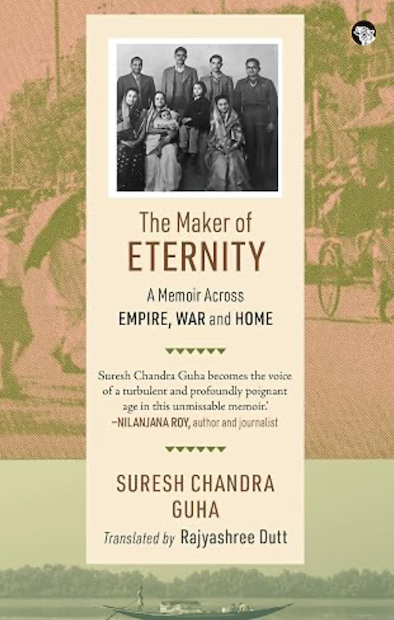
The significance of the title, The Maker of Eternity, becomes especially poignant in Rajyashree Dutt’s introduction. Although she acknowledges that she was not particularly close to her grandfather, she discovers through his manuscript an extraordinary life concealed behind the ordinary figure she had known. She writes, “I have to admit, I was never close to my grandfather”.
This admission establishes the emotional foundation for what follows. The book is not simply a sentimental family portrait. It is an effort to rediscover a person, understand his experiences and, through him, recover an entire historical era.
The Extraordinary Within an Ordinary Life
One of the memoir’s greatest strengths is its focus on ordinary individuals. Guha’s grandfather is not transformed into a legendary hero. Instead, his significance emerges naturally through his habits, principles, professional life and relationships with others.
Dutt describes him as a disciplined and intelligent man who lived through remarkable circumstances without necessarily viewing himself as remarkable. She recalls that he was “a simple man in his habits but not simple in anything else”.
This observation serves almost as a key to understanding the entire memoir. Guha’s world is populated by people who may never have found a place in conventional historical accounts, yet whose lives reveal extraordinary courage, generosity, resilience and wisdom.
The introduction concludes with another particularly memorable observation, in which Dutt describes her grandfather as “an ordinary man who lived such an extraordinary life”.
The memoir consequently questions the conventional idea of who makes history. History is not created exclusively by rulers, politicians, generals and celebrated public figures. It is also shaped by teachers, postal employees, doctors, villagers, travellers, families and children who experience the consequences of enormous historical transformations simply by living through them.
Childhood as a Window into a Vanished India
The section titled “My Childhood” is among the most evocative portions of the memoir. Through recollections of school, teachers, classmates and family life, Guha recreates the social atmosphere of the early twentieth century with remarkable immediacy.
Education during this period was strict and, at times, unforgiving. On his first day at school, the young narrator encounters Bankim Babu, a teacher whose teaching methods involve memorisation, discipline and physical punishment. The classroom becomes, in effect, a miniature representation of an educational system vastly different from the one familiar to contemporary readers.
Yet Guha recalls these experiences without resentment. Even a painful incident involving a cigarette becomes an “indelible lesson” that remained with him throughout his life.
This reflective quality defines the memoir. Guha does not simply recount events; he considers what those events taught him and how they shaped his understanding of life.
The school episodes are particularly effective because of their attention to everyday details: wooden benches, slates, multiplication tables, teachers carrying canes, classmates arriving late and the fascination children felt towards unusual or eccentric adults. Such seemingly insignificant details give the narrative its sense of authenticity and allow readers to enter the world of Guha’s childhood.
Family, Memory and the Foundations of Belonging
The early chapters also devote considerable attention to ancestry and family history. In “My Great-Grandfather: Parbaticharan Basu,” Guha moves further into his family’s past and introduces a figure remembered for his generosity, principles and concern for the wider community.
One of the most revealing episodes concerns Parbaticharan’s decision to construct a reservoir so that villagers could obtain clean drinking water. He undertakes the project despite financial difficulties and even returns home after an extended absence when he is unable to recover money owed to him.
The episode reflects one of the memoir’s recurring moral ideas: the value of a life should not be measured solely by material wealth but also by what one contributes to the lives of others.
The reservoir consequently takes on a symbolic significance. Water is indispensable to human survival, but here it also represents inheritance. Parbaticharan leaves behind something more meaningful than property—he leaves behind an improvement in the lives of the people around him.
Bengal and Assam as Living Characters
The chapter “The East” substantially broadens the memoir’s scope. What begins as a family narrative develops into an account of the political, social and geographical history of eastern India.
Guha discusses the partition of Bengal and the creation of Eastern Bengal and Assam in 1905. He describes administrative changes, the development of roads and institutions and the arrival of officials and professionals.
Yet colonial history is never presented simply as a sequence of dates and political developments. Guha repeatedly demonstrates how administrative and political decisions affected ordinary people.
The Swadeshi movement, increasing communal tensions and episodes of violence appear alongside childhood memories. Political developments that might seem distant in historical accounts are shown here as forces capable of disturbing communities that had previously lived peacefully together. The narrator remembers how communal harmony could suddenly fracture and how violence could become part of everyday existence.
This interweaving of personal experience and political history is one of the defining features of the memoir. It allows the reader to understand history not merely as something that happened in government offices or political movements, but as something experienced within homes, schools and communities.
Guwahati and the Transformation of a City
The descriptions of Guwahati are especially fascinating because they capture the city during an important period of transformation.
The journey from Dhaka towards Guwahati takes the narrator through river routes, railway stations, forests and rural landscapes. Throughout these recollections, the Brahmaputra occupies a central place in the geographical imagination. The river is much more than a backdrop: it influences travel, occupations and the rhythm of everyday existence.
Guha writes that “The road along the Brahmaputra was the most important” road in the city.
He also recalls the extraordinary tranquillity of the landscape, describing the evening scenery beside the river in terms that suggest it was almost beyond verbal expression.
These recollections are especially valuable because they preserve a Guwahati that has largely vanished. Guha describes forests, hills, sparse settlements, the Brahmaputra and small communities before rapid urbanisation transformed the region.
At the same time, he records the gradual expansion of the city, as houses, offices, hotels and factories began appearing with the growth of the population.
In this way, the memoir becomes an unintended piece of urban history. Guha is not consciously writing a history of Guwahati, yet his memories preserve a record of how the city looked and felt before modern development altered its character.
Colonial India Beyond Simple Judgements
One of the memoir’s most impressive qualities is its nuanced portrayal of colonial India. Guha does not reduce the period to a straightforward conflict between British rulers and Indian subjects.
His recollections include British officials, Indian administrators, teachers, doctors and ordinary citizens. While some colonial officials are remembered as harsh or insensitive, others are recalled for their integrity, compassion and dedication to their responsibilities.
The account of Nicholas Beatson Bell is particularly striking. During a cholera epidemic, Bell is remembered as personally helping to carry bodies when the crematorium could no longer cope with the number of deaths.
The episode complicates any simplistic understanding of colonial society. It suggests that acknowledging the injustices and inequalities of colonial rule does not require ignoring individual acts of courage or humanity.
Likewise, Guha’s discussion of British military activity in Assam and resistance from tribal communities reveals the complexity and violence of the period. The British possessed superior firearms, while the local terrain and indigenous weapons created difficulties for them.
Through such accounts, the memoir presents colonial India as a complicated human landscape rather than a simplified historical binary.
The Horror of Disease
The chapter “The Dark Side” contains some of the memoir’s most haunting passages.
A family wedding is overshadowed by illness and death, and later the community is struck by a cholera epidemic. Guha recalls the fear created by a disease capable of killing people within hours.
The sentence “Every day we heard of someone we knew contracting cholera” communicates the terrifying closeness of the epidemic.
What makes these passages particularly powerful is Guha’s restraint. He does not exaggerate or sensationalise death. Instead, he demonstrates how an epidemic alters ordinary existence. People become afraid to travel, familiar sounds take on ominous significance and death becomes a constant presence in everyday life.
Although these events belong to another century, the emotional experience they convey is universal. The memoir captures the uncertainty, fear and helplessness that accompany the spread of contagious disease.
Superstition, Faith and Rationality
Religion, superstition and traditional belief form another fascinating strand of the memoir.
Guha recalls a society in which astrology, fortune-telling, rituals, healers and traditional practices existed alongside modern education and Western medicine. His encounter with the Muslim fortune-teller Pir Baksh is particularly memorable. Pir Baksh predicts that Guha’s father will leave Guwahati within three years and later examines the child’s future.
Importantly, the memoir neither wholeheartedly endorses these beliefs nor simply mocks them. Instead, they are presented as natural elements of the cultural environment in which people lived.
A similar tension between rational and supernatural explanations appears in the account of the mysterious illness affecting Chakrabarty’s household. Various approaches—including rituals, charms, exorcism and pilgrimage—are attempted before the illness eventually appears to disappear.
These episodes enrich the memoir by demonstrating that rational and supernatural explanations were not necessarily mutually exclusive in the everyday lives of people of that period. Both could exist side by side within the same cultural world.
Nature, Memory and a Vanishing Landscape
Nature occupies an almost sacred position in Guha’s recollections.
The forests of Assam are remembered not simply as picturesque scenery but as an essential part of childhood. At the same time, Guha recognises their gradual disappearance. Forests are cleared, settlements expand and familiar landscapes are transformed.
His observations about the forests are particularly poignant because they contain an implicit environmental warning. He notes that the forests that once drew people to the region are disappearing and that animals are increasingly being displaced.
This aspect gives the memoir an unexpected contemporary relevance. A book centred on memories of the early twentieth century also becomes a reflection on urbanisation, environmental destruction and ecological loss.
Courage on the River
The chapter describing life aboard the kosh boat provides another memorable example of Guha’s storytelling.
He recalls travelling with his father while his father worked as a postal inspector. Life on the river involved long journeys as well as considerable danger. At one point, pirates approach the boat, creating a potentially life-threatening situation. A courageous employee named Barada confronts the danger and protects the others.
The episode has the excitement of an adventure narrative, but its deeper significance lies in what it reveals about the people inhabiting Guha’s world. Courage was not merely an abstract moral quality. In many circumstances, it was a practical necessity.
Communalism and the Human Cost of Partition
The chapters set in Rawalpindi form one of the memoir’s most significant historical sections. Guha reached Rawalpindi in 1942, expecting it to be another stage in his professional journey. Instead, he would remain there until the upheaval of Partition transformed the course of his life once again.
What makes these chapters particularly powerful is that Guha does not present communal tension merely as a political development. He shows how it gradually entered ordinary life. Hindus, Muslims and Sikhs who had lived alongside one another found their relationships increasingly affected by the growing influence of communal politics. The atmosphere changed not only through major political decisions but also through an increasing sense of suspicion, insecurity and separation.
For Guha, the experience carried an additional emotional weight. He had already been uprooted from Burma during the Second World War, and Partition brought another devastating disruption. Once again, a place that had become part of his life was suddenly no longer a secure home. The loss involved far more than physical possessions: it meant abandoning familiar surroundings, accumulated memories, professional stability and the life he had painstakingly built.
The memoir brings the refugee experience into sharp focus through its descriptions of railway journeys, overcrowded trains, refugee camps and interrupted travel. In one account from October 1947, Guha and his son attempt to escape by train, only to find their journey thrown into uncertainty and the possibility of being directed towards a refugee camp. Such episodes reveal how little control ordinary people had over their own movements during those chaotic months.
This is what makes Guha’s treatment of Partition so affecting. The term itself can easily become a distant historical concept—something represented by dates, political negotiations and maps. Guha restores the human dimension to that history.
In his recollection, Partition is not simply the division of a subcontinent. It is waiting on railway platforms, travelling without possessions, facing uncertainty at every stage of a journey, and leaving behind a home without knowing where or whether another home will be found.
Through these intimate memories, a monumental political event becomes a deeply personal story of fear, displacement, loss and survival.
Remembering History Before the Digital Age
One of the memoir’s greatest strengths lies in the historical perspective of its author. Guha belonged to a generation that lived through momentous political and social upheavals at a time when communication was slow, fragmented and entirely different from what we take for granted today.
There were no smartphones to capture events as they unfolded, no internet to provide instant information, and no constant stream of digital updates. News travelled through newspapers, radio, correspondence and personal conversations. Much of what people knew about major events depended on what they happened to read, hear or learn from those around them.
Against this backdrop, the precision of Guha’s recollections becomes especially striking.
Rajyashree Dutt recounts her surprise at discovering the memoir and later checking its details against historical records. What impressed her was the extent to which Guha had managed to reconstruct people, incidents and circumstances with remarkable accuracy despite not having maintained a detailed diary or written notes at the time.
This gives the memoir an almost visual quality. Guha’s recollections do not merely record historical events; they recreate the world in which those events occurred. Streets, railway stations, landscapes, encounters and conversations emerge with such vividness that the reader can almost picture the scenes unfolding. His memory becomes, in effect, a window into an era when history was experienced directly rather than continuously documented through technology.
Writing Style and Narrative Strength
The prose of the memoir is straightforward, observant and conversational. Guha does not depend on excessive literary ornamentation. Instead, his strength lies in his attention to detail.
He remembers people through their habits, voices, occupations and eccentricities. Landscapes are recalled through roads, rivers, houses, gardens and weather. Historical events are remembered through their effects on ordinary individuals.
The translator’s contribution is equally important. Rajyashree Dutt’s introduction establishes the memoir as an act of recovery. Through her translation, what began as a family manuscript becomes accessible not only as a personal document but also as a work of literary and historical significance.
Perhaps the memoir’s greatest literary achievement is its authenticity. It does not feel like a manufactured historical novel. Instead, it resembles someone opening an old trunk of memories and discovering that every object within it contains a story.
A Book About What We Leave Behind
Ultimately, The Maker of Eternity is a meditation on legacy.
The family members remembered in its pages are gone. The cities have changed, forests have disappeared, political boundaries have shifted and social customs have evolved. Yet through the act of remembering, these people acquire another form of life.
This is where the title acquires its deepest meaning. Eternity need not necessarily be understood in a religious or metaphysical sense. It can be created through memory, writing and the influence one leaves upon others.
The great-grandfather who constructs a reservoir, the teacher who leaves an indelible lesson, the courageous boatman who confronts pirates, the doctor who serves the poor and the grandfather whose manuscript survives all become part of a larger inheritance.
Their lives endure because someone remembered them and gave their memories a permanent form.
Conclusion
The Maker of Eternity is far more than a family memoir. It is a richly layered record of memory, history and social transformation. Through stories of childhood, education, ancestry, travel and family life, Suresh Chandra Guha reconstructs a world that existed before modern India assumed its present form.
The memoir’s greatest achievement lies in the way it connects intimate experiences with broader historical forces. A classroom becomes a window into an era; a family tragedy reveals the devastation caused by an epidemic; a journey by boat illuminates the geography and dangers of colonial Assam; and the story of a single grandfather becomes a reflection on an entire generation.
The book is most moving when it reminds us that history is ultimately composed of individual lives. The people who dominate official histories may occupy the headlines, but the true character of an age is often preserved through those who simply lived through it.
The final impression is therefore both deeply personal and universal. Dutt’s description of the grandfather as “an ordinary man who lived such an extraordinary life” is equally an apt description of the memoir itself.
The Maker of Eternity ultimately demonstrates that an ordinary life, when faithfully remembered, can become extraordinary literature—and that perhaps the most enduring form of eternity is simply the preservation of memory.