Some books describe a place. Others attempt to make the reader feel a place. Santiniketan: Nature’s Gateway to Spirituality, a collaborative work by Bitann Chakraborty and Kiriti Sengupta, belongs firmly to the second category. Published by Hawakal Publishers in July 2026, the book combines Chakraborty’s photography with Sengupta’s poems, prose and translations to create an intimate portrait of Santiniketan.
At first glance, the book appears to be a photographic celebration of Santiniketan. But as one moves through its pages, it becomes clear that the authors are attempting something more ambitious. They are interested not merely in what Santiniketan looks like, but in what it suggests: about nature, spirituality, labour, memory, solitude, culture and the relationship between human beings and the world around them.
The result is neither a traditional travelogue nor a conventional coffee-table book. It is a slow, reflective journey through a landscape that has acquired extraordinary cultural significance through Rabindranath Tagore.
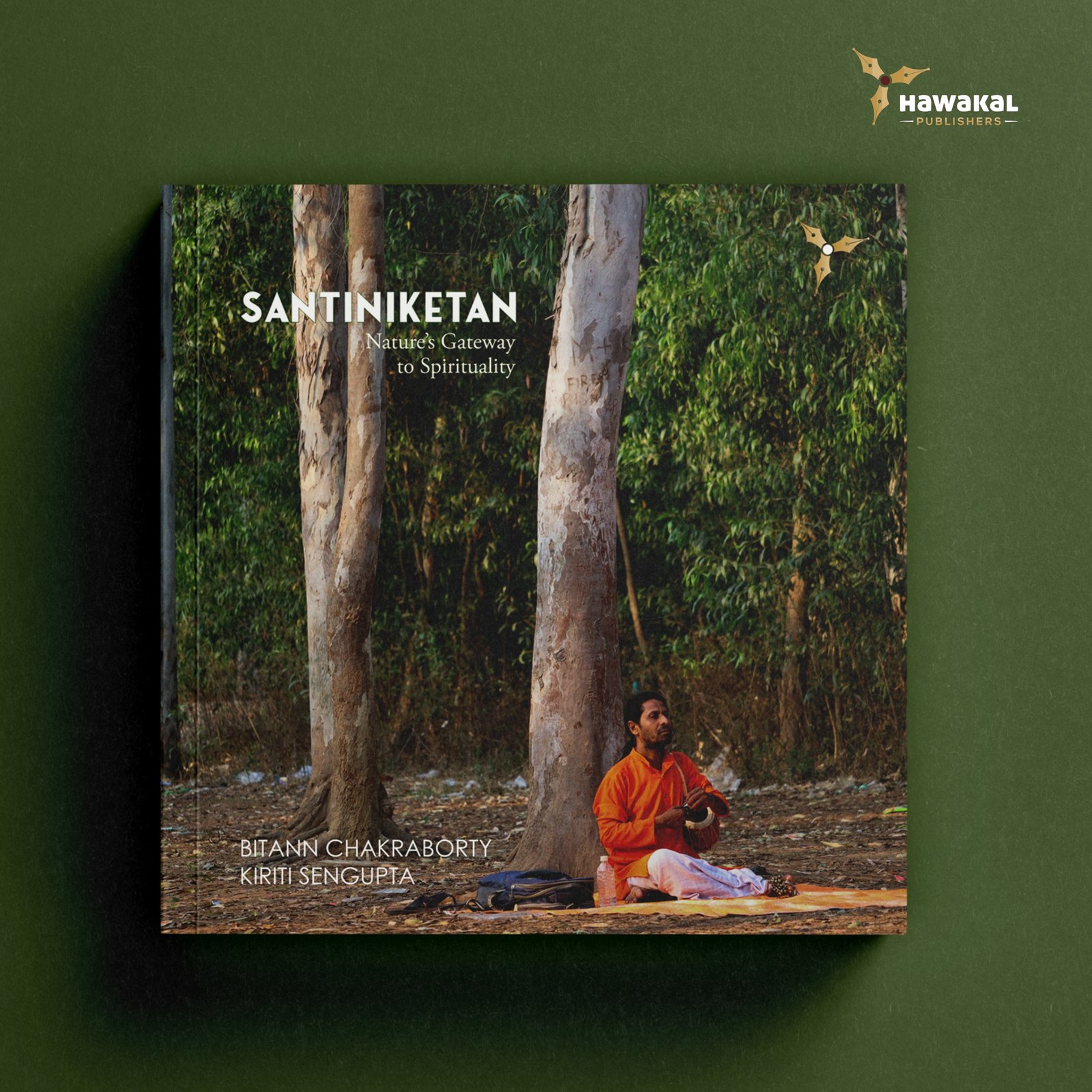
More Than a Portrait of a Tourist Destination
Santiniketan is already an intensely familiar name in Indian cultural history. Its association with Tagore, Visva-Bharati, literature, music, art and education has made it a destination for generations of visitors. The challenge for any contemporary book about the place is therefore to find something beyond the familiar imagery.
Chakraborty and Sengupta address this challenge by deliberately looking away from the conventional tourist perspective. Their introduction emphasizes the difference between merely visiting Santiniketan and becoming sufficiently familiar with it to understand its atmosphere. They connect this deeper engagement with Tagore’s belief that nature and spirituality are closely intertwined.
That approach determines the character of the entire book. Instead of giving readers a catalogue of famous buildings and attractions, the authors draw attention to ponds, trees, roads, fields, animals, musicians, workers, flowers and changing light.
The ordinary becomes the subject.
The Camera Finds the Unnoticed
Bitann Chakraborty’s photographs are the book’s most immediate attraction. Yet their power lies not simply in technical beauty. They repeatedly encourage the viewer to notice things that could easily disappear into the background of everyday life.
A photograph of a rural road after rain, for example, becomes an image of light and transition. A tree standing beside a road acquires an almost monumental presence. A pond filled with water-lilies is simultaneously a natural landscape and a workplace.
The photograph accompanying “Lal Bundh” is a particularly effective example. A washerman works in the water while flowers occupy the surrounding pond. The accompanying description identifies Lal Bundh as a Visva-Bharati-maintained pond used by local washermen.
This combination of image and information is important. The photograph might initially be appreciated for its colour and composition, but the accompanying text reminds us that the landscape has a practical function for local people.
The camera therefore does not simply aestheticize Santiniketan. It also documents its everyday life.
Words That Transform the Photographs
Kiriti Sengupta’s writing performs a complementary function. His short poems and prose pieces rarely explain the photographs directly. Instead, they introduce another level of interpretation.
This can be seen in “Experience Personified,” where an apparently simple walk across dew-covered grass becomes an intimate encounter with nature. The speaker removes his shoes, feels the droplets against his feet and ultimately treats the experience itself as something worthy of a name.
The passage demonstrates one of Sengupta’s recurring techniques: sensory experience becomes philosophical reflection.
The same process occurs in “Illumination.” A walk along a road turns into a meditation on shadows, identity and light. The shadows seem to acquire a life of their own before a sudden burst of illumination transforms the scene.
Such pieces encourage the reader to look again at the photograph. The image remains unchanged, but its meaning has expanded.
Tagore Is the Invisible Companion
There is no meaningful way to separate Santiniketan from Rabindranath Tagore, and the authors do not attempt to do so. Instead, Tagore becomes an almost invisible companion throughout the book.
The introduction openly acknowledges his centrality, arguing that the atmosphere of Santiniketan remains infused with his presence and that his understanding of nature and spirituality provides an important key to the place.
Tagore’s words appear alongside the photographs, while excerpts from Gitanjali and other writings provide a literary counterpoint to the contemporary images. The publication also specifies that the Gitanjali excerpts are Tagore’s own prose translations of his original Bengali poems.
This is particularly effective because Tagore is not used merely as an ornament. His ideas actively shape the book’s interpretation of landscape.
One excerpt from Gitanjali describes a traveller moving through external worlds before eventually arriving at an inner shrine. That idea closely parallels the structure of this book: the reader begins by looking outward at Santiniketan and gradually finds themselves being asked to look inward.
Spirituality Without a Conventional Religious Framework
The word “spirituality” in the title could suggest that the book is primarily religious. It is not.
Its spirituality is much more experiential. It emerges from the act of observing, listening, walking and remaining attentive.
A tree, a pool of water, a patch of grass, moonlight or rain can become a point of reflection. The authors repeatedly suggest that the sacred does not necessarily have to be found inside a temple or through formal ritual.
The section on Upasana Griha is particularly significant in this regard. The historic Kanch Mandir, built in 1891 by Maharshi Debendranath Tagore, is described as a glass prayer hall without idols.
That detail fits naturally into the book’s larger philosophical direction. Spirituality is presented less as an institution and more as a way of perceiving the world.
Silence Is Not Always Peaceful
One of the more interesting qualities of Sengupta’s writing is his refusal to romanticize every aspect of nature.
The section titled “Quietude and Loneliness” challenges the assumption that silence is automatically comforting. Silence can be hypnotic and powerful, but it can also become unsettling and confrontational.
This is an important distinction because Santiniketan is often imagined as an uncomplicated refuge from urban noise. The book suggests that genuine solitude is more complicated.
When external distractions disappear, the self becomes more visible. Peace can therefore lead to introspection, but introspection can also lead to discomfort.
This gives the book a psychological dimension that goes beyond landscape photography.
The Landscape Is Worked, Not Merely Admired
Perhaps one of the book’s most valuable contributions is its attention to labour.
The countryside is not presented simply as an attractive backdrop. People cultivate the fields, wash clothes, sell handicrafts, make music and sustain local traditions.
The line accompanying the paddy-field photograph—contrasting artificial intelligence with the “sunburnt hands” of agricultural workers—is particularly pointed. It shifts attention away from romantic images of rural Bengal and toward the physical effort behind agricultural production.
“Beyond Humanity” similarly turns its gaze toward the animals working in the fields, asking whether the steers understand their rights.
These observations broaden the book’s definition of spirituality. If nature is sacred, then the people and animals participating in its cycles must also matter.
Culture Lives in Everyday Encounters
The book is also attentive to Santiniketan’s living cultural traditions.
The section on the Bauls is especially evocative. The authors focus on the ektara and the ability of music to transcend divisions. The Bauls are identified as wandering minstrels whose music and poetry have received UNESCO recognition as Intangible Cultural Heritage.
Photography cannot capture sound, but the combination of image and poetry creates an imaginative approximation of it. The reader is encouraged to picture the music as something inseparable from the landscape.
The same principle appears in the treatment of the Santhal community and tribal dance. The book describes the energetic movements, traditional clothing and natural rhythms associated with these performances.
The cultural Santiniketan presented here is therefore not frozen in Tagore’s era. It continues to evolve through communities, performers, artisans and ordinary residents.
Sonajhuri Haat and the Human Face of Culture
The section on the dokra seller is another example of the authors’ interest in individual lives.
Rather than presenting handicrafts simply as souvenirs, the text considers the cultural significance embedded within the objects. The dokra seller has been working for years, surrounded by decorative pieces and idols, while the prose reflects on the spiritual meaning of what she sells. Sonajhuri Haat is described as an open-air craft market beneath trees on red laterite soil near the Kopai River.
The result is a more human portrait of Santiniketan’s cultural economy.
The book repeatedly reminds us that behind every “cultural experience” are individuals who work, create and earn their livelihoods.
Memory, Time and the Presence of History
Another recurring theme is memory.
The authors seem fascinated by the possibility that landscapes preserve traces of the people who have passed through them. “A Fair Witness” asks whether trees record human history, followed by the simple admission that the author wishes they did.
It is a deceptively simple observation.
Santiniketan is filled with historical associations, yet history is not always visible. Buildings can survive, but conversations disappear. People die, while trees remain. Roads are altered, but landscapes preserve fragments of earlier lives.
Photography itself becomes a form of preservation. Chakraborty’s images capture moments that would otherwise pass unnoticed.
A Place Where Scholarship and Nature Coexist
The book also acknowledges Santiniketan’s intellectual legacy.
The reference to Pratichi, the ancestral residence of economist Amartya Sen, brings another layer of scholarship into the narrative. The text identifies Pratichi as Sen’s ancestral home and reflects on the curiosity surrounding the property.
Elsewhere, Taladhwaja becomes associated with Tejesh Chandra Sen, a scholar, teacher and nature enthusiast who was affectionately called “Tarubilasi,” or lover of trees, by Tagore.
These references reinforce the book’s larger argument: Santiniketan’s identity is built from the interaction of intellectual life and the natural world.
What Makes the Collaboration Work
The partnership between photographer and writer is central to the book’s success.
The authors explain that the project was conceived specifically as a collaborative photobook, with Chakraborty’s photographs complemented by Sengupta’s prose and poetry.
Their professional backgrounds make the partnership particularly appropriate. Sengupta has an established career in poetry, prose and translation and maintains a close connection with Bengali literary traditions. Chakraborty brings his experience as both a storyteller and photographer, with photographic work extending across places including Santiniketan, Rishikesh and Varanasi.
The result is a genuine conversation between image and language.
Neither dominates consistently. Sometimes the photograph makes the strongest statement; at other times the accompanying prose changes how the image is understood.
A Few Limitations
The book’s distinctive character may not appeal to every reader.
Those looking for a comprehensive history of Santiniketan, a conventional travel guide or detailed information about its institutions will need to look elsewhere. The authors are not attempting that kind of documentation.
The writing can also become abstract. Some short pieces are immediately accessible, while others demand a more contemplative reading. Similarly, recurring ideas about spirituality, nature, light, darkness and inwardness can occasionally produce a sense of repetition.
Yet these are relatively minor reservations. They arise largely because the book chooses contemplation over conventional narrative.
Conclusion
SANTINIKETAN: Nature’s Gateway to Spirituality succeeds because it does not try to provide a definitive explanation of Santiniketan. Instead, it provides a series of invitations to observe.
The book asks readers to notice the washerman in the pond, the worker in the paddy field, the Baul with an ektara, the craft seller at the market, the animal labouring in the soil, the moon above the landscape and the sunlight filtering through trees. Through these details, Santiniketan becomes more than a historical or cultural landmark.
It becomes a living ecosystem of people, memories, traditions and natural forms.
The photographs preserve fleeting moments, while the poems and prose turn those moments into questions about existence. Tagore’s presence provides the philosophical background, but the book remains firmly interested in contemporary Santiniketan as well.
Ultimately, this is a book about attention. It argues, implicitly rather than didactically, that spirituality may begin with simply learning to see.
For readers who appreciate photography accompanied by poetry and reflective prose, this is an absorbing and visually rich volume. It is not a book to rush through. Its images and words work best when encountered slowly, allowing one photograph to remain in the mind before turning the page.
In the end, the book leaves behind a compelling impression: Santiniketan is not merely a place one visits. It is a landscape that asks to be experienced, interpreted and remembered. And in bringing together photography, poetry, Tagore’s literary legacy and the textures of everyday life, Chakraborty and Sengupta offer a thoughtful contemporary attempt to capture that experience.