Bombay Tabloid is messy, excessive and deliberately outrageous, but its distinctive voice and vivid depiction of Bombay give it an identity that is difficult to mistake for any other novel. Best for readers who enjoy black comedy, crime fiction, morally ambiguous characters, Indian urban settings and unconventional storytelling.
Rating: ⭐⭐⭐⭐⭐ (5/5)
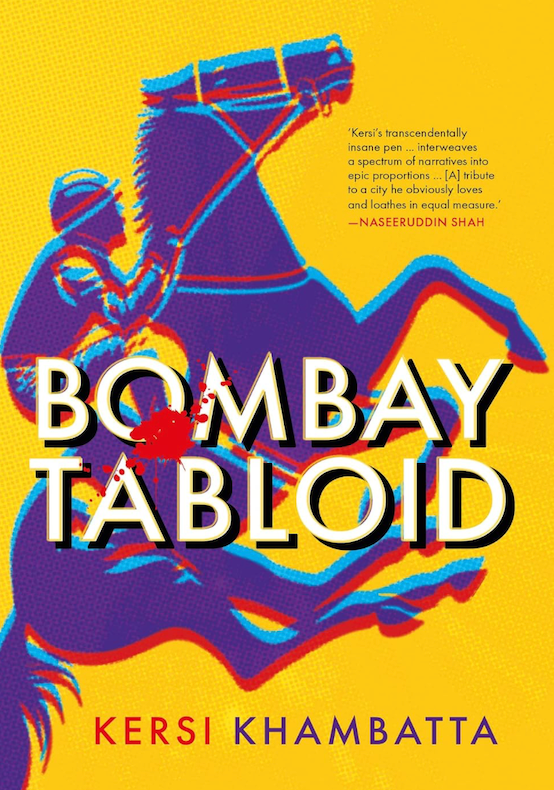
Kersi Khambatta’s Bombay Tabloid is far removed from the formula of a conventional crime novel. It is unruly, irreverent, profane and frequently hilarious, while beneath its comic surface lies a distinctly darker examination of Bombay and the people who inhabit it. The novel brings together businessmen, police officers, servants, criminals, gamblers, lovers, relatives and assorted outsiders, placing them in a city where privilege and deprivation, money and desperation, violence and entertainment constantly collide.
The book’s greatest distinguishing feature is its unmistakable voice. Khambatta does not depict Bombay as a glamorous, carefully polished metropolis. Instead, he presents a city of crowded neighbourhoods, ageing families, pubs, restaurants, servants, police stations, questionable business dealings, gambling, Bollywood influences and domestic conflicts. His humour can be deliberately crude, but the vulgarity frequently conceals observations about class, privilege, hypocrisy and the compromises people make to survive.
The narrative itself is deliberately unconventional. Different characters and periods of time intersect, while sensational chapter headings such as “Satanic Deals,” “Wet-Bags and Razor Blades,” and “I Suddenly Like You, Let’s Fuck” reinforce the novel’s tabloid sensibility. At first glance, the story can appear fragmented, but recurring characters, concealed information and tangled relationships gradually connect its different strands.
Bombay as a City of Contradictions
The city is arguably the novel’s most important character. Bombay exists here as much more than a backdrop for the action. Wealthy residences, streets, restaurants, police investigations and family homes all become parts of the same social landscape, one in which extraordinary privilege can exist alongside profound insecurity.
One of the more striking reflections concerns a working-class character looking back at his family and the deterioration of his father’s circumstances. The passage evokes the disappointment of people who once imagined that their lives could remain respectable and stable, only to discover that hardship and corruption were impossible to escape. This bleak understanding of the city is summed up in the line:
“It’s a machine that will grind you if you let it.”
The metaphor captures much of the novel’s underlying philosophy. Bombay is portrayed as dynamic and alluring, but it can also consume those who fail to adapt to its demands.
Throughout the novel, Khambatta places older social hierarchies beside newer forms of wealth and ambition. Families carry the weight of their histories, servants retain memories of generations of employers, wealthy businessmen behave as though their money places them beyond consequences, and less privileged characters are repeatedly reminded of the social boundaries surrounding them.
This is why the novel functions simultaneously as satire and social observation. Its comedy may be outrageous, but behind many of the jokes is an examination of power, privilege and the contradictions of respectable society.
Cyrus and the Dysfunctional Family Around Him
Cyrus Kerman is one of the principal figures through whom this strange and frequently dysfunctional universe comes into focus. His life is entangled with characters such as his father Adi, Rumi, Yadav and numerous others whose individual stories gradually overlap.
His relationship with Adi is particularly significant. Adi does not fit neatly into the role of either villainous father or conventional patriarch. He is frequently cruel and unpredictable, yet the narrative also reveals moments of vulnerability. Consequently, the relationship between father and son possesses a complexity that goes beyond straightforward resentment.
The extent of the dysfunction surrounding Cyrus is immediately apparent in the description of his childhood. Khambatta allows the abnormality of the situation to reveal the instability of the family.
Family disputes repeatedly descend into darkly comic exchanges. At one point, frustration is expressed with almost theatrical aggression:
“Well, fuck mum. Mum can go fuck herself!”
Such language is central to the novel’s characterisation. The profanity is certainly provocative, but it also reflects people who rely on anger, sarcasm and insults because they seem incapable of expressing vulnerability through conventional emotional language.
Comedy, Sarcasm and the Art of Excess
Khambatta’s humour is arguably the defining feature of his writing. Conversations are filled with insults, bizarre observations, irreverent remarks and characters who seem determined to turn even ordinary interactions into performances.
The humour frequently appears at precisely the moments when seriousness might otherwise dominate. A brief observation about Rumi demonstrates the conversational quality of the prose:
“Rumi has a great poker face. Not fazed.”
The simplicity of the line is part of its effectiveness. Khambatta often creates the impression that the reader is standing beside the characters and overhearing their conversations rather than reading carefully constructed literary dialogue.
His comedy becomes even more distinctive when placed alongside violence. Discussions involving money, crime or betrayal can suddenly be interrupted by an absurd insult or joke. The resulting tonal shifts are sometimes jarring, but that instability is central to the novel’s personality.
The dialogue also carries something of the exaggerated rhythm associated with Bollywood and the colourful speech of Mumbai’s streets. One particularly theatrical exchange reads:
“Sure, you little fart, that’s the least of your problems. Don’t you think? Where the fuck are you going?”
The language is intentionally crude, but its theatrical quality makes the exchange amusing as well. Khambatta’s characters almost never speak neutrally. They exaggerate, provoke and perform, constantly constructing and reconstructing their identities through language.
Crime, Violence and a Morally Unstable World
For all its comedy, Bombay Tabloid is a remarkably violent novel. Murder, intimidation, physical assaults and criminal schemes appear repeatedly, often alongside the mundane concerns of everyday life.
What makes the treatment of violence particularly interesting is that Khambatta does not confine it to professional criminals. Aggression also exists within families, workplaces and personal relationships. Characters manipulate one another, issue threats and exploit their social or financial advantages, demonstrating that power can be exercised through money and status just as effectively as through physical force.
The episode involving Mihir Patel is particularly disturbing. His death is described with considerable brutality, and the violence emerges from an otherwise ordinary sequence involving food and everyday frustrations. The sudden transition from routine concerns to death reinforces one of the novel’s recurring ideas: ordinary existence can become catastrophically unstable without warning.
The distinction between respectable society and the criminal underworld is similarly blurred. Businessmen can be corrupt, policemen can be compromised, and wealthy families can act with a ruthlessness comparable to that of criminals.
Against this backdrop, the title Bombay Tabloid becomes especially appropriate. Like a sensational newspaper, the novel thrives on scandal, crime, sex, money, personalities and shocking revelations.
Police, Guns and the Criminal World
The police characters provide another avenue through which Khambatta explores both comedy and institutional dysfunction. Law enforcement is not portrayed as a uniformly dignified or authoritative institution. Instead, police officers possess their own personalities, prejudices, egos and absurdities.
The relationship between the authorities and the criminal world is particularly revealing. Characters understand that information can be concealed or manipulated, and much of their behaviour involves calculating what should or should not be disclosed to the police.
The discussion surrounding Cyrus’s gun illustrates this mixture of anxiety and absurdity. A character worries:
“Every time I read in the papers about someone getting shot, I say, he Bhagwan, let it not be my gun.”
The concern is obviously serious, yet the way it is expressed makes the situation comic. Rather than simply fearing that someone has been murdered, the immediate anxiety is whether the character’s own firearm might somehow be connected to the crime.
The answer is equally direct:
“Nobody’s going to murder anyone with your gun.” (p. 327)
This exchange exemplifies Khambatta’s method. Potentially dangerous circumstances are transformed into comic conversations, but the underlying threat never completely disappears.
Fathers, Families and the Legacy of the Past
The novel repeatedly returns to the ways in which parents shape the lives of their children. The damage created within families is rarely confined to one generation.
Fathers, in particular, occupy contradictory positions. They can represent authority and financial security while simultaneously becoming sources of fear, shame or emotional trauma. At the same time, Khambatta suggests that these fathers are themselves products of difficult histories.
Cyrus’s relationship with Adi embodies this contradiction. Adi’s behaviour can be deeply objectionable, yet Cyrus remains connected to him and must live with the consequences of being his son. What children inherit from their parents is therefore not limited to money or social position. They also inherit secrets, unresolved conflicts, emotional wounds and patterns of behaviour.
The novel becomes more emotionally effective when its characters are permitted moments of regret. Beneath the aggressive jokes and provocative dialogue are individuals who recognise that certain relationships may have been damaged permanently.
This emotional layer gives the book greater depth. The characters frequently speak outrageously, but their inability to communicate pain directly is often what drives that outrageousness in the first place.
Sex, Attraction and Complicated Relationships
Sexuality is woven deeply into the novel’s world, and Khambatta approaches desire with the same lack of restraint that characterises his treatment of violence, money and food.
The chapter title “I Suddenly Like You, Let’s Fuck” is an excellent illustration of the novel’s attitude. It combines affection and blunt sexuality in a manner that is simultaneously comic, provocative and deliberately undignified.
Relationships in the novel rarely follow conventional romantic patterns. Desire intersects with jealousy, social status, power, insecurity and personal expectations. Characters frequently express themselves in ways that would be considered shocking in ordinary social circumstances, allowing Khambatta to explore the distance between public respectability and private behaviour.
Hypocrisy is especially important here. People who maintain respectable public identities may behave very differently behind closed doors, while characters who are regarded as socially disreputable can sometimes demonstrate greater loyalty or honesty.
A Distinctively Indian Voice
The novel’s language is likely to be one of its most divisive elements. Khambatta combines English with Hindi, Mumbai slang, Parsi cultural references and expressions influenced by the city’s multilingual environment.
This linguistic mixing gives the dialogue an authenticity that would be difficult to achieve through sanitised or overly formal English. The characters sound as though they belong to the social world they inhabit rather than speaking in an artificially international literary register.
The references to Bollywood, local food, neighbourhood life, Parsis, police officers and wealthy businessmen further strengthen the sense of place. Cultural details are not simply decorative; they contribute to the atmosphere and identity of the novel.
At the same time, the profanity can become overwhelming. Because explicit language appears so frequently, individual swear words can lose some of their initial force. Readers uncomfortable with sexual or vulgar language may therefore find the book difficult to sustain.
Yet this excess is also deliberate. The characters themselves are exaggerated, unpredictable and excessive, and the language reflects their personalities.
The Novel’s Sensational Structure
The organisation of Bombay Tabloid reinforces its tabloid identity. The story is divided into numbered sections and chapters whose titles deliberately evoke sensational journalism.
The novel repeatedly treats private events as though they were sensational public entertainment. Murder, family disputes, sexual encounters, money and criminal activity all become part of the same chaotic narrative universe.
The chronology is similarly unconventional. The story moves between different periods, with characters recalling earlier events and information sometimes appearing through accounts or diary-like material. This creates additional layers but can occasionally make the narrative challenging to follow.
The fragmented storytelling nevertheless serves a purpose. The characters themselves rarely have complete knowledge of what is happening. Information emerges gradually, often through conversations and revelations rather than through straightforward exposition.
What Works — and What Does Not
The novel’s greatest achievement is its voice. Khambatta gives his characters distinctive personalities, allowing them to come across as simultaneously obnoxious, funny, damaged, vulnerable and occasionally touching.
His depiction of Bombay is equally successful. The city’s class divisions, wealth, food, language, cultural references and social contradictions are integrated into the story rather than being used merely as scenery.
However, the novel’s greatest strength is also its most obvious weakness: it is excessive.
There are numerous characters, overlapping storylines, abrupt tonal changes and frequent shifts in perspective. The repeated profanity and sexual humour can begin to feel monotonous, while some scenes appear designed primarily to shock or amuse rather than develop the central narrative.
For some readers, the sheer quantity of subplots may make the novel feel unfocused. Others may find the deliberately outrageous style exhausting.
Nevertheless, the excess appears to be part of the design rather than an accidental flaw. Bombay Tabloid is not attempting to be restrained or minimalist. It is closer to a sprawling Mumbai crime story filtered through satire, black humour and deliberately sensational storytelling.
Conclusion
Kersi Khambatta’s Bombay Tabloid is a chaotic, irreverent and often hilarious exploration of Bombay’s darker social landscape. Its cast includes dysfunctional families, businessmen, servants, policemen, criminals, lovers and outsiders, all navigating questions of money, status, desire, power and the consequences of earlier choices.
The novel’s greatest achievement is its ability to place comedy and tragedy side by side without allowing either to completely overwhelm the other. Murder can be followed by a vulgar joke; a family confrontation can be simultaneously ridiculous and painful; and a criminal situation can become absurd without losing its sense of danger.
This is unlikely to be the right novel for readers who prefer elegant restraint, conventional plotting or morally straightforward characters. But readers prepared to accept its vulgarity, fragmentation and deliberately excessive humour will find something considerably more unusual here: a distinctly Indian crime saga in which Bombay is not simply the setting but an almost living presence, full of contradictions, absurdities and people struggling to survive within them.