Guts, Glory and Empire ultimately succeeds as an act of historical recovery. It restores an overlooked South Asian community to the history of Zanzibar and, in doing so, offers a broader and more complicated understanding of how the Indian Ocean world was shaped.
Rating: ⭐⭐⭐⭐☆ (4.5/5)
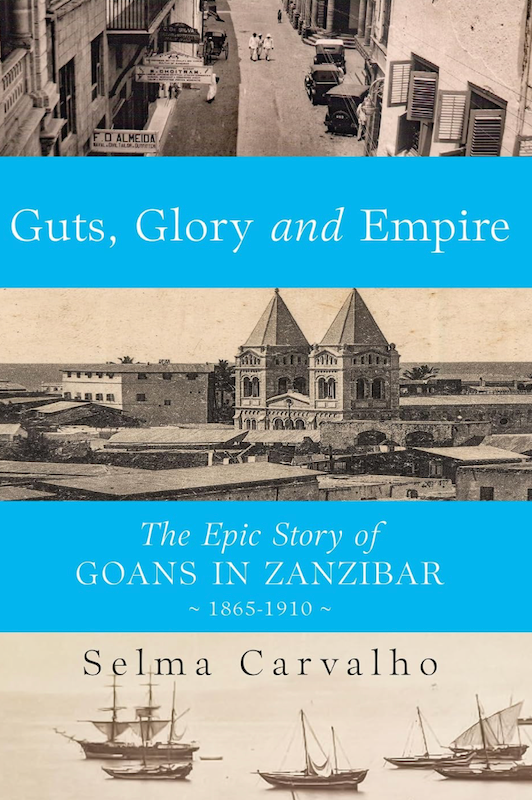
Selma Carvalho’s Guts, Glory and Empire offers a detailed reconstruction of a community that has received far less attention than it deserves in conventional accounts of East African history: the Goans of Zanzibar. Drawing extensively on historical records and individual stories, Carvalho places Goan migrants within the wider history of the nineteenth- and early twentieth-century Indian Ocean. Sailors, merchants, doctors, interpreters, shopkeepers, civil servants, priests, photographers and political figures all enter her narrative, creating a picture of a community whose presence extended well beyond the confines of a migrant labour force.
What makes the book particularly valuable is that Carvalho does not treat migration as a straightforward story of economic advancement. Goan life in Zanzibar was shaped by several overlapping forces, including Portuguese colonialism, Catholicism, caste, commerce, race, imperial politics and family ambition. The people she follows occupied contradictory positions within these systems. They could experience discrimination while benefiting from colonial privileges; they could be subjects of empire while participating in its economic structures; and they could seek social advancement while maintaining hierarchies of caste and status.
The result is a history that resists the familiar narrative of immigrants arriving, succeeding and prospering. Carvalho instead examines how a diaspora negotiated a complicated collection of identities and hierarchies while attempting to establish a durable community thousands of miles from Goa.
Zanzibar: More Than a Colonial Backdrop
One of the book’s most effective choices is to begin with Zanzibar itself. Carvalho presents the island as a major Indian Ocean hub rather than simply a peripheral location within European imperial history. By the nineteenth century, Zanzibar connected East Africa with India, Arabia and Europe and had already developed extensive commercial and cultural networks.
This context matters because the Goans did not enter an untouched colonial frontier. They became participants in an existing maritime economy whose connections stretched across the Indian Ocean. Their arrival and subsequent mobility were therefore part of a much older history of movement and exchange.
Carvalho consequently pushes back against histories that place European expansion at the beginning of the story and treat Asian migration as something produced solely by colonialism. Her narrative demonstrates that Indian Ocean mobility had its own momentum and history.
The strength of her approach also lies in the way she populates Zanzibar with individuals rather than abstract historical categories. Merchants, sailors, doctors, servants, priests, bureaucrats, photographers and families all appear within the narrative. Their presence makes the city feel like a living social environment rather than merely a location on an imperial map.
Carvalho also challenges the tendency to describe Asian migration primarily through the language of displacement. As she writes:
“viewed as an exercise in displacement and extraction rather than contribution.”
That observation goes to the heart of her project. The book is fundamentally concerned with recovering contribution from a historical narrative in which Asian communities have too often been treated as peripheral.
From Migrants to a Community
Another major strength of the book is its refusal to portray the Goans as a homogeneous group. Their experiences varied considerably according to education, occupation, wealth, family background and social connections.
Some arrived with limited education and initially worked as sailors, cooks, stewards or servants. Others eventually entered professions and commercial activities that brought them considerable influence. Carvalho traces this progression through individual biographies, demonstrating how social advancement actually took place rather than simply declaring that the community became prosperous.
The chapter “Universal Provider” is particularly useful in this regard. It explores the trajectories of early migrants who arrived with little but gradually established themselves within Zanzibar’s commercial and social landscape.
A central figure is C. R. Souza, whose career becomes a lens through which Carvalho examines the development of Goan business networks, migration patterns, family relationships and community leadership.
Souza’s importance extends beyond his personal achievements. His story illustrates the mechanisms through which individual migrants accumulated resources, developed relationships and eventually became influential members of an emerging diaspora.
This biographical method gives Carvalho’s history much of its energy. Rather than presenting prosperity as an inevitable outcome, she shows the networks and institutions that made it possible.
The Indian Ocean as a Route to Mobility
The maritime dimension of Goan migration is one of the book’s most illuminating subjects. Employment at sea became deeply embedded in the movement of Goans between different parts of the Indian Ocean.
Carvalho captures the strength of this maritime culture when she writes:
“the impulsion to live off the sea was so deeply ingrained”
The sea functioned as far more than a workplace. Ships created routes through which people could move from Goa to Bombay, Zanzibar and other ports, opening opportunities for employment and eventually facilitating movement into different professions.
Carvalho is also interested in occupations that conventional histories tend to overlook. Cooks, stewards, servants, sailors and clerks performed essential work within colonial commercial and administrative systems, even though their contributions rarely received historical recognition.
This raises an important question that runs beneath much of the book: who actually made colonial cities function?
European administrators and officials may have occupied the most prominent positions, but everyday life depended upon a much larger workforce. Carvalho restores some of those people to the historical record, showing how the supposedly peripheral labour of migrants was integral to the functioning of Zanzibar.
Commerce and the Uncomfortable Side of Success
The book becomes particularly compelling when Carvalho refuses to idealise the Goan experience.
It would have been easy to portray Goans exclusively as colonised subjects navigating European power. Instead, Carvalho examines the ways in which individuals within the community also participated in economic systems that could exploit others.
Her treatment of the slave trade is especially significant. The book discusses evidence connecting individual Goans to commercial networks associated with slave-trading expeditions. Importantly, Carvalho does not transform these individual cases into a sweeping indictment of the entire Goan population. She distinguishes between individuals, commercial structures and the wider community.
That restraint strengthens rather than weakens the argument.
The same complexity appears in Carvalho’s discussion of Indian commercial influence in Zanzibar, which she describes as:
“so fierce, so stifling”
The phrase conveys the competitive and hierarchical character of Zanzibar’s commercial world. Power was not exercised exclusively by Europeans. Arab elites, Indian merchants, Portuguese officials and African communities occupied different positions within an intricate economic structure.
Consequently, Carvalho avoids reducing Zanzibar’s history to a simple conflict between colonisers and colonised. The relationships were more fluid, and the beneficiaries and victims of particular systems could vary according to context.
Race, Caste and Social Contradictions
The book’s examination of race and caste is perhaps its most challenging dimension.
Goans themselves existed within European racial hierarchies, yet some members of the community also adopted attitudes that placed them above indigenous Africans. This created a fundamental contradiction: people who experienced discrimination could simultaneously participate in other forms of social exclusion.
Portuguese citizenship could provide Goans with a degree of protection or status in their dealings with colonial authorities. At the same time, sections of the community sought distance from African populations and maintained distinctions based on caste, colour and social standing.
Carvalho does not attempt to resolve these contradictions. Instead, she treats them as essential to understanding how the community functioned.
Her discussion of caste is similarly important. Migration did not automatically erase inherited social structures. Marriage, family reputation, occupation and religious affiliation continued to influence social relationships.
The Goan diaspora therefore emerges as neither wholly traditional nor wholly modern. Its members were geographically mobile and professionally ambitious while retaining social practices and identities inherited from Goa.
Family, Inheritance and the Souza Legacy
The history of the Souza family provides one of the clearest examples of how economic and domestic life intersected.
Following C. R. Souza’s death in 1900, the handling of his commercial interests reveals the importance of inheritance, gender and family relationships. His widow, Roza Marianne Martins, inherited the principal share of the business, while younger male relatives increasingly took on managerial responsibilities.
Carvalho’s treatment of these developments also draws attention to women whose roles have frequently disappeared from conventional accounts of commercial history. Women were not simply passive figures standing behind successful businessmen. Their position within households, inheritance structures and family networks could have direct economic consequences.
The chapter “The English Stores” further develops this theme by examining the roles played by widows, nephews, attorneys and other relatives in business succession.
The result is a history that moves naturally between public institutions and private households. Commerce cannot be separated from family, and the development of a migrant business community cannot be understood without examining the domestic structures that sustained it.
Portuguese Power and the Consulate
Portugal’s position in Zanzibar provides another important dimension of Carvalho’s narrative.
The chapters dealing with the Portuguese consulate, particularly “Brás In-Charge,” demonstrate that imperial power was exercised through individuals as much as formal institutions. Brás emerges as an ambitious and forceful character whose position offered him:
“tremendous power.”
His career also illustrates Portugal’s complicated position within Zanzibar. Portugal remained a European colonial power, but its influence was weaker than Britain’s. Portuguese officials consequently had to negotiate between British authority, the Sultanate and the interests of the Goan population.
Carvalho’s portraits of Brás, John Kirk and other colonial figures give imperial history a human dimension. Officials were not simply representatives of abstract states. They possessed rivalries, ambitions, prejudices and personal agendas.
Empire, in Carvalho’s telling, was therefore constructed through imperfect institutions and imperfect individuals.
Political Organisation and Internal Divisions
As the book progresses, the Goan community becomes increasingly politically organised. Associations, charitable bodies, religious institutions and other organisations emerged to represent collective interests.
Yet Carvalho does not portray these organisations as naturally united. Personal rivalries, competing interests and factional disputes repeatedly affected their functioning.
One particularly revealing discussion identifies a “fundamental flaw” within the community: its associations struggled to escape internal manoeuvring and factional politics.
This is significant because it prevents the diaspora from becoming an idealised historical community. Shared origin does not necessarily produce political unity. The Goans of Zanzibar had disagreements over leadership, status, money and political strategy.
At the same time, the very existence of these disputes indicates how established the community had become. By the beginning of the twentieth century, the Goans were no longer merely individual migrants attempting to make a living. They had developed institutions and a collective political presence.
Religion, Education and Advancement
Catholicism is woven throughout Carvalho’s account of Goan life. Churches, priests, schools and charitable organisations played important roles in consolidating community identity.
Yet, once again, Carvalho avoids presenting religion as uncomplicatedly positive. Catholic institutions existed within a colonial environment in which missionary activity and European imperial interests were often closely connected. Goan Catholics therefore had their own complicated relationship with the institutions that helped sustain them.
The chapter devoted to St Joseph’s Cathedral illustrates the importance of the church as a social and cultural centre. Religious institutions offered spiritual support, but they also created networks and reinforced relationships between families and members of the wider community.
Education provided another route to advancement. The emergence of doctors, lawyers, administrators and other professionals became evidence of the community’s growing social influence.
Carvalho consequently presents education not merely as an individual pathway to employment but as one of the forces that enabled a migrant population to develop into an urban professional elite.
Women and the Economics of Migration
Carvalho’s attention to women is another valuable feature of the book.
The chapter “The Half-Nephews”, together with her broader discussion of Goan families, shows how migration affected marriage and domestic life. Men frequently travelled for work while wives remained in Goa, and over time families increasingly began relocating together.
Carvalho emphasises the importance of cooperation between spouses:
“The partnership of enterprise between husband and wife was essential in realising their own potential.”
This observation challenges the tendency to describe migrant entrepreneurship almost exclusively through male achievement.
The household itself was an economic institution. Women maintained homes, raised children, preserved family connections and, in some cases, participated directly in business. Their contributions were often less visible than those of men but remained fundamental to the stability and expansion of migrant families.
A Dense but Vivid Historical Narrative
Despite its substantial archival foundation, Guts, Glory and Empire is written in a style that remains accessible to the general reader.
Carvalho has a clear interest in storytelling. Individuals recur throughout the narrative, businesses pass between generations, political disagreements resurface and institutions evolve over time. This creates a sense of continuity that a purely chronological account might lack.
Her use of small details is particularly effective. Clothing, homes, correspondence, official records, family relationships and professional rivalries often reveal more about historical personalities than broad generalisations could.
There is, however, a cost to this richness. The sheer number of people introduced throughout the book can occasionally become difficult to track. The reader encounters numerous Goan families, alongside British, Portuguese and Arab officials and other figures.
Yet this density is also part of the book’s achievement. Carvalho is not telling the story of a handful of exceptional individuals. She is reconstructing an entire social world.
Beyond Heroes and Victims
The greatest achievement of Guts, Glory and Empire may ultimately be its refusal to impose simple moral categories upon the past.
The Goans are neither presented merely as oppressed migrants nor transformed into heroic entrepreneurs who triumph over adversity. Their position changes according to circumstance.
They are migrants who become settlers. They are subjects of empire who can also benefit from imperial institutions. They experience racial prejudice while sometimes reproducing it. They oppose aspects of British domination while participating in commercial structures that affect African populations. They are Catholics influenced by Portuguese culture while retaining a distinct Goan identity.
Carvalho’s approach recognises that historical individuals can occupy contradictory positions at the same time.
This complexity also gives her treatment of empire considerable depth. Empire appears not merely as conquest or political domination but as a system embedded in passports, laws, commercial enterprises, churches, schools, consulates, racial classifications and everyday social relationships.
In other words, empire reaches into ordinary life.
The Disappearance of a Community
The closing sections of the book carry a distinct sense of loss. The generation Carvalho has spent the book reconstructing gradually disappears from Zanzibar.
The deaths and departures of prominent Goans mark the end of a particular historical era. Figures such as C. R. Souza and others who helped establish the community during the nineteenth century pass from the scene, and with them a particular social world begins to fade.
The ending therefore feels larger than the conclusion of individual biographies. It marks the closing of an entire chapter in the history of Zanzibar.
But Carvalho’s broader argument is that historical disappearance should never be confused with historical insignificance.
Goans contributed to Zanzibar’s commercial, professional, administrative and religious life. Their institutions and work left an imprint that remained even after many members of the community eventually departed.
This is particularly important because Asian communities have frequently been described in colonial histories as outsiders or temporary residents.
Carvalho challenges that assumption. The Goans did not merely pass through Zanzibar.
They made it home.
Conclusion
Guts, Glory and Empire is a substantial contribution to the history of Zanzibar and the wider Indian Ocean world. Its most important accomplishment is to bring the Goan community into the centre of a history from which South Asians have too often been marginalised.
Carvalho’s greatest strength is her willingness to preserve complexity. Her Goans are not simplified into heroes, victims or villains. They are sailors, merchants, doctors, priests, administrators, servants, entrepreneurs and family members whose lives were shaped by caste, religion, commerce, Portuguese identity and colonial structures.
They could experience discrimination while participating in systems of privilege. They could challenge imperial authority while benefiting from it. They could pursue social mobility while retaining older hierarchies. These contradictions do not weaken the story; they make it more convincing.
Histories of Zanzibar often foreground the Sultanate, the slave trade, European exploration and British imperial expansion. Carvalho adds an essential dimension by recovering the experiences of South Asians who crossed the Indian Ocean and established businesses, institutions, professions, families and political organisations on the island.
Ultimately, the book demonstrates that migration is about far more than physical movement. It involves the creation of institutions, the negotiation of identity, the construction of family networks and the gradual transformation of an unfamiliar place into home.
For readers interested in Goan history, South Asian migration, colonialism, Portuguese imperialism, the Indian Ocean or the social history of East Africa, Guts, Glory and Empire offers a rich and rewarding account. Its value lies precisely in its refusal to make the past neat. Instead, Carvalho presents a world that is complicated, ambitious, conflicted and deeply human.
https://www.amazon.in/Glory-Empire-Story-Zanzibar-1865-1910/dp/9363360792?crid=3IXCE6303VIC6&dib=eyJ2IjoiMSJ9.6kV30SEvE84zLvPNI9HfgA.STeUGeKGt2nyPhTkVWek0qE-P2J3saiz6IzkYMWrOQE&dib_tag=se&keywords=Guts%2C+Glory+and+Empire+selma&qid=1791347016&sprefix=guts%2C+glory+and+empire+sel%2Caps%2C301&sr=8-1&linkCode=ll2&tag=newasiwri-21&linkId=67f5972b8001fc959d9ef9d479dcba97&ref_=as_li_ss_tl