The memoir is equally compelling because it does not romanticise journalism. Reporters demand independence while depending upon institutions. They seek truth while requiring access. They challenge politicians while cultivating relationships with them. They may find themselves close to historic events while remaining vulnerable to ordinary professional concerns such as salaries, promotions and job security.
Rating: ⭐⭐⭐⭐⭐ (5/5)
Journalism, History and the Search Beyond the Official Version
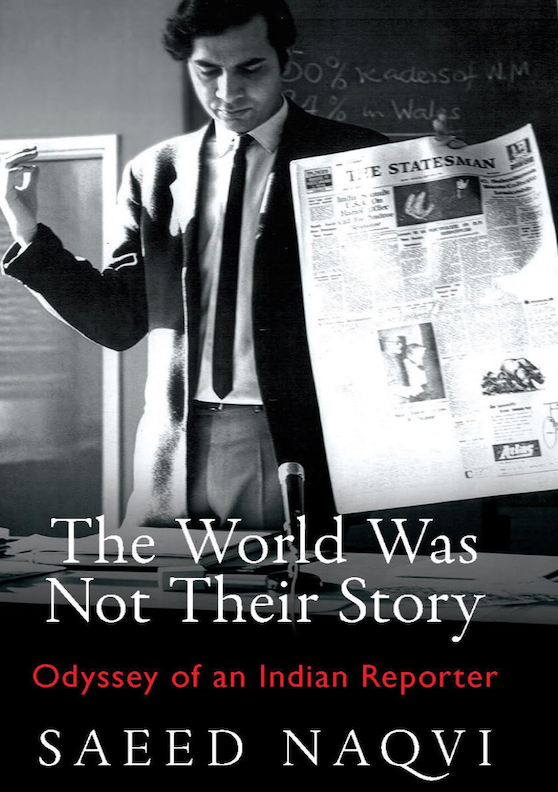
Saeed Naqvi’s The World Was Not Their Story can be read as a memoir of an extraordinary journalistic career, but describing it simply as an autobiography would undersell its ambition. The book is also a record of a changing India and an evolving international order, reconstructed through the experiences of a reporter who repeatedly found himself in the vicinity of major political figures and historical events.
Published by Speaking Tiger Books in 2026, the memoir draws upon Naqvi’s many decades in journalism, beginning with his formative years at The Statesman and eventually taking him across a remarkable range of assignments. The Beatles, Northern Ireland, Indira Gandhi, Pakistan, Afghanistan, the Soviet Union, Fidel Castro, Benjamin Netanyahu and the politics of the Middle East all become part of his professional journey.
The structure of the book reflects this extraordinary range. “Entering the Fourth Estate” introduces the young journalist to the institutions and personalities of the profession, while “Breaking New Ground” expands the narrative into international reporting. Subsequent chapters take Naqvi from Moscow and Nicaragua to Cuba, Afghanistan and Gaza.
Yet the book is ultimately less interested in the geography of Naqvi’s career than in the mechanics of journalism itself. He examines how reporters secure access, how stories emerge, how editors and proprietors influence coverage, how political assumptions penetrate newsrooms and how an event can look dramatically different to someone who has actually witnessed it.
In that sense, The World Was Not Their Story becomes both a professional memoir and an extended meditation on journalism as a vocation.
Entering Journalism and Learning How Institutions Work
The memoir begins with a chapter whose title immediately captures one of its central themes: “Journalism: Employed, Promoted, Sacked.” Naqvi recalls arriving at The Statesman in May 1963, when he was twenty-three, to meet Philip Crosland, the newspaper’s British Resident Editor.
The exchange that follows is remarkably brief:
“Have you ever written anything?”
“Poetry.”
It is an understated introduction to a career that would eventually take Naqvi around the world. At this point, however, he is still a young man entering a profession whose demands he has yet to discover.
His recollections of those early years recreate the atmosphere of the newspaper office in considerable detail. The newsroom is not merely a workplace populated by journalists; it is an institution governed by status, hierarchy, class and tradition. Typewriters, newspapers, corridors and separate territories occupied by editors and reporters form the physical and social landscape in which Naqvi learns his craft.
One observation about the newspaper’s dining room is particularly revealing:
“The only place where the management and the editorial came together was at the high table.”
The significance of the remark extends far beyond the dining room. Newspapers may claim to be institutions devoted to informing the public, but they are also organisations with owners, managers, hierarchies and competing interests. Editorial independence exists within those structures rather than outside them.
Naqvi’s first experiences therefore teach him two things simultaneously: how to become a reporter and how institutions exercise influence.
A Memoir Filled With Characters
The people who populate The World Was Not Their Story are almost as important as the events themselves. Editors, reporters, politicians, diplomats, intellectuals and ordinary individuals are remembered through small details, personal habits and distinctive personalities.
Naqvi’s descriptions vary in tone. At different moments he can be affectionate, amused, ironic or sharply critical. This variety prevents the memoir from becoming an overly reverential account of journalism. Its newsroom is full of strong personalities, rivalries, eccentricities and professional ambitions.
Importantly, Naqvi does not consistently position himself as the all-knowing narrator. In many of the early episodes, he is simply a young reporter attempting to make sense of the people and institutions surrounding him. That perspective lends the memoir an appealing sense of immediacy.
There is humour throughout the narrative as well. Journalism is not presented as a heroic profession in which reporters spend their lives solemnly pursuing truth. Meals, cigarettes, drinking, travel complications, office politics, bureaucratic absurdities and sheer accidents all become part of the story.
This combination of historical significance and everyday absurdity gives the memoir much of its charm.
The Beatles and the Pursuit of an Exclusive Story
Among the liveliest episodes is Naqvi’s account of the Beatles’ visit to India. In “The Beatles Recollected in Tranquillity,” he describes a period when The Statesman was attempting to adapt to the interests of a younger readership.
The Beatles story comes to him unexpectedly. Naqvi discovers that the group intends to travel to Rishikesh to meditate with Maharishi Mahesh Yogi. He immediately recognises the significance of the information:
“For me, the Beatles story was a gift from the gods.”
But having the information is only the beginning. The Beatles and their management are determined to control access, meaning that the real journalistic challenge is figuring out how to get close enough to report the story.
Naqvi explains his determination:
“I had to beat this system. The Beatles were going to be a sensational global story—and it had fallen into my lap.”
The episode offers a straightforward illustration of what makes a scoop possible. A journalist does not necessarily need the largest organisation or the greatest financial resources. Curiosity, persistence, relationships, observation and good fortune can matter just as much.
The story also reflects a broader transformation within Indian journalism. A newspaper with a strongly British institutional heritage was increasingly recognising that its Indian readership was interested in global popular culture. The Beatles assignment consequently becomes more than an amusing journalistic anecdote; it reflects changes taking place within Indian society itself.
Journalism Requires Historical Context
As the memoir progresses, Naqvi moves increasingly beyond newsroom stories and into political history. His reporting from Northern Ireland, for instance, is presented against the historical background of the conflict between Unionists and Irish nationalists rather than simply as an account of a foreign assignment.
The same approach becomes evident in “Clash of Ideologies Worldwide,” where the Indian Emergency of 1975 is considered alongside the ideological conflicts unfolding internationally. Chile, European communism, Angola, apartheid South Africa, the Soviet Union and Indian politics all enter the same broader framework.
This insistence on context is one of the book’s defining characteristics.
For Naqvi, political events rarely exist independently. Understanding Indira Gandhi requires an understanding of the ideological struggles surrounding her. Understanding Afghanistan means considering Pakistan, the United States, the Soviet Union and India’s strategic interests. The Middle East cannot be separated from the competing arguments surrounding security, nationalism and Palestinian statehood.
His approach consequently feels somewhat old-fashioned, but in a productive sense. He assumes that journalism should encourage readers to understand history rather than merely consume isolated events.
Challenging the Cult of Political Figures
One of the most compelling aspects of Naqvi’s writing is his scepticism toward the political reverence that can surround powerful leaders.
He writes:
“Reverence gradually leads to deification. A deity once placed on a pedestal cannot be pulled down.”
The observation extends beyond the immediate political subject under discussion and becomes representative of Naqvi’s broader journalistic philosophy.
He is wary of hero worship because it can undermine the journalist’s obligation to scrutinise power. Political leaders can become symbols, and once they acquire symbolic status, questioning them becomes considerably more difficult.
What is notable is that Naqvi does not appear interested in replacing one mythology with another. His scepticism is not confined to one political camp. Instead, he repeatedly examines the processes through which reputations are created, political figures become icons and public narratives become established.
Curiosity, rather than political allegiance, is therefore at the heart of his journalistic instinct.
Washington and the Complications of Access
The sections dealing with Washington provide a fascinating glimpse into international journalism before smartphones, social media and instant communication transformed the profession.
Naqvi’s interview with Zbigniew Brzezinski illustrates the logistical difficulties involved in securing meaningful access. Security arrangements, restricted interview times, cameras and the expectations of audiences in both India and the United States all become part of the assignment.
His reflections after the encounter contain both humour and disappointment:
“The Indian in the White House had created a kind of impact, but I still had no job awaiting me on my return.”
The line neatly captures one of the recurring tensions in the memoir. A journalist can receive international recognition, secure remarkable interviews and undertake extraordinary assignments while remaining professionally vulnerable.
That contradiction is embedded in the title of the opening chapter itself. Employment, promotion and dismissal remain realities even for journalists who have accumulated extraordinary professional experiences.
Indian Politics, Access and the Exercise of Power
Naqvi’s proximity to Indian political life gives the memoir particular historical value. His interactions with figures including Indira Gandhi, Jayaprakash Narayan, Morarji Desai and Atal Bihari Vajpayee allow him to observe politics from a position that extends beyond the formal press gallery.
His account of Indira Gandhi, Bhutto and Sashthi Brata demonstrates how political decisions are often inseparable from personality, relationships and personal calculations.
The memoir also reveals the reciprocal nature of the relationship between politicians and journalists. Politicians need media attention, while journalists depend upon political access. Press secretaries can determine which reporters get access and what they are permitted to see, while journalists influence which political figures and issues receive public attention.
The sections dealing with the Emergency consequently become a reflection on journalism as much as a record of political history. The central issue is whether a press can preserve its independence when political authority becomes overwhelming.
Moscow and Journalism Behind a Closed System
The Moscow chapters are especially engaging because they place Naqvi inside a political environment whose assumptions differed sharply from those of the Western systems with which he was more familiar.
His encounter with Mikhail Gorbachev stands out. The setting is bureaucratic and highly controlled, yet the interview becomes unexpectedly personal and conversational. Naqvi notices Gorbachev’s interest in books and reading, something that contrasts with the conventional image of the Soviet leader as a figure defined entirely by superpower politics.
At one point, Gorbachev says:
“I have a habit of reading.”
The simplicity of the remark has a humanising effect. It briefly shifts the reader away from geopolitics and toward the individual behind the political office.
Elsewhere, Naqvi captures the romantic image associated with Moscow through a line from Majrooh Sultanpuri:
“Moscow, that blessed place where stars come down to shower their salutations.”
Together, these moments present the Soviet Union in several dimensions at once: as a geopolitical superpower, an ideological experiment and a place that inspired cultural fascination.
Naqvi’s retrospective position adds another layer. Knowing that the Soviet system would eventually collapse changes the way earlier observations are understood. Events acquire meanings that were impossible to see clearly at the time.
The Human Comedy of International Reporting
International journalism in Naqvi’s memoir is not presented as an endless succession of glamorous encounters with presidents and revolutionary leaders. Travel problems, lost luggage, bureaucratic obstacles and seemingly trivial concerns frequently intrude upon major assignments.
The Cuba chapter, “Fidel Serves Brandy, Not Cigars,” captures this perfectly. Naqvi interviews Fidel Castro but is also preoccupied with bringing Cuban cigars back to India.
When the recording of the interview disappears during his return journey, the episode becomes almost farcical. Eventually, both the recording and the cigars are recovered.
Naqvi’s assessment of Castro is strikingly direct:
“Fidel was honest, straightforward, lucid.”
The story illustrates one of the memoir’s most appealing qualities. Historical significance and ordinary human concerns are allowed to exist side by side.
A reporter can sit across from Fidel Castro and, in the same episode, worry about what will happen to his cigars at customs.
Afghanistan, Nicaragua and the Reality Behind Official Narratives
The later sections of the memoir broaden its geopolitical scope further, linking Afghanistan, Nicaragua, Iran, Pakistan and the United States through networks of strategic interests.
Naqvi’s reporting from Nicaragua, for example, examines the connections between the Contras, the Reagan administration, Iran and the wider Cold War. Rather than accepting official explanations at face value, he looks for the relationships and motivations operating underneath them.
This is one of the clearest patterns in Naqvi’s journalism: an interest in the distance between governments’ public explanations and the realities revealed by their actions.
The same approach appears in his coverage of Afghanistan. Conversations with American and Iranian officials expose competing interpretations of the region, while the benefit of hindsight enables Naqvi to recognise assumptions that would later prove deeply consequential.
The journalist’s responsibility, in his telling, is therefore not simply to repeat what powerful institutions say. It is to investigate what their actions actually suggest.
Gaza and the Question of Competing Claims
The later section “It Was Once Possible to Visit Gaza” brings the memoir into the contemporary political world.
Naqvi’s conversation with Benjamin Netanyahu is particularly notable because he allows the Israeli leader’s security argument to be articulated rather than reducing it to a caricature. At the same time, he examines what that argument means in relation to the Palestinian demand for self-government.
The exchange concludes with a formulation that reflects one of the memoir’s larger concerns:
“We have to find a balance between the Israeli need for security and the Palestinian need to govern themselves.”
The significance of the passage lies in Naqvi’s willingness to remain within the tension between competing claims. His journalism is often strongest when it does not attempt to erase complexity in favour of a single, convenient explanation.
A Conversational and Digressive Voice
Naqvi’s prose does not strive for the polished, tightly controlled structure associated with conventional literary memoirs. Instead, it resembles the voice of an experienced reporter recounting stories to an intelligent listener.
The narrative frequently moves through recollections, conversations, historical digressions and personal anecdotes. One memory can lead to another, a city can trigger recollections of an earlier assignment and a conversation with a political figure can become an opportunity to explain a larger historical development.
This occasionally makes the book feel expansive. Readers expecting a strictly chronological autobiography may find the transitions loose and the structure somewhat sprawling.
Yet that quality also contributes to its authenticity. The narrative resembles memory itself, where experiences are rarely recalled in neat chronological order.
Conversation is particularly important to Naqvi’s storytelling. Many of the strongest passages emerge from exchanges with other people rather than from lengthy descriptive passages. The result is a memoir that often feels spoken as much as written.
Why the Memoir Matters
The central achievement of The World Was Not Their Story is its argument that journalism cannot be reduced to the production of news articles.
It is fundamentally a way of seeing.
Naqvi’s career covers a period of extraordinary technological and institutional change. His early journalism depended on typewriters, telegrams, physical travel and personal relationships. International reporting was costly and logistically demanding. Information could take considerable time to travel, and gaining access to important figures often depended heavily upon personal connections.
Much of that world has now disappeared.
For younger journalists, the memoir consequently serves as a record of a profession that technology has transformed almost beyond recognition.
But the fundamental questions remain remarkably familiar. Who controls information? Who determines what becomes news? Can a journalist remain independent while relying on institutional access? Does proximity to powerful people compromise objectivity? How can reporters challenge authority without allowing their own ideological assumptions to determine what they see?
Naqvi does not attempt to resolve these questions with simple formulas. Instead, he answers them through decades of experience.
Conclusion
The World Was Not Their Story is ultimately more than the professional memoir of Saeed Naqvi. It is an extended reflection on journalism as witness.
Its extraordinary value comes partly from the people and places Naqvi has encountered, but even more from his ability to connect individual experiences with the larger forces of history. The Beatles in Rishikesh, Indira Gandhi during the Emergency, Northern Ireland, Washington, Gorbachev in Moscow, Fidel Castro in Cuba, Afghanistan, Nicaragua and the Israeli-Palestinian conflict may initially seem like unrelated episodes. In Naqvi’s account, however, they form parts of one long education in understanding power.
That is why the opening chapter’s title, “Journalism: Employed, Promoted, Sacked,” works almost as a summary of the entire memoir. Journalism emerges as both vocation and livelihood, idealism and compromise, privilege and uncertainty.
Above all, Naqvi makes a case for curiosity. His most compelling stories frequently originate in the refusal to accept the first explanation, the decision to make another phone call, the persistence required to obtain another interview or the instinct to ask a question that others have overlooked.
The enduring lesson of the memoir is therefore less about a particular political ideology than about the responsibilities of observation. A journalist’s job is to remain curious when everyone else has already decided what the story means.
For readers interested in journalism, Indian political history, international affairs or the lives of people who found themselves unusually close to history as it happened, The World Was Not Their Story offers a substantial and rewarding read. It can be sprawling and anecdotal, and its structure occasionally wanders, but those qualities also contribute to its greatest strength: it feels experienced rather than manufactured.
Naqvi does not observe history from a safe distance. He brings the reader into newsrooms, press conferences, aircraft, hotels, political offices and the uncertain spaces outside interview rooms where journalists wait for access.
And ultimately, that is what gives the memoir its lasting impact: the world may belong to politicians, governments and institutions, but the reporter’s task is to keep looking beyond the story they want told.
https://www.amazon.in/World-Was-Not-Their-Story/dp/9363360326?crid=ZG45NNE0RRU8&dib=eyJ2IjoiMSJ9.bio4WJjx1GpyaN_qk8r6uEHzhnBneAIZ-hgdV6oBegrrOORy2TEHobSSUZzQ0pORVMx1nPiORX12RcIqrSyxlB2fJjWP-58aO993Su2f4bDr8swAMx-aAYRox8J6Kmo984GxRiLb_elV37hlnZ_u6I0Vq2yvJmZemmM0eMxcRXM._J-d2uUMWpHWQEtnISFOrw_WiCzbBMeZyHSByAw83C4&dib_tag=se&keywords=saeed+naqvi&qid=1791348396&sprefix=saeed+naqv%2Caps%2C332&sr=8-1&linkCode=ll2&tag=newasiwri-21&linkId=697fbfd2fa4f37cfffda53325bd277b3&ref_=as_li_ss_tl