Rating: ⭐⭐⭐⭐⭐ (5/5)
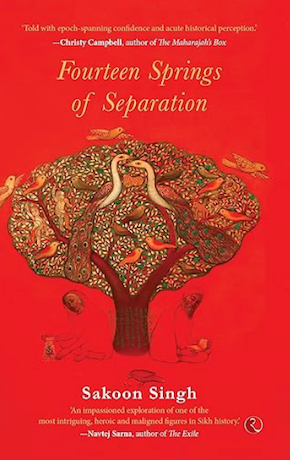
One of the most difficult challenges in historical fiction is weaving authentic history into an engaging narrative without allowing either element to overshadow the other. Some novels become weighed down by historical detail, while others sacrifice accuracy for dramatic effect. Fourteen Springs of Separation avoids both extremes, delivering a story that is meticulously researched yet emotionally absorbing. Blending nineteenth-century Punjab with contemporary settings in India and the United Kingdom, the novel seamlessly combines historical drama, family saga, romance, mystery, and reflections on identity, loss, and remembrance.
Instead of treating history as a distant record of political events, the novel reveals its deeply human consequences. The collapse of the Sikh Empire, the exile of Maharani Jind Kaur, the heartbreaking separation of a mother from her son, and the scattering of the Lahore Court’s priceless treasures are portrayed not merely as historical milestones but as lived experiences whose emotional echoes continue across generations.
The novel’s layered narrative design is among its most impressive achievements. It moves fluidly across different eras, following Maharani Jind Kaur’s imprisonment and daring escape from Chunar Fort, the fading power of the Lahore Durbar, and present-day storylines unfolding in Chandigarh and London. As family memories, treasured artefacts, and hidden connections gradually intertwine, the past unfolds like an intricate puzzle, transforming history itself into the novel’s most compelling mystery.
The novel opens with an unforgettable declaration:
“I had broken out of prison, but I wasn’t free yet.”
Maharani Jind Kaur: The Heart of the Novel
Though understated, this opening reflection immediately defines the novel’s emotional core. Freedom from captivity does not erase the deeper wounds of loss. Even after escaping confinement, Maharani Jind Kaur continues to carry the burdens of exile, the anguish of being separated from her son, Duleep Singh, and the painful awareness that the kingdom she fought to protect can never be restored to what it once was.
Among the novel’s greatest accomplishments is its intimate first-person portrayal of Jind Kaur. Rather than presenting her as a legendary figure viewed from a distance, the narrative invites readers into her inner world, revealing her courage alongside her vulnerability, wit, doubts, determination, and enduring strength. The chapters set during her imprisonment are especially affecting, capturing the emotional cost of captivity with remarkable sensitivity. One particularly poignant passage poses a question that reaches far beyond the political turmoil of its time:
“But separating a child from his mother? Who does that?”
With remarkable economy, the novel distils the violence of imperial rule into its most personal expression. Instead of dwelling on battles and political victories, it highlights the heartbreak of separation and the enduring scars left on individual lives, transforming history into an intensely emotional experience.
The opening of Despatches from Prison is equally poignant:
“It’s the third day since Mai Sahib last touched a morsel.”
Its emotional force lies in its quietness. Rather than relying on dramatic declarations or political rhetoric, the narrative centres on silence, hunger, uncertainty, and a mother’s overwhelming grief. This understated approach gives the scene a depth that lingers long after it is read.
Despite its tragic historical backdrop, the novel also embraces moments of joy and tenderness. The chapters exploring Jind Kaur’s early years are infused with romance, optimism, and the vitality of a flourishing Lahore. Through vivid depictions of festive celebrations, lively bazaars, elegant attire, and the carefree spirit of youth, the author recreates a world that feels both richly textured and painfully fragile. These lyrical passages rank among the novel’s most memorable achievements.
The novel’s poetic sensibility is evident in its celebration of beauty, drawing on the natural imagery and cultural identity of Punjab.
“Delicate eyes, innocent like the fawn’s… Rising, like the battalions of Punjab taking on Hind.”
The same vivid attention to detail brings nineteenth-century Lahore to life. Bustling streets lined with artisans and merchants create a city that feels vibrant and lived-in rather than reconstructed from historical records:
“…selling clothes, cattle feed, seeds and a variety of other things. Dingy enclosures with roofs of stretched sheepskin sheltered ironsmiths, jewellers, carpenters, dyers and cloth merchants…”
These richly observed moments do far more than establish historical context. They immerse readers in the rhythms of everyday life, where commerce, celebration, conversation, and tradition unfold naturally, making the city itself a memorable presence in the novel.
The depth of the author’s research is unmistakable, but it never interrupts the storytelling. Details of Sikh court life, traditional dress, jewellery, architecture, customs, and political affairs emerge organically through the experiences of the characters instead of appearing as detached historical commentary. References to jamawar shawls, parandas, gulbands, and the priceless collections of the Toshakhana enrich the narrative while preserving its momentum.
A particularly compelling section explores the famed Lahore Toshakhana:
“The Toshakhana was a veritable hall, with vault after vault stuffed with valuables and jewels…”
More than an account of royal splendour, this episode becomes a poignant reminder of what was lost after the annexation of Punjab. The dispersal of these treasures is presented not simply as the removal of material wealth, but as the fragmentation of a cultural legacy that once embodied the history and identity of an entire kingdom.
The Mystery of the Lahore Court Treasures
The novel’s contemporary narrative is every bit as compelling as its historical chapters. Moving between Chandigarh and London, it follows seemingly ordinary characters whose lives are gradually transformed by their unexpected connection to a forgotten chapter of the past.
The central mystery unfolds with deceptive simplicity. Sam’s purchase of an old necklace from a Bangladeshi flea market appears to be little more than an impulsive bargain, yet the trinket slowly reveals itself to be an object of remarkable historical significance. The mystery deepens when Preet Aunty examines an ageing velvet jewellery box and uncovers an inscription concealed beneath a worn label:
“From the Collection Of The Lahore Court 1849.”
This discovery marks one of the novel’s most rewarding turning points. From this moment onward, the historical and contemporary storylines merge seamlessly, as a forgotten artefact becomes the thread linking generations. The investigation unfolds at a measured pace, offering the quiet satisfaction of a well-crafted historical mystery.
The portrayal of Chandigarh is equally distinctive. Rather than relying on familiar descriptions of its modernist design, the novel explores overlooked neighbourhoods, ageing military surplus shops, and everyday spaces shaped by memory and lived experience. The city emerges not as an architectural landmark but as a repository of personal histories.
One brief observation captures this atmosphere perfectly:
“Zakshmi Stores looked like it was in a time warp. Blink and you could miss it.”
Moments such as this reveal the author’s gift for recognising significance in places that might otherwise escape notice, suggesting that history often survives in the most unassuming corners of everyday life.
The relationship between Mehr and Angad provides another emotional anchor for the novel. Their conversations—filled with recollections of bicycles, neighbourhood games, solar cookers, and childhood adventures—possess an effortless authenticity that makes their bond feel entirely believable. These quieter episodes offer a welcome counterpoint to the novel’s larger historical concerns, grounding its epic themes in recognisable human experience.
Mehr’s adoption story further broadens the novel’s exploration of identity. In doing so, the narrative suggests that history is not confined to royal courts or political upheavals; it is equally embedded within family relationships, inherited silences, and the search for personal origins.
Memory, Identity, and the Echoes of History
Across the novel, memory becomes an act of preservation against the forces of forgetting. Whether through Maharani Jind Kaur’s longing for Lahore, Mehr’s gradual recovery of buried memories, or Sam’s determination to uncover the provenance of a forgotten heirloom, remembrance emerges as a means of reclaiming identities threatened by time and historical displacement.
The novel’s philosophical dimension is beautifully reinforced through the inclusion of Shah Mohammad’s poetry:
“The world is an inn, visited by travellers… All vanished without a trace…”
The verses resonate beyond their immediate setting, underscoring the book’s reflections on impermanence, loss, and the fleeting nature of political power.
A second memorable observation expands these themes even further:
“I know the difference between asli and naqali… between real and unreal, illusion and reality.”
What begins as a seemingly ordinary conversation about genuine gold gradually develops into a wider meditation on truth itself—raising questions about authenticity in history, memory, and personal identity.
The writing consistently balances elegance with clarity. Rich descriptive passages never overwhelm the narrative, and literary flourishes are always anchored by purposeful storytelling. Whether depicting the forests surrounding Chunar Fort under moonlight, rain-soaked London streets, the corridors of the Tower of London, or the vibrant bazaars of Lahore, each setting is rendered with striking immediacy.
The novel’s pacing remains assured throughout, although readers unfamiliar with Sikh history may occasionally find the historical detail demanding. At times the narrative pauses to provide additional context, yet these sections ultimately strengthen the story by enriching its historical foundations rather than slowing its momentum.
In the end, Fourteen Springs of Separation is far more than a historical novel. It is a thoughtful exploration of exile, motherhood, inheritance, identity, love, and the enduring ways in which the past shapes the present. Through meticulous research, memorable characters, and an absorbing mystery, the author transforms major historical events into deeply personal stories that continue to resonate across generations.
Few works of historical fiction succeed in making the collapse of a kingdom feel as emotionally immediate as the grief of a mother separated from her child or the discovery of an overlooked heirloom carrying the memory of a lost empire. That is the novel’s lasting achievement. It reminds readers that history does not disappear with the passing of time and it survives in treasured objects, family narratives, collective memory, and the stories we continue to tell.
Fourteen Springs of Separation is an accomplished work of historical fiction that combines rigorous scholarship with emotional depth. Blending political history, literary storytelling, mystery, romance, and family drama, it offers a richly rewarding reading experience while bringing the history of the Sikh Empire vividly to life for modern audiences.
Conclusion
Beyond its literary merits, Fourteen Springs of Separation performs an important act of historical preservation. By bringing to life the story of Maharani Jind Kaur, the fall of the Sikh Empire, and the dispersal of the Lahore Court’s treasures, the novel illuminates a pivotal period of South Asian history that remains unfamiliar to many readers. Its meticulous research is evident throughout, yet the historical detail is always woven into an engaging narrative rather than presented as a history lesson. Readers with an interest in historical figures, the Sikh Empire, and nineteenth-century India will find the novel especially rewarding. Thoughtfully researched and emotionally resonant, it succeeds not only as a work of fiction but also as a compelling tribute to a significant chapter of history whose legacy continues to shape the present.