Rating: ⭐⭐⭐⭐⭐ (5/5)
A Wide-Ranging Exploration of Civilizations, Power, and the Fate of Nations
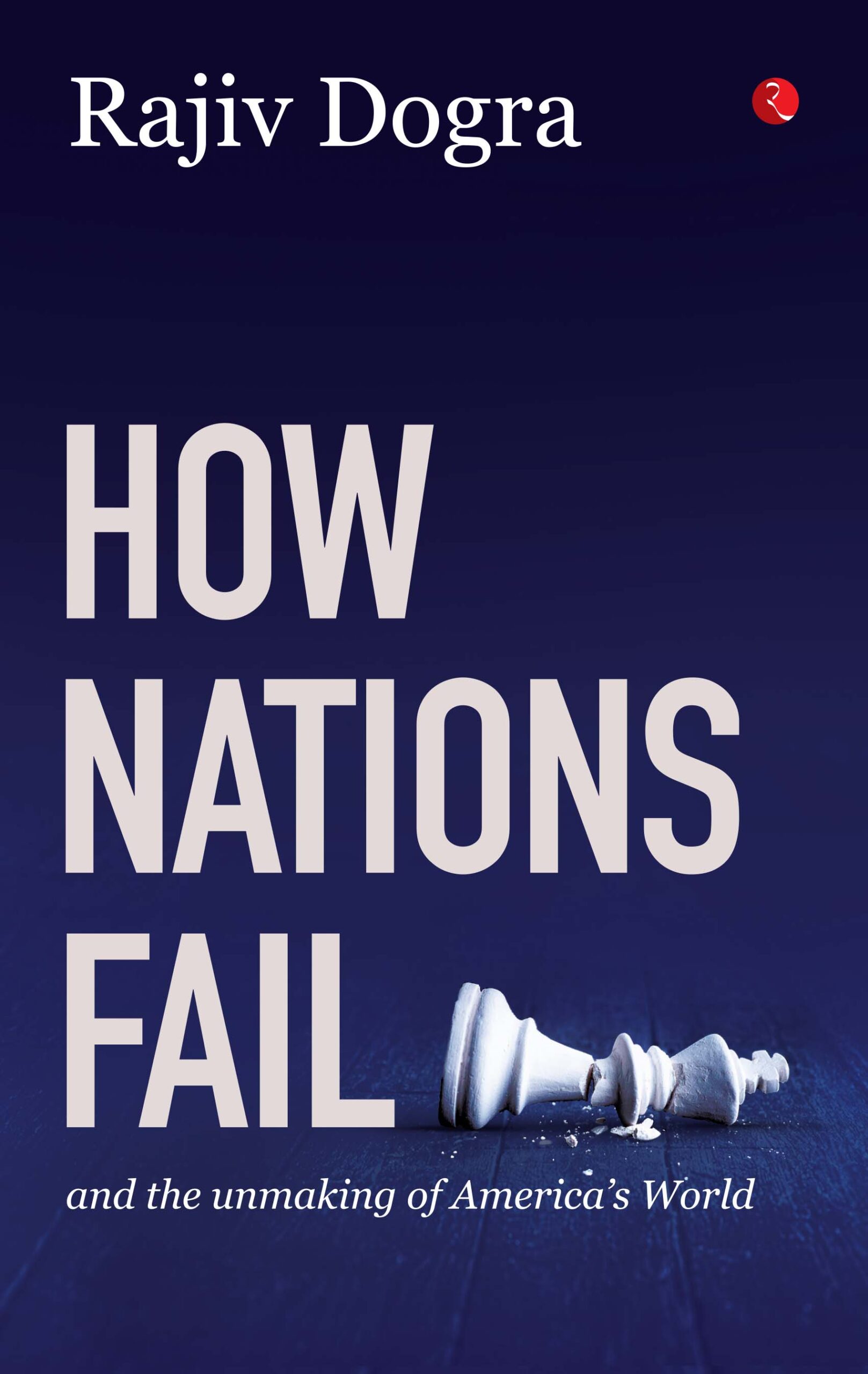
Rajiv Dogra’s How Nations Fail: And the Unmaking of America’s World presents an expansive examination of the historical forces that shape the rise, dominance, and eventual decline of nations. Drawing upon decades of diplomatic experience and an extensive understanding of history, the author moves beyond conventional political analysis to explore how leadership, institutions, culture, economics, technological progress, and strategic decision-making collectively determine the destiny of civilizations.
Although its title echoes the well-known work by Daron Acemoglu and James Robinson, Dogra’s study follows a distinctly different trajectory. Rather than concentrating primarily on economic institutions, he offers a broader geopolitical and historical perspective, investigating recurring patterns that have influenced empires from antiquity to the present. The result is a thought-provoking work that combines historical scholarship with contemporary relevance, making it especially appealing to readers interested in world history, diplomacy, international relations, and strategic affairs.
An Engaging Opening Rooted in Indigenous Tradition
The book begins with an unexpected yet memorable story from the tribal communities of Bastar, where village deities are annually judged on their ability to safeguard their people. Those believed to have failed are symbolically stripped of their divine authority. Dogra transforms this tradition into a compelling political metaphor, asking whether political leaders should also be held accountable for their performance rather than simply their promises.
This unconventional introduction immediately establishes one of the book’s central arguments: the strength of a nation ultimately depends upon responsible leadership and institutional accountability.
As the author observes, “National failure does not happen overnight. The decay of the state, and its institutions, takes place over time.”
This insight becomes the foundation upon which much of the subsequent analysis is built.
A Panoramic Survey of Human Civilization
One of the book’s greatest achievements lies in its remarkable historical breadth. Dogra takes readers on an intellectual journey through ancient Mesopotamia, Egypt, Greece, Rome, India, China, the Indus Valley Civilization, the Mongol Empire, European colonial expansion, and the emergence of the United States as a global superpower.
Rather than presenting isolated historical narratives, he demonstrates how similar patterns repeatedly emerge across different cultures and time periods. Geography, governance, innovation, military capability, social cohesion, and political leadership all interact in complex ways to determine whether societies flourish or decline.
A particularly striking observation appears during the discussion of historical decline:
“Great civilizations are not murdered. Instead, they take their own lives.”
Drawing upon Arnold Toynbee’s famous insight, Dogra argues that internal deterioration often weakens civilizations long before external threats become decisive.
Leadership at the Heart of National Success
Throughout the book, leadership remains one of the defining themes. Dogra argues that national collapse rarely results from a single catastrophic event. Instead, decline usually emerges gradually through ineffective governance, weakening institutions, corruption, excessive centralization of power, and the erosion of public confidence.
Historical events are therefore presented not as inevitable outcomes but as the consequences of choices made by individuals occupying positions of power. By focusing on the decisions of rulers, policymakers, and political elites, the narrative highlights the human dimension of history and illustrates how leadership can fundamentally alter the trajectory of nations.
Importantly, Dogra avoids simplistic ideological arguments. Rather than portraying democracy or authoritarianism as universally superior, he evaluates both systems through historical experience, examining their respective strengths, vulnerabilities, and long-term sustainability.
Understanding Today’s Changing Global Order
A significant portion of the book is devoted to analysing the evolving balance of power in the twenty-first century. Dogra explores the strategic positions of the United States, China, India, Russia, and Europe while considering whether the international order established after the Second World War is undergoing irreversible transformation.
His discussion of China is measured and balanced, acknowledging both its remarkable economic rise and the structural challenges it continues to face. Likewise, his assessment of the United States recognises its enduring military, technological, and financial strengths while questioning whether its period of uncontested global leadership can continue indefinitely.
Rather than relying on dramatic predictions, Dogra focuses on long-term structural trends that are gradually reshaping international politics. Readers may not agree with every conclusion, but the arguments are consistently supported by historical context and careful reasoning.
Scholarly Research Presented with Clarity
The depth of research underpinning the book is immediately apparent. Dogra draws extensively upon historians, philosophers, economists, diplomats, and political thinkers, incorporating ideas from figures such as Tacitus, Virgil, Arnold Toynbee, Cardinal Richelieu, Charles de Gaulle, Marcus Aurelius, and Paul Kennedy.
Despite this impressive scholarly foundation, the writing remains accessible. Complex geopolitical concepts are explained with clarity, allowing readers without specialised academic backgrounds to engage comfortably with the material.
Those who appreciate the works of Henry Kissinger, Niall Ferguson, Fareed Zakaria, Yuval Noah Harari, or Paul Kennedy will find a similar appreciation for broad historical analysis and global strategic thinking.
Memorable Reflections Throughout the Narrative
Dogra’s prose frequently combines analytical precision with philosophical reflection. Many chapters contain concise observations that invite readers to pause and reconsider commonly accepted assumptions.
For instance, while discussing institutional development, he writes:
“Inclusive institutions… are widely seen as drivers of economic development.”
Rather than treating this as an unquestionable truth, Dogra explores its broader implications alongside alternative historical interpretations, encouraging readers to engage critically with the evidence presented.
This willingness to stimulate reflection rather than merely present conclusions gives the book considerable intellectual depth.
Appreciating Historical Complexity
A particularly commendable aspect of the book is its refusal to reduce history to a single explanatory model. Dogra consistently demonstrates that no individual factor alone determines the success or failure of nations.
Economic prosperity cannot guarantee long-term stability.
Military superiority does not ensure lasting dominance.
Technological innovation, while important, is insufficient by itself.
Likewise, neither democratic institutions nor authoritarian governance automatically produce successful societies.
Instead, national outcomes emerge through the interaction of leadership, institutional resilience, public trust, education, innovation, culture, historical experience, and geopolitical circumstances. This nuanced perspective strengthens the credibility of the overall argument and distinguishes the work from more deterministic studies of political development.
Minor Reservations
Given its ambitious scope, the book inevitably moves quickly through several major historical periods and civilizations. Some readers may wish that certain case studies had received more detailed treatment, particularly those that introduce especially fascinating historical episodes.
Similarly, Dogra’s interpretations of contemporary geopolitical developments may provoke debate among readers with differing strategic or ideological viewpoints. Yet these differences are less shortcomings than reflections of the inherently contested nature of international politics.
Indeed, one of the book’s greatest strengths is its ability to encourage informed discussion rather than insist upon definitive answers.
Why the Book Remains Highly Relevant
Beyond its historical survey, How Nations Fail addresses pressing questions confronting today’s world. It encourages readers to reflect upon issues such as institutional resilience, political legitimacy, technological disruption, economic inequality, and intensifying geopolitical competition.
Can democratic systems withstand growing political polarisation?
Can authoritarian governments sustain long-term legitimacy?
How should nations adapt to rapid technological transformation?
What determines whether global powers retain or lose their influence?
These questions extend beyond academia and diplomacy, making the book relevant for policymakers, students, business leaders, and general readers alike.
Conclusion
How Nations Fail: And the Unmaking of America’s World is an insightful and thoroughly researched contribution to contemporary geopolitical literature. Rajiv Dogra successfully combines historical scholarship, diplomatic experience, and strategic analysis to produce a work that examines both the achievements and vulnerabilities of civilizations across thousands of years.
Rather than simply documenting episodes of national decline, the book investigates the deeper structural forces that shape political success and failure. It reminds readers that national greatness depends not only on wealth or military capability but also on strong institutions, accountable leadership, civic resilience, and the ability to adapt to changing historical circumstances.
Well researched, elegantly argued, and highly accessible, this book records significant historical developments while placing them within a broader geopolitical framework. It will particularly appeal to readers interested in history, international relations, diplomacy, political science, and the evolving global balance of power.
A compelling, balanced, and intellectually rewarding study that successfully connects the lessons of history with the geopolitical realities of the modern world, making it essential reading for anyone seeking a deeper understanding of how nations rise, flourish, and ultimately decline.