A Story of War, Friendship and Freedom!
The War Elephants of Trigarta is an engaging and emotionally rich historical adventure that successfully combines the grandeur of ancient warfare with the intimacy of a child’s friendship with an elephant. Mili and Nathu provide the heart of the story, while the novel’s reflections on courage, memory, compassion and freedom give it resonance beyond its historical setting.
Rating: ★★★★★ 5/5
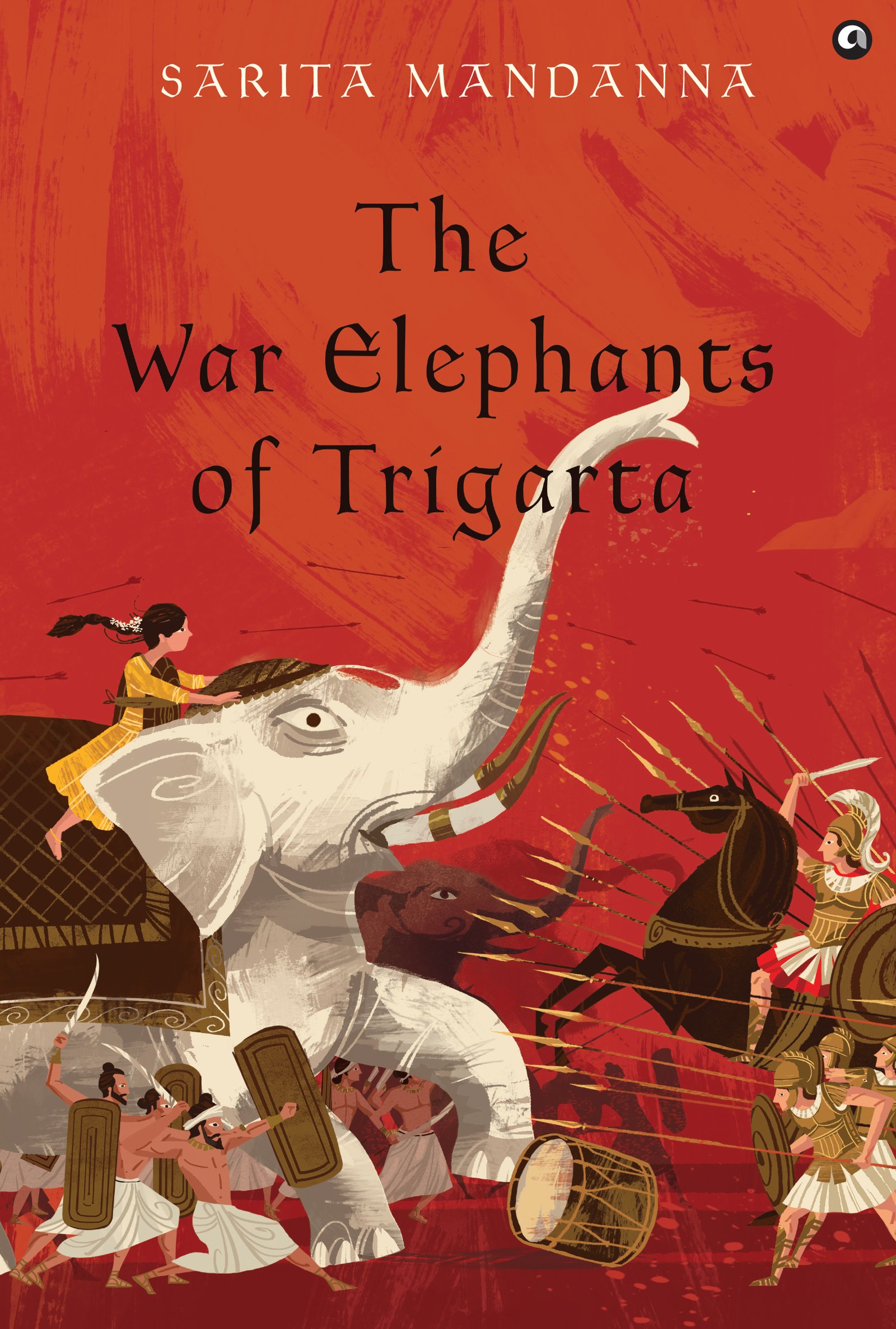
Sarita Mandanna’s The War Elephants of Trigarta is an evocative work of historical fiction that brings the ancient world to life through the experiences of a child caught between family, war and an extraordinary friendship with an elephant. Set against the backdrop of Alexander’s invasion of the Indian subcontinent, the novel combines historical adventure with a deeply personal story of growing up, confronting loss and learning that genuine love cannot always be expressed through possession.
At the centre of the narrative is Mili, a young girl whose life is closely connected with the elephants of Trigarta. Her father is a respected military commander responsible for the kingdom’s war elephants, and from an early age Mili displays an unusual understanding of these magnificent animals. Her relationship with Nathu, a rare white elephant, eventually becomes the emotional core of the novel.
What makes the book especially compelling is the way Mandanna takes a vast historical conflict and reduces it to something intimate. Instead of viewing Alexander’s campaign only through kings, armies and military strategy, the reader experiences its consequences through a child, her family and an animal whose life becomes entangled with the ambitions of men.
A Dramatic Beginning
The novel begins in the middle of conflict, immediately placing the reader in the chaos of the battlefield. Eleven-year-old Mili finds herself surrounded by the violence of the war between Trigarta and Alexander’s forces.
“More than six hours now, since it had begun. Six long hours of soldiers shouting, grunting as they pressed and pushed against each other.”
The opening effectively establishes the scale and brutality of the conflict. The battlefield is noisy, frightening and chaotic, filled with soldiers, weapons, horses and elephants. Yet rather than continuing chronologically, Mandanna takes the reader backwards, showing how Mili arrived at this dangerous moment.
This narrative decision creates a sense of inevitability. The reader knows from the beginning that the peaceful world Mili inhabits cannot last. Her friendship with Nathu, her relationship with her father and the life she takes for granted are all moving towards a confrontation with war.
The novel also introduces a contemporary storyline involving Arya, a boy visiting Persepolis with his mother. His discovery of an ancient coin creates a connection between the present and the distant past. This framing device reinforces one of the novel’s major ideas: history is not simply something that happened long ago; it is something that continues to shape how we understand the world.
Arya’s mother expresses this beautifully:
“The more we learn about their stories, the more we know the past, the better we understand our world.”
The statement provides an important key to understanding the novel itself. Mandanna is not merely reconstructing an ancient war. She is imagining the lives that existed behind the historical record.
Mili and the Making of a Warrior
Mili is the emotional centre of the story, and her development gives the novel its coming-of-age dimension.
From the outset, she is curious, energetic and confident. Having grown up around elephants, she possesses an instinctive understanding of them that even the adults recognise. Her father, Baba, sees something special in her:
“It’s in your blood, this elephant-sense.”
Mili also dreams of following in her father’s footsteps and becoming a general. Her relationship with Baba is affectionate but also deeply influential. He represents the ideal of courage and duty that Mili initially wants to emulate.
One of their recurring exchanges is particularly memorable:
“Never too old…”
“…and never too young!”
At first, these words feel like nothing more than a playful exchange between a father and daughter. As the narrative develops, however, they acquire a much deeper meaning. Mili is eventually placed in situations where her age becomes almost irrelevant. The responsibilities placed upon her require maturity far beyond her years.
Importantly, Mili’s courage is not presented as the absence of fear. She experiences fear, uncertainty and grief. Her strength comes from continuing to act despite those emotions. This makes her transformation more convincing than the conventional portrayal of a fearless young hero.
Nathu and the Heart of the Novel
If Mili provides the emotional centre of the human story, Nathu provides its emotional soul.
Nathu is a rare white elephant who is initially frightened and resistant to being controlled. The adults attempt to train him using established methods, but Mili instinctively understands that force will not create trust.
Instead, she speaks to him, spends time with him and tries to understand what he is experiencing.
Her approach is summed up when she tells him:
“I can be your friend, you know.”
The simplicity of this sentence is important. Mili is offering companionship rather than demanding obedience.
Their relationship develops gradually, making it much more believable and affecting. One particularly touching moment comes when Nathu reaches towards Mili through the bars. Later, he gives her a pebble.
The gesture is small, but it becomes meaningful precisely because Nathu cannot communicate with Mili through words. Their relationship develops through gestures, patience and trust.
This friendship also establishes one of the novel’s most important contrasts: domination versus understanding.
Nathu is valuable to Trigarta because he is a powerful war elephant. But to Mili, he is not simply a military resource. He is an individual creature with emotions, memories and fears.
Compassion as a Form of Leadership
Mandanna repeatedly suggests that authority alone cannot create loyalty.
The adults possess experience and knowledge, yet their methods do not immediately succeed with Nathu. Mili succeeds because she approaches him differently. She observes him rather than simply commanding him.
She later explains:
“He likes to be asked politely, and he likes to copy me.”
The statement reflects a much broader principle running through the novel. Leadership is not necessarily about imposing one’s will on another person—or another creature. It can also involve patience, empathy and earning trust.
This becomes increasingly relevant as Mili’s responsibilities grow. The qualities that initially make her unusual around elephants eventually become qualities that help her deal with people and circumstances as well.
In that sense, her relationship with Nathu is also a form of education. He teaches her lessons about trust and responsibility that conventional military training could never provide.
The Elephants of Trigarta
The world surrounding Trigarta’s elephant corps is one of the novel’s most vivid elements.
The elephants are deeply embedded in the kingdom’s military culture. They are trained, admired and treated as symbols of strength. Their presence gives Trigarta a distinctive identity and contributes to the grandeur of the historical setting.
The bard’s description captures this almost mythical image:
“O golden armoured giants! Trumpeting as you tread / O tusked lords! Filling enemy ranks with dread.”
The imagery presents the elephants as magnificent instruments of warfare. Yet Mandanna gradually complicates this image by showing what exists beneath the spectacle.
These animals are capable of fear, affection and suffering. They are not merely weapons with legs and tusks.
That tension becomes increasingly significant as the war approaches. The same creatures celebrated as symbols of military power are eventually shown paying the physical and psychological price of that warfare.
Alexander and Two Different Ideas of War
Alexander’s presence hangs over much of the novel even before he appears directly.
His reputation precedes him. The people of Trigarta know that he has conquered Persia and is continuing eastward. His approach creates anxiety because his methods of warfare do not necessarily correspond with the moral framework followed by the warriors of Trigarta.
That framework is expressed through the following declaration:
“A warrior I am, never cruel even towards my foe / I shall sacrifice myself and all I hold dear / But never shall I stray from dharma, nor fight a shameful war.”
The novel does not, however, reduce Alexander to a simplistic villain.
The novel is therefore less interested in presenting an uncomplicated struggle between good and evil than in showing how different cultures understand honour, power and conquest.
Karan and the Power of Ideas
Karan provides an interesting counterbalance to Mili.
Where Mili’s strengths are instinctive and emotional, Karan’s intelligence is more analytical. His education gives him the opportunity to engage with questions that extend beyond the immediate concerns of battle.
His encounter with Alexander becomes particularly interesting because it is not simply a conversation between two characters. It is a clash between different ideas about conquest, civilisation and legitimacy.
Karan responds to Alexander with a Sanskrit proverb:
“A fool is praised by his household,
A landlord, by the village that he owns.
A king is praised by those he rules over,
But a wise man, by all the world.”
The exchange adds intellectual depth to the novel without overwhelming its adventure narrative. Karan’s presence also gives Mili someone who can support and challenge her as events become increasingly dangerous.
When Childhood Meets War
The novel’s emotional intensity increases dramatically when the distant threat of war becomes immediate.
Until this point, Mili’s world is relatively familiar. She has her father, Karan, Nathu and the life she knows. War exists somewhere beyond that world.
Then everything changes.
Baba can no longer simply be Mili’s father. He is also a military commander responsible for his kingdom. Mili herself must be removed from danger.
His words to her are painful because they reveal the conflict between her desire to help and his responsibility to protect her:
“The best way you can help me is by keeping safe, child.”
For Mili, this is an important moment of transition. She wants to fight beside her father, but she is forced to confront the fact that there are circumstances she cannot control.
The novel consequently shifts from childhood adventure into a much more serious exploration of separation, fear and loss.
The Battlefield
When Mili finally reaches the battlefield, the elephants that previously belonged to the world of training and companionship become part of an actual war.
She is no longer simply the girl who plays with Nathu. She is riding him into battle.
The scene combines excitement with genuine danger. Mili is frightened, but she remembers Baba’s instructions:
“Guide Nathu. Stay calm.”
The words echo the lessons she has received throughout the novel. Her courage is therefore not something that suddenly appears. It is the result of everything she has learned.
The battle also contains an inventive moment in which Mili uses a war drum in an unconventional way. Nathu kicks it into the opposing ranks, turning an object associated with military ceremony into something unexpectedly useful.
The sequence adds humour and energy to an otherwise frightening episode and demonstrates Mandanna’s ability to move between lightness and seriousness.
The Reality Behind the Heroism
The novel becomes considerably darker once the battle is over.
The earlier image of the majestic war elephant is replaced by something far more disturbing. Nathu has suffered physically and psychologically, and Mili encounters him in a very different state.
The description is devastating:
“He was so thin. Deep hollows in the sides of his temples.”
This moment strips away the glamour surrounding the war elephants.
Nathu had previously represented power, prestige and military strength. Now the reader is confronted with the consequences of using a living creature in warfare.
The transformation is one of the book’s most effective emotional devices. It forces Mili to understand that victory and heroism can come at a terrible cost.
Freedom as the Ultimate Act of Love
The closing portion of the novel is particularly moving because Mili must deal with two kinds of loss: the death of her father and the suffering of Nathu.
Instead of trying to keep Nathu close to her, she gradually recognises that his survival may depend upon his freedom.
Raja Puru expresses this idea clearly:
“Better for our White One to live free, away from the greed of men.”
This represents a profound shift in the way Nathu is perceived.
Earlier, his rarity made him valuable. His whiteness made him a symbol. His strength made him useful to the military.
Now those things matter less than his right to live freely.
Mili therefore makes one of the most painful decisions in the story: she lets him go.
Her farewell is heartbreaking:
“Go back to the jungle, Nathu. I can’t protect you here.”
The tragedy is that Mili’s love for Nathu does not result in keeping him beside her. It results in allowing him to leave.
This is perhaps the novel’s most mature idea. Love is not always possession. Sometimes it is the willingness to accept separation when separation is necessary for someone else’s well-being.
Why the Modern Story Matters
The Arya storyline becomes more meaningful as the novel progresses.
At first, the modern sections may appear disconnected from Mili’s ancient world. The connection becomes clearer through the ancient coin and Arya’s curiosity about the people who once lived in the places he visits.
His mother offers another explanation of what studying history actually means:
“It’s picking through ruins and trying to understand the people who once made lives there.”
That idea effectively describes the novel itself.
Mandanna takes a historical period known primarily through famous names and military campaigns and reconstructs it through individual experiences. Behind the armies are families. Behind the victories are losses. Behind the historical monuments are ordinary people whose lives were permanently altered by events much larger than themselves.
The modern narrative therefore reinforces the novel’s broader meditation on memory.
Themes of Courage, Loss and Letting Go
The book succeeds because its themes are accessible without being simplistic.
Courage is one of its strongest recurring ideas, but courage is not equated with physical strength. Mili learns that being brave can mean enduring fear, accepting loss or making a painful decision for another person’s benefit.
Friendship is equally important. Her relationship with Nathu crosses the boundary between human and animal and becomes an example of communication built on patience rather than force.
The novel also explores grief in a way that feels closely connected to Mili’s development. Losing Baba forces her to move beyond childhood dependence, while losing Nathu through freedom teaches her another kind of sacrifice.
The result is a coming-of-age journey shaped not simply by adventure, but by things Mili cannot prevent.
Historical Fiction with Emotional Depth
One of the book’s greatest achievements is the way it makes a distant historical period feel immediate.
The ancient setting provides the scale: kingdoms, armies, elephants, kings and Alexander’s campaigns.
But the emotional story remains personal.
Mili worries about her father. Nathu fears captivity. Karan wrestles with ideas of power and wisdom. Families face separation. Animals suffer the consequences of human ambition.
This combination allows the novel to function on two levels. Young readers can experience it as an exciting historical adventure, while older readers can appreciate its questions about war, power, memory, compassion and freedom.
A Few Limitations
The novel’s ambition occasionally makes it feel broader than necessary.
It moves between historical adventure, family drama, animal fiction, mythology, coming-of-age storytelling and a contemporary framing narrative. Because of this, some of the historical explanations surrounding Alexander can slow the momentum of Mili’s personal story.
Similarly, readers who become deeply invested in Mili and Nathu may initially find the shift to Arya’s modern-day storyline disruptive.
However, these structural choices ultimately serve the novel’s larger concern with history and memory. The separate narrative threads eventually come together thematically, even when they temporarily move the reader away from Mili.
Final Assessment
The War Elephants of Trigarta is ultimately a novel about the human consequences hidden inside historical events.
Its battlefield scenes provide adventure, but its emotional strength comes from quieter moments: a girl speaking to a frightened elephant, a father trying to protect his daughter, a friend challenging an idea of conquest, and a child eventually choosing freedom for a creature she loves.
Mili’s journey is especially satisfying because she does not simply become a conventional warrior. She learns something more complicated. Courage can mean fighting, but it can also mean protecting. Strength can mean restraint. And love can mean letting go.
Nathu’s transformation is perhaps the clearest expression of this message. He begins as a magnificent symbol of Trigarta’s military power and ends as an individual whose freedom matters more than his usefulness.
That transformation also changes Mili. She begins by wanting to become like her father. By the conclusion, she has developed her own understanding of what courage and responsibility mean.
The novel’s treatment of history is equally effective. Through the ancient coin, the ruins of Persepolis and Arya’s curiosity, Mandanna reminds readers that historical events are ultimately made up of individual lives. The people who disappear from textbooks once had families, friendships, hopes and fears.
That is what gives The War Elephants of Trigarta its lasting emotional quality. It is not simply a story about Alexander, ancient India or war elephants. It is a story about friendship, grief, courage, compassion and freedom—and about how even the smallest human connection can survive across centuries.
https://www.amazon.in/WAR-ELEPHANTS-TRIGARTA-Sarita-Mandanna/dp/8119635140?crid=25BISBZJ2KE8L&dib=eyJ2IjoiMSJ9.UPK63SKQS78UR8zIs2d2Uw.4KiYU_DMSExZS0_C6FKvGLk5bJ-ivvn4BEhkdlhpcr0&dib_tag=se&keywords=the+war+elephants+of+trigarta&qid=1790170814&sprefix=the+war+eklephants+of%2Caps%2C286&sr=8-1&linkCode=ll2&tag=newasiwri-21&linkId=e8a7113a32667a68ef365e9419a9e97e&ref_=as_li_ss_tl